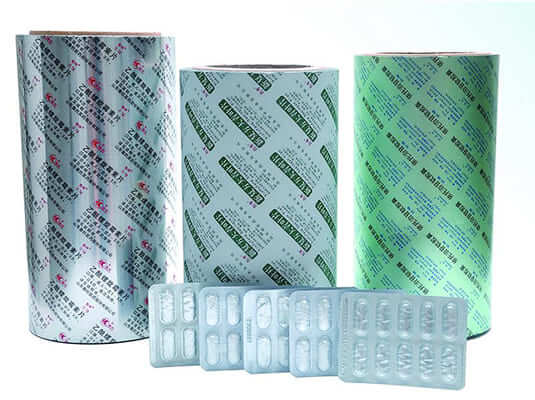
1. Introduction
Premier aluminium foil is widely used in food packaging, pharmaceutical packaging, household products, and industrial applications.
Its popularity comes from a combination of excellent barrier performance, lightweight construction, flexibility, thermal conductivity, and corrosion resistance.
As packaging and manufacturing requirements become more demanding, buyers increasingly focus on more than just foil thickness and price.
Consistent material quality, controlled mechanical properties, low pinhole levels, surface cleanliness, and reliable processing performance are equally important.
Compared with ordinary aluminium foil, premier aluminium foil emphasizes tighter quality control and greater consistency throughout production.
These characteristics help manufacturers achieve stable performance during printing, coating, lamination, sealing, stamping, and other converting processes.
The selection of suitable aluminium foil depends on its intended application.
For example, 8011 aluminium foil is commonly used for household and food packaging, while 8021 aluminium foil is widely selected for pharmaceutical cold-forming applications.
Alloys such as 1235 and 8079 are also important in flexible packaging and laminated structures.
Premier Aluminium Foil
2. What Is Premier Aluminium Foil?
2.1 Definition of Premier Aluminium Foil
Premier aluminium foil refers to high-quality aluminium foil manufactured under controlled production conditions to meet specific requirements for packaging, converting, and industrial applications.
It is produced by repeatedly rolling aluminium alloy material until it reaches the required thinness.
Depending on the application, the finished foil can be supplied as jumbo rolls, slit coils, sheets, or converted products.
Premier aluminium foil is available in different alloys, tempers, thicknesses, widths, and surface finishes.
It can also undergo additional processing, including coating, printing, embossing, and lamination.
Typical product forms include:
- Bare Aluminium Foil: Uncoated foil used for household, food packaging, and industrial applications.
- Coated Aluminium Foil: Foil with functional coatings for heat sealing, corrosion protection, or other specific requirements.
- Printed Aluminium Foil: Foil with customized printing for product identification and packaging design.
- Laminated Aluminium Foil: Aluminium foil combined with plastic films, paper, or other materials to create multilayer packaging structures.
- Embossed Aluminium Foil: Foil with textured surfaces for decorative or functional purposes.
2.2 What Makes Aluminium Foil Premier?
Premier aluminium foil is distinguished by consistent material quality, reliable performance, and strict manufacturing control. Its quality depends on several key factors:
- Consistent Thickness: Uniform thickness and accurate dimensions ensure stable performance during printing, coating, lamination, and packaging.
- Low Pinhole Levels: Controlled pinholes help maintain effective barriers against moisture, oxygen, and light.
- Excellent Surface Quality: Clean, smooth surfaces with minimal scratches, oil stains, and oxidation marks improve appearance and processing performance.
- Reliable Mechanical Properties: Appropriate tensile strength, elongation, and flexibility help prevent tearing and cracking during converting.
- Stable Barrier Performance: High-quality aluminium foil provides reliable protection for food, pharmaceutical products, and other sensitive contents.
- Good Processing Performance: Consistent material properties support efficient slitting, rewinding, printing, coating, heat sealing, and lamination.
Overall, premier aluminium foil combines precise specifications, dependable barrier properties, and consistent processing quality to meet demanding packaging and industrial requirements.
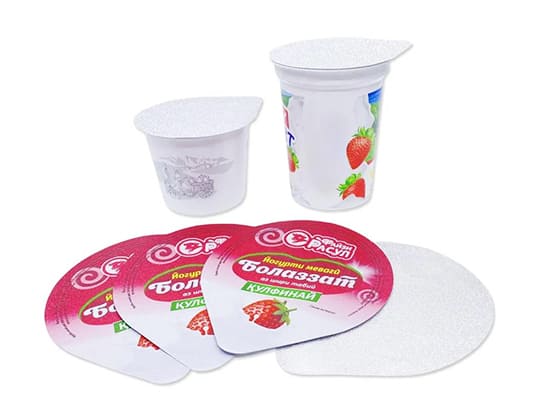
Aluminum foil for yogurt lids
3. Common Aluminium Alloys Used in Premier Aluminium Foil
Different aluminium alloys offer different levels of strength, ductility, flexibility, and formability.
Common alloys used in premier aluminium foil include 1235, 8011, 8021, 8079, 3003, and 3004.
3.1 1235 Aluminium Foil
1235 is a commercially pure aluminium alloy with a minimum aluminium content of 99.35%.
It offers excellent flexibility, ductility, and electrical and thermal conductivity.
Key characteristics:
- High aluminium purity.
- Excellent flexibility and ductility.
- Good rolling and lamination performance.
Typical applications: Flexible food packaging, household foil, cable wrapping, and industrial insulation.
3.2 8011 Aluminium Foil
8011 aluminum foil is an aluminium-iron-silicon alloy widely used in packaging applications.
It provides a good balance of strength, flexibility, and processing performance.
Key characteristics:
- Good mechanical strength.
- Excellent rolling and converting performance.
- Suitable for coating, printing, and lamination.
Typical applications: Household foil, food packaging, pharmaceutical blister lidding, and bottle caps.
3.3 8021 Aluminium Foil
8021 is an aluminium-iron alloy commonly used in pharmaceutical packaging.
Its O temper offers excellent ductility and deep-drawing performance for cold-forming applications.
Key characteristics:
- Excellent formability in O temper.
- Good ductility and mechanical performance.
- Suitable for high-barrier pharmaceutical packaging structures.
Typical applications: Alu-Alu cold-forming blister foil and pharmaceutical packaging laminates.
3.4 8079 Aluminium Foil
8079 is an aluminium-iron-silicon alloy suitable for thin-gauge flexible packaging and pharmaceutical applications. It offers good elongation and processing performance.
Key characteristics:
- Good ductility and flexibility.
- Suitable for thin-gauge foil production.
- Good lamination and converting performance.
Typical applications: Flexible food packaging, pharmaceutical foil, and laminated packaging materials.
3.5 3003 Aluminium Foil
3003 aluminum foil is an aluminium-manganese alloy with higher strength than commercially pure 1xxx-series aluminium. It combines good formability with corrosion resistance.
Key characteristics:
- Good mechanical strength.
- Good corrosion resistance.
- Suitable for forming and fabrication.
Typical applications: Aluminium food containers, formed packaging, and industrial foil products.
3.6 3004 Aluminium Foil
3004 is an aluminium-manganese alloy known for its strength and deep-drawing performance.
It is suitable for applications requiring good structural stability during forming.
Key characteristics:
- Good mechanical strength.
- Excellent deep-drawing characteristics.
- Good corrosion resistance.
Typical applications: Aluminium food trays, containers, and formed aluminium products.

Huawei Premier Aluminium Foil
4. Core Specifications of Premier Aluminium Foil
Premier aluminium foil is available in various alloys, tempers, thicknesses, and surface finishes to meet different packaging and industrial requirements.
The following table outlines its main technical specifications and customization options.
| Parameter | Typical Specifications |
|---|---|
| Alloy | 1235, 8011, 8021, 8079, 3003, 3004 |
| Temper | O, H14, H16, H18, H19, H22, H24 |
| Thickness | 0.006–0.200 mm, depending on application |
| Thickness Tolerance | According to applicable standards or customized requirements |
| Width | 100–1,600 mm; customized widths available |
| Coil Outer Diameter | Customized according to customer requirements and equipment capacity |
| Coil Inner Diameter | 76 mm, 152 mm, or customized |
| Surface Finish | One-side bright, two-side bright, matte |
| Surface Quality | Clean, smooth, and free from excessive oil stains, scratches, and visible defects |
| Surface Treatment | Mill finish, degreased, coated, printed, laminated, or embossed |
| Coating Options | Heat-seal lacquer, protective coating, primer, PE, and other application-specific coatings |
| Pinhole Requirements | Controlled according to foil thickness, application, and agreed quality standards |
| Typical Applications | Food packaging, pharmaceutical packaging, household foil, cable wrapping, and industrial insulation |
| Applicable Standards | ASTM B479, EN 546 series, subject to product type and requirements |
Note: The specifications are general references. Actual dimensional tolerances, mechanical properties, pinhole requirements, and surface quality standards depend on the selected alloy, temper, thickness, manufacturing process, and end application.
5. Key Properties and Performance Advantages of Premier Aluminium Foil
Premier aluminium foil offers excellent barrier protection, flexibility, thermal conductivity, and processing performance.
These properties make it suitable for food packaging, pharmaceutical packaging, household products, and industrial applications.
5.1 Excellent Barrier Properties
Aluminium foil provides an effective barrier against moisture, oxygen, light, and external contaminants when its surface is continuous and free from significant defects.
This helps protect sensitive products and extend shelf life.
5.2 Good Flexibility and Formability
Aluminium foil can be easily bent, folded, embossed, and laminated into different shapes and structures.
Its flexibility and ductility make it suitable for packaging, deep drawing, and other forming processes.
5.3 Excellent Thermal and Electrical Conductivity
Aluminium foil has good thermal and electrical conductivity, making it suitable for heat transfer, cable shielding, insulation systems, and electrical applications.
5.4 Lightweight and Corrosion Resistance
With a density of approximately 2.70 g/cm³, aluminium foil provides effective performance with relatively low material weight.
Its natural oxide layer also offers protection against corrosion in many environments.
5.5 Stable Processing Performance
Consistent thickness, mechanical properties, and surface quality support efficient slitting, rewinding, printing, coating, lamination, and forming.
This helps improve production efficiency and reduce material waste.
5.6 Recyclability
Aluminium is recyclable and can retain its material properties through repeated recycling.
However, the recyclability of coated or laminated foil depends on its material structure and available recycling facilities.

Container Premier Aluminium Foil
6. Types of Premier Aluminium Foil by Surface Treatment and Structure
Premier aluminium foil is available in different surface finishes, coatings, and composite structures to meet specific requirements for appearance, barrier protection, sealing, and processing.
6.1 Plain Aluminium Foil
Plain aluminium foil has an untreated metallic surface and is available in bright, matte, or one-side bright finishes.
It is commonly used for household foil, food wrapping, cable shielding, and industrial insulation.
6.2 Coated Aluminium Foil
Coated aluminium foil has one or both surfaces treated with functional materials to improve sealing, protection, or adhesion.
Common coatings include:
- Heat-seal lacquer: Supports heat sealing in packaging applications.
- PE coating: Provides moisture resistance and supports lamination.
- Protective coating: Helps protect the foil surface from staining and corrosion.
- Primer coating: Improves adhesion to printing inks, adhesives, and other materials.
6.3 Printed Aluminium Foil
Printed aluminium foil features customized logos, graphics, patterns, or product information. It is widely used in food, pharmaceutical, and decorative packaging.
6.4 Laminated Aluminium Foil
Laminated aluminium foil combines aluminium with plastic films or paper to create multilayer packaging structures.
Common combinations include:
- Aluminium foil + PE
- Aluminium foil + PET
- Aluminium foil + paper
- Aluminium foil + PET + PE
These structures provide different levels of barrier protection, mechanical strength, and heat-sealing performance.
6.5 Embossed Aluminium Foil
Embossed aluminium foil features raised patterns or textures created by mechanical rollers.
It offers a distinctive appearance and is used in household products, decorative packaging, and selected industrial applications.
7. Typical Applications of Premier Aluminium Foil
Premier aluminium foil is widely used in packaging and industrial sectors because of its lightweight structure, barrier performance, flexibility, and thermal and electrical conductivity.
7.1 Food and Beverage Packaging
Aluminium foil helps protect food products from moisture, oxygen, light, and external contamination.
It is commonly converted into flexible packaging, containers, and sealing materials.
Typical applications include:
- Flexible food packaging and laminated pouches.
- Aluminium foil trays and takeaway containers.
- Chocolate, confectionery, and snack packaging.
- Dairy product lids and heat-sealable foil.
- Beverage cartons and aseptic packaging structures.
7.2 Pharmaceutical Packaging
Pharmaceutical aluminium foil is used to protect medicines from moisture, oxygen, light, and other external factors.
Alloy selection, temper, pinhole control, and surface quality are particularly important.
Common applications include:
- 8011 H18: Pharmaceutical blister lidding foil.
- 8021 O: Aluminium cold-forming foil for Alu-Alu blister packaging.
- 8079: Flexible pharmaceutical packaging and laminated foil structures.
- Pharmaceutical sachets and strip packaging.
The foil structure must be selected according to the medicine, forming process, sealing system, and required barrier performance.
Container Premier Aluminium Foil
7.3 Household Aluminium Foil
Household aluminium foil is commonly supplied in rolls or pre-cut sheets for daily kitchen use.
Typical applications include:
- Wrapping and storing food.
- Baking, grilling, and cooking.
- Covering food containers.
- Freezer and refrigerator packaging.
Alloys such as 1235 and 8011 are commonly selected according to the required thickness, strength, and flexibility.

Premier Household Aluminium Foil
7.4 Industrial Aluminium Foil
Aluminium foil also plays an important role in industrial applications where thermal performance, electrical conductivity, reflectivity, or lightweight construction is required.
Typical applications include:
- Cable shielding: Aluminium foil is used as a shielding or moisture-barrier layer in cable structures.
- Thermal insulation: Reflective foil layers are incorporated into building and industrial insulation materials.
- Heat exchangers: Aluminium foil is used in selected heat-transfer and fin-stock applications.
- Automotive components: Used in thermal management, insulation, and selected lightweight components.
- Electrical applications: Used in capacitors and other electrical products requiring thin aluminium material.

Cable shielding used Aluminium Foil
7.5 Other Packaging and Specialty Applications
Premier aluminium foil is also used in bottle-cap materials, decorative packaging, tobacco packaging, and specialty laminates.
Alloy, temper, thickness, and surface treatment are selected according to forming, printing, sealing, and barrier requirements.
8. Manufacturing Process of Premier Aluminium Foil
Premier aluminium foil manufacturing involves several controlled processes to achieve the required thickness, mechanical properties, surface quality, and performance.
The main production stages include:
8.1 Raw Material Selection and Alloy Preparation
Aluminium ingots and alloying elements are selected according to the required alloy grade, such as 1235, 8011, 8021, or 8079.
The materials are melted, and their chemical composition is adjusted to meet the required specifications.
8.2 Casting and Homogenization
Molten aluminium is cast into slabs or strips. For ingot-based production, homogenization heat treatment helps improve structural uniformity and prepare the material for rolling.
8.3 Hot Rolling and Cold Rolling
The cast material undergoes hot rolling to reduce its thickness and produce intermediate coils.
Cold rolling then further reduces the thickness while controlling dimensional accuracy, surface quality, and mechanical properties.
8.4 Foil Rolling
The aluminium strip passes through specialized foil rolling mills to reach the required final thickness, typically between 0.006 and 0.200 mm.
Very thin foil is often produced through double rolling, creating one bright surface and one matte surface.
8.5 Annealing and Temper Control
Annealing adjusts the foil’s mechanical properties to achieve the required temper, such as O, H14, H18, or H24.
This process controls hardness, strength, flexibility, and elongation.
8.6 Surface Treatment and Further Processing
Depending on the application, aluminium foil may undergo degreasing, coating, printing, embossing, lamination, slitting, and rewinding to meet specific product requirements.
8.7 Quality Inspection and Packaging
Finished foil is inspected for alloy composition, thickness, width, mechanical properties, surface quality, and pinhole levels.
Qualified products are then slit, rewound, labeled, and packed for storage and transportation.

Production of Premier Aluminium Foil
9 Premier Aluminium Foil vs. Standard Aluminium Foil
| Comparison | Premier Aluminium Foil | Standard Aluminium Foil |
|---|---|---|
| Material Consistency | Tightly controlled according to agreed specifications | Depends on product grade and quality requirements |
| Thickness Accuracy | Controlled dimensional tolerances | May have broader tolerances |
| Pinhole Control | Strictly managed according to application | Depends on thickness and intended use |
| Surface Quality | Clean and uniform, with controlled defects | Quality requirements vary |
| Mechanical Properties | Specified to match processing requirements | General-purpose performance |
| Barrier Performance | Designed to meet specific packaging requirements | Depends on thickness and material quality |
| Processing Stability | Suitable for demanding converting operations | Depends on product grade and manufacturing control |
| Quality Inspection | Application-specific inspection and documentation | Inspection requirements vary |
| Typical Applications | Pharmaceutical, food, flexible packaging, and industrial applications | General household and packaging applications |
Premier aluminium foil is therefore not a separate standardized alloy category.
It is a quality positioning supported by measurable technical specifications, manufacturing consistency, and application-specific inspection requirements.
10. Premier Aluminium Foil Manufacturer and Supplier – Huawei Aluminum
Henan Huawei Aluminum Co., Ltd. is an aluminium manufacturer and supplier established in 2001, with more than 20 years of experience in aluminium alloy production and sales.
The company supplies aluminium products to customers in over 72 countries, serving packaging, transportation, construction, and industrial markets.
10.1 Wide Range of Aluminium Foil Products
Huawei Aluminum provides aluminium foil in different alloy grades, tempers, thicknesses, and widths to meet diverse customer requirements.
Available product options include:
- Alloys: 1235, 8011, 8021, 8079, 3003, 3004, and other grades.
- Tempers: O, H14, H16, H18, H19, and other specified tempers.
- Thickness: Customized according to product type and application.
- Surface Options: Bright, matte, coated, printed, laminated, and embossed.
- Product Forms: Jumbo rolls, slit coils, and customized foil rolls.
10.2 Why Choose Huawei Aluminum?
- Manufacturing Experience: Established in 2001, with more than two decades of aluminium industry experience.
- Product Range: Supplies aluminium foil, sheet, plate, coil, strip, circles, and embossed products.
- Customization: Supports different alloys, tempers, dimensions, and surface treatments.
- Quality Control: Focuses on chemical composition, mechanical properties, dimensions, and surface quality.
- Export Experience: Products supplied to customers in more than 72 countries.
Whether you need aluminium foil for food packaging, pharmaceutical applications, household products, or industrial use, Huawei Aluminum can help select suitable materials and specifications.
11. Conclusion
Premier aluminium foil is an important material for food packaging, pharmaceutical products, household applications, and industrial uses.
Its excellent barrier properties, flexibility, lightweight structure, and processing performance make it suitable for applications with demanding material requirements.
Selecting the right alloy, temper, thickness, surface finish, and packaging structure is essential to achieving reliable performance.
Working with an experienced aluminium foil manufacturer also helps ensure consistent product quality and customized specifications.
Huawei Aluminum provides a range of aluminium foil products and processing solutions to support different customer requirements.
Contact us to discuss your application and obtain a customized quotation.
FAQs
1. What is premier aluminium foil?
Premier aluminium foil features consistent thickness, good surface quality, low pinhole levels, and reliable mechanical and barrier performance.
2. Which alloys are commonly used?
Common alloys include 1235, 8011, 8021, 8079, 3003, and 3004, depending on the application and required properties.
3. What thicknesses are available?
Typical thicknesses range from 0.006 to 0.200 mm (6–200 μm), with customized options available.
4. What is the difference between O and H18 temper?
O temper is soft and highly ductile, while H18 is harder and stronger, with lower elongation.
5. What are the main applications?
Typical applications include food and pharmaceutical packaging, household foil, cable shielding, and industrial insulation.
6. Can aluminium foil be coated or laminated?
Yes. It can be coated with heat-seal lacquer or PE and laminated with PET, plastic films, or paper.
7. Is aluminium foil recyclable?
Yes. Aluminium is recyclable, although recycling coated and laminated foil depends on its structure and local facilities.
8. Does Huawei Aluminum provide customized foil?
Yes. Huawei Aluminum offers customized alloys, tempers, thicknesses, widths, and surface treatments according to customer requirements.
Casting production process and its introduction
The purpose of melting and casting is to produce alloys with satisfactory composition and high purity of melt, so as to create favorable conditions for casting alloys of various shapes.
Melting and casting process steps: batching --- feeding --- melting --- stirring after melting, slag removal --- pre-analysis sampling --- adding alloy to adjust the composition, stirring --- refining --- static Setting——Guide furnace casting.
Hot rolling production process and its introduction
- 1. Hot rolling generally refers to rolling above the metal recrystallization temperature;
- 2. During the hot rolling process, the metal has both hardening and softening processes. Due to the influence of deformation speed, as long as the recovery and recrystallization process is too late, there will be a certain work hardening;
- 3. The recrystallization of the metal after hot rolling is incomplete, that is, the coexistence of recrystallized structure and deformed structure;
- 4. Hot rolling can improve the processing performance of metals and alloys, reduce or eliminate casting defects.
- 1. The casting and rolling temperature is generally between 680°C and 700°C. The lower the better, the stable casting and rolling line usually stops once a month or more to re-stand. During the production process, it is necessary to strictly control the liquid level of the front tank to prevent low liquid level;
- 2. Lubrication uses C powder with incomplete combustion of gas for lubrication, which is also one of the reasons for the dirty surface of casting and rolling materials;
- 3. The production speed is generally between 1.5m/min-2.5m/min;
- 4. The surface quality of products produced by casting and rolling is generally relatively low, and generally cannot meet products with special physical and chemical performance requirements.
- 1. Cold rolling refers to the rolling production method below the recrystallization temperature;
- 2. There will be no dynamic recrystallization during the rolling process, and the temperature will rise to the recovery temperature at most, and the cold rolling will appear in a work hardening state, and the work hardening rate will be large;
- 3. The cold-rolled sheet and strip have high dimensional accuracy, good surface quality, uniform structure and performance, and products in various states can be obtained with heat treatment;
- 4. Cold rolling can roll out thin strips, but at the same time, it has the disadvantages of high energy consumption for deformation and many processing passes.
- 1. Finishing is a processing method to make the cold-rolled sheet meet the customer's requirements, or to facilitate the subsequent processing of the product;
- 2. The finishing equipment can correct the defects produced in the hot rolling and cold rolling production process, such as cracked edge, oily, poor plate shape, residual stress, etc. It needs to ensure that no other defects are brought into the production process;
- 3. There are various finishing equipments, mainly including cross-cutting, slitting, stretching and straightening, annealing furnace, slitter, etc.
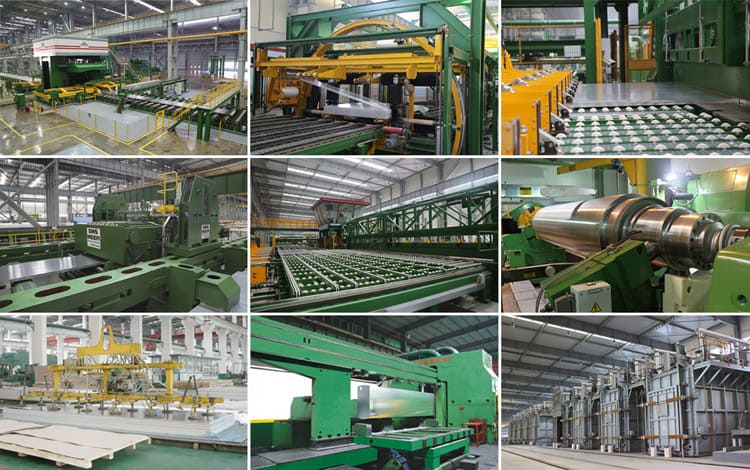
Casting and rolling process
Casting and rolling process: liquid metal, front box (liquid level control), casting and rolling machine (lubrication system, cooling water), shearing machine, coiling machine.
Cold rolling production process
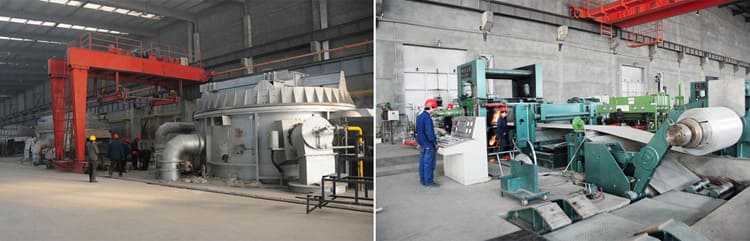
Introduction to finishing production process
Aluminum alloy has the characteristics of low density, good mechanical properties, good processing performance, non-toxic, easy to recycle, excellent electrical conductivity, heat transfer and corrosion resistance, so it has a wide range of applications.
Aerospace: used to make aircraft skins, fuselage frames, girders, rotors, propellers, fuel tanks, wall panels and landing gear struts, as well as rocket forging rings, spacecraft wall panels, etc.
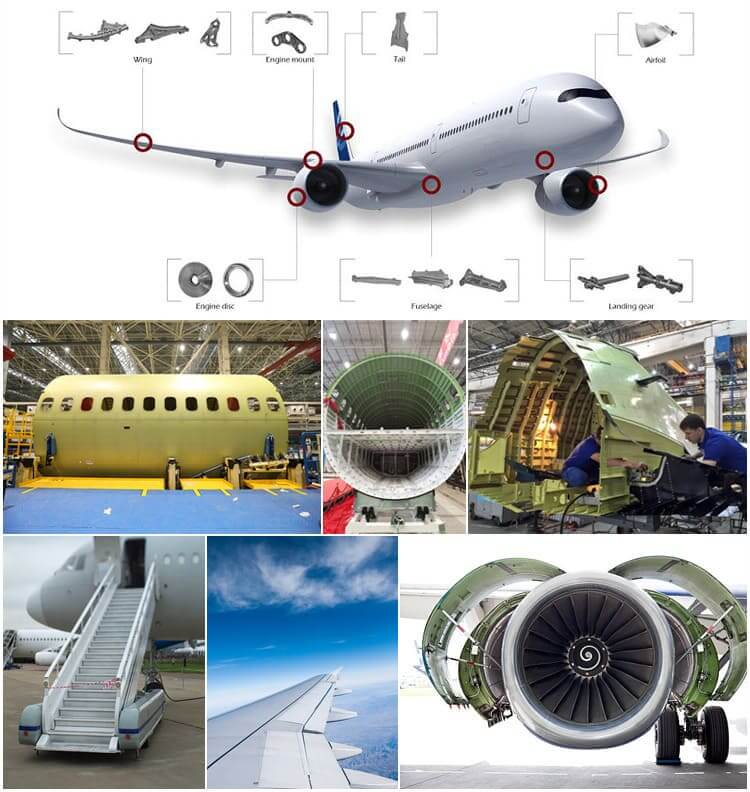
Aluminum alloy used for aerospace
Transportation: used for car body structure materials of automobiles, subway vehicles, railway passenger cars, high-speed passenger cars, doors and windows, shelves, automotive engine parts, air conditioners, radiators, body panels, wheels and ship materials.
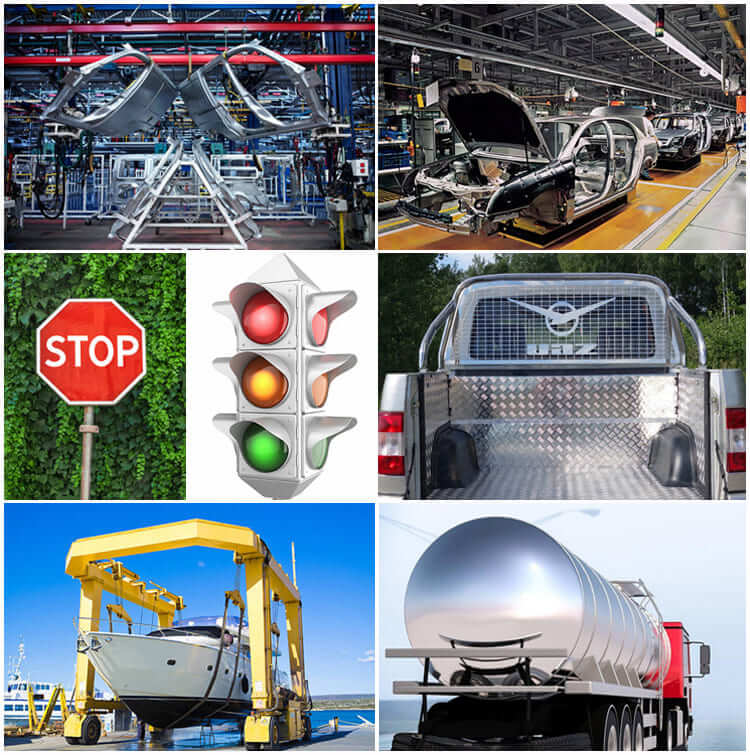
Traffic application
Packaging: All-aluminum pop cans are mainly used as metal packaging materials in the form of thin plates and foils, and are made into cans, lids, bottles, barrels, and packaging foils. Widely used in the packaging of beverages, food, cosmetics, medicines, cigarettes, industrial products, medicines, etc.
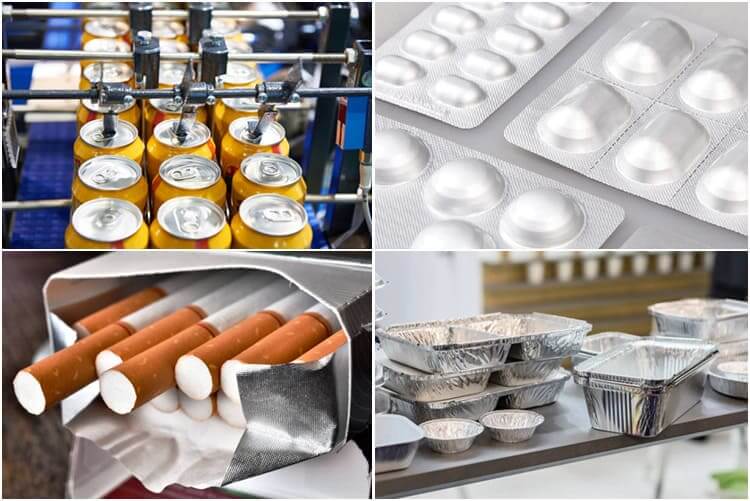
Packaging application
Printing: Mainly used to make PS plates, aluminum-based PS plates are a new type of material in the printing industry, used for automatic plate making and printing.
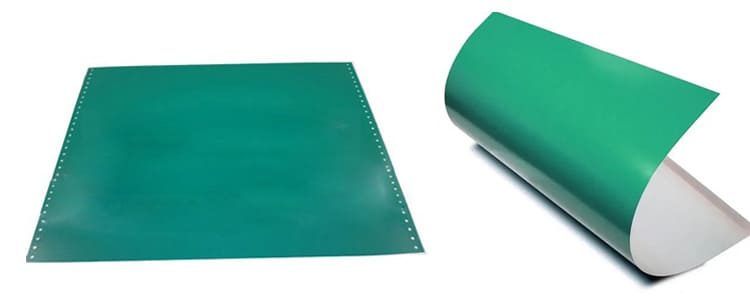
PS printing
Architectural decoration: aluminum alloy is widely used in building structures, doors and windows, suspended ceilings, decorative surfaces, etc. due to its good corrosion resistance, sufficient strength, excellent process performance and welding performance.

Aluminum alloy construction application
Electronic products: computers, mobile phones, refrigerator shells, radiators, etc.
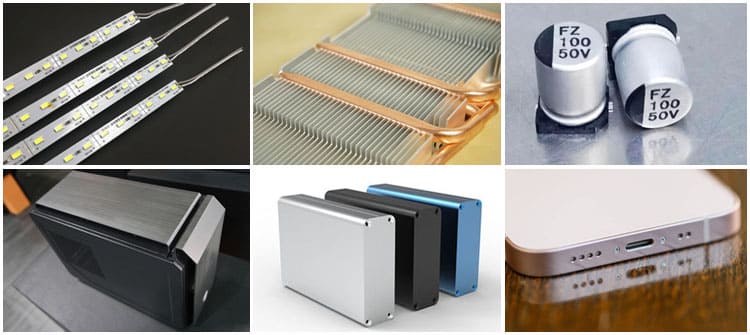
Electronic product application
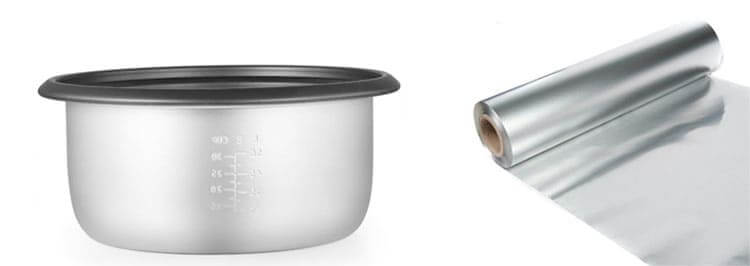
Kitchen supplies: aluminum pots, aluminum basins, rice cooker liners, household aluminum foil, etc.
Kitchen application
Packaging Of Aluminum Sheet/Coil
Every detail of packaging is where we pursue perfect service. Our packaging process as a whole is as follows:
Lamination: clear film, blue film, micro-mucosal, high-mucosal, laser cutting film (2 brands, Novacell and Polyphem);
Protection: paper corner protectors, anti-pressure pads;
drying: desiccant;
Tray: fumigated harmless wooden tray, reusable iron tray;
Packing: Tic-tac-toe steel belt, or PVC packing belt;
Material Quality: Completely free from defects such as white rust, oil spots, rolling marks, edge damage, bends, dents, holes, break lines, scratches, etc., no coil set.
Port: Qingdao or other ports in China.
Lead time: 15-45 days.
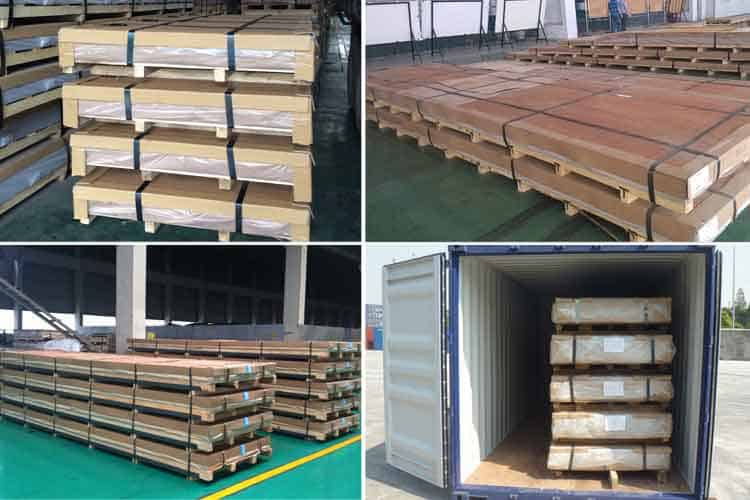
Aluminum sheet/plate packaging process
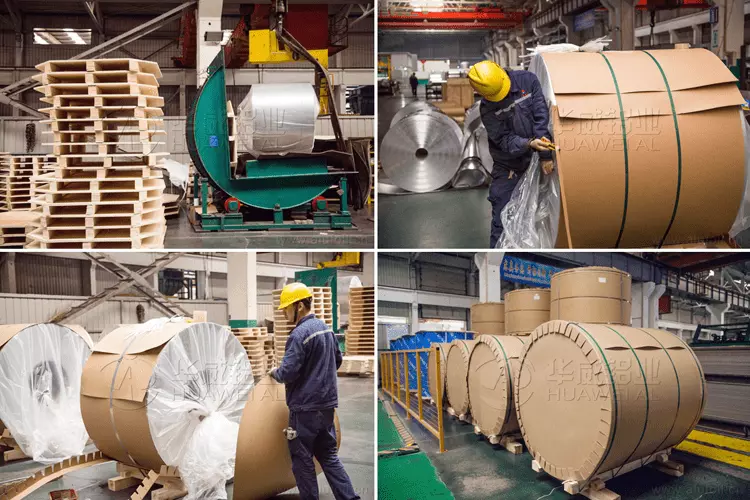
Aluminum coil packaging process
F: Are you a manufacturer or a trader?
Q: We are a manufacturer, our factory is at No.3 Weier Road, Industrial Zone, Gongyi, Henan, China.
F: What is the MOQ for ordering the product?
Q: Our MOQ is 5 tons, and some special products will have a minimum order quantity of 1 or 2 tons.
F: How long is your lead time?
Q: Generally our lead time is about 30 days.
F: Do your products have quality assurance?
Q: Yes, if there is a quality problem with our products, we will compensate the customer until they are satisfied.
Related Products


Latest Blogs
5052 vs 6061 Aluminum: Key Differences & Best Uses
Compare 5052 vs 6061 aluminum for strength, corrosion resistance, formability, and machining. Discover which alloy best fits your project.
Common Alloys of Reefer Truck Used PE Coated Aluminum Coil
Discover common alloys of reefer truck used PE coated aluminum coil, including 3003, 3004, and 3105. Designed for excellent corrosion resistance, formability, and long-lasting outdoor performance.
Is Aluminum Conductive? Properties, Uses & Benefits Explained
Is aluminum conductive? Discover aluminum's electrical conductivity, key advantages, and why it is widely used in power transmission and industrial applications.
Unlocking Sustainability: The Truth About Aluminum Foil Recycling
Is Aluminum Foil Recyclable? Learn how aluminum foil can be recycled, how to prepare it properly, and why recycling helps reduce waste and save resources.