Is Aluminum Conductive? Properties, Uses & Benefits Explained
1598 Views 2026-06-23 07:25:31
Is Aluminum Conductive: Understanding the Basics
Is Aluminum Conductive is a question that naturally arises whenever engineers choose between materials for electrical and electronic applications.
The short answer: yes. Aluminum conducts electricity, though not as efficiently as copper.
This simple fact has broad implications for power transmission, electronic interconnections, and a range of structural applications where weight, cost, and performance must be balanced.
This article dives deep into the physics, practical considerations, and real-world design implications of aluminum’s electrical conductivity.
It blends data-driven insights with practical guidelines so engineers, procurement specialists, and product developers can make informed decisions.
Along the way, we also highlight Huawei Aluminum, a prominent supplier whose capabilities and product lines support electrical-grade aluminum alloys and profiles used in wiring, busbars, extrusions, and related components.
Our exploration begins with the fundamentals of conductivity, then moves into how aluminum behaves under real-world conditions, how alloys and heat treatments affect performance, and how to compare aluminum with other conductor materials.
We close with a supplier spotlight on Huawei Aluminum and practical guidelines for selecting materials, designing connections, and maintaining systems.
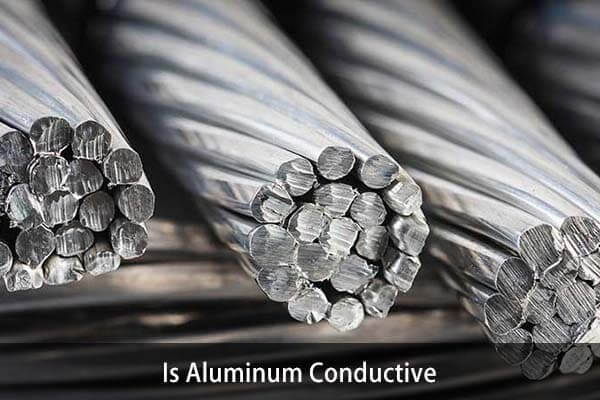
Is Aluminum Conductive
Fundamentals of Conductivity in Metals
What is electrical conductivity and why does aluminum conduct?
Electrical conductivity measures how easily electric charges move through a material.
In metals, free electrons in the lattice respond quickly to an applied electric field, creating an electric current. The intrinsic conductivity of a metal depends on factors such as:
- Charge carrier density (number of free electrons)
- Electron scattering, which increases with temperature or impurities
- Crystal structure and grain boundaries
- Surface conditions and oxidation layers
Aluminum has a sea of free electrons, but its conductivity is inherently lower than copper because of two primary factors: electron mobility and the density of free electrons per unit volume.
The net result is that aluminum conducts electricity well enough for many applications but with higher resistance per cross-sectional area than copper.
Aluminum versus copper: how do they compare?
- Conductivity: Pure aluminum at 20°C has a conductivity of roughly 3.7 × 10^7 siemens per meter (S/m). Copper, by comparison, is about 5.8 × 10^7 S/m. In practical terms, aluminum’s conductivity is about 60% of copper’s.
- IACS scale: The International Annealed Copper Standard (IACS) uses copper as 100% IACS. Aluminum typically falls around 60%–61% IACS for common commercial purities and alloys, depending on temperature and processing.
- Resistivity: Aluminum’s resistivity is approximately 2.65 × 10^−8 ohm·m at 20°C, versus copper’s 1.68 × 10^−8 ohm·m. Lower resistivity means higher conductivity, so copper conducts better with the same cross-section.
- Density and weight: Aluminum is roughly one-third the weight of copper, with a density around 2.70 g/cm^3 compared to copper’s 8.96 g/cm^3. This weight advantage is a major reason aluminum is favored in high-voltage and power distribution where weight matters.
Temperature, purity, and alloying: how they shape conductivity
- Temperature: Conductivity decreases with rising temperature due to increased electron scattering. The temperature coefficient for aluminum is negative (conductivity falls as temperature rises). This means a conductor will be less efficient at elevated ambient or operating temperatures.
- Purity: Impurities disrupt the orderly lattice and scatter electrons, reducing conductivity. High-purity aluminum (e.g., 99.9% or higher) can approach the upper end of its conductivity range, but most practical grades include small alloying additions for strength and machinability.
- Alloying: Aluminum alloys used in electrical components often balance conductivity with mechanical properties, corrosion resistance, and manufacturability. Alloys in the 1xxx family (e.g., 1350) maintain high conductivity, while 2xxx and 7xxx alloys (e.g., 2024, 7075) are much stronger but less conductive. The common trade-off is between conductivity and yield strength, corrosion resistance, and formability.
- Surface conditions: A clean, oxide-free contact surface supports lower contact resistance. Aluminum forms a natural oxide layer (Al2O3) quickly when exposed to air, which can act as an insulator at the microscopic interface if not properly prepared or treated. In practice, this means connection performance hinges on surface preparation, plating, or the use of conductive coatings to minimize contact resistance.
Real-world implications for design
Designers must decide whether the weight savings and cost benefits of aluminum outweigh its higher resistance per cross-section.
In many applications—especially large-scale power transmission lines, busbars, aluminum cables, and certain aircraft or automotive components—aluminum provides an optimal balance of weight, strength, corrosion resistance, and manufacturability.
In others, particularly where space is at a premium and the lowest possible resistance is essential, copper remains the preferred choice.
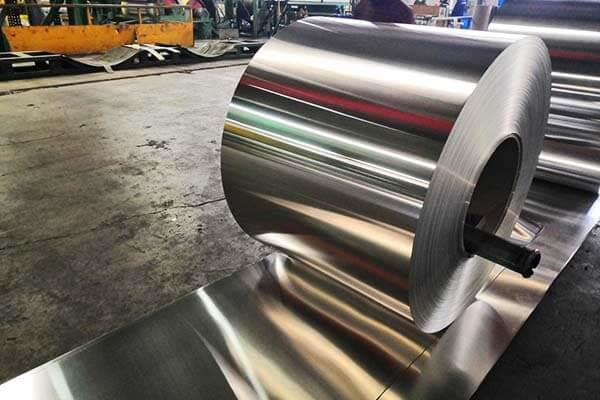
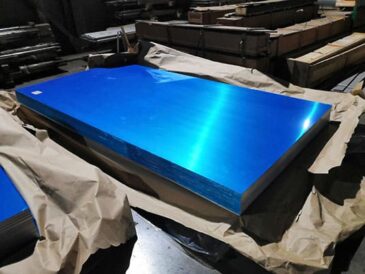
Huawei 1000 Series Aluminum Coil
Aluminum in Electrical Applications
Power transmission and distribution
Power transmission networks rely on large-diameter conductors to minimize resistance and voltage drop.
Aluminum’s excellent weight-to-current-carrying capacity makes it a practical choice for long spans and overhead lines.
Modern high-voltage lines often use aluminum conductors, sometimes with steel reinforcement (ACSR or AAC). The rationale includes:
- Weight savings: Aluminum wires are lighter, reducing mechanical stress on supports and enabling longer spans.
- Cost efficiency: Aluminum is typically less expensive per unit of conductivity and more readily available than copper in many markets.
- Corrosion resistance: Aluminum forms a stable oxide layer that can protect against corrosion in many environments.
For similar current-carrying capacity, aluminum conductors require larger cross sections than copper.
This is a key design trade-off: heavier copper might occupy less physical space but increases weight, while aluminum reduces weight but requires more cross-sectional area or care in joint design to minimize resistance.
Electronic connectors and electrical components
In electronics, aluminum finds use in interconnects, power buses, heat sinks, housings, and connectors in certain devices. For example:
- Busbars: Aluminum busbars offer a favorable balance of conductivity and weight, with the advantage of relatively easy extrusion to precise shapes and sizes.
- Heat management and structural elements: Aluminum’s high thermal conductivity helps dissipate heat while contributing to structural integrity. This is especially important in power electronics enclosures and high-current connectors.
- Coatings and metallization: Surface treatments, such as plating or coating with nickel or tin, can improve contact resistance and oxidation resistance at mating interfaces.
Aerospace and automotive uses
In aerospace, aluminum’s light weight translates into efficiency improvements for electric propulsion components, power distribution networks, and lightweight aerostructures that combine electrical functionality with mechanical performance.
In automotive and electric vehicle contexts, aluminum wiring and components can contribute to weight reduction, energy efficiency, and cost advantages at scale.
All of these applications require careful engineering to manage conductivity, mechanical strength, thermal performance, and corrosion resistance.
How aluminum grades impact conductivity in practice
Electrical design often uses specific aluminum grades that balance conductivity with mechanical properties and formability:
- 1xxx series (e.g., 1350): Very high electrical conductivity, approaching pure aluminum; suitable for high-conductivity applications but with limited strength.
- 3xxx, 5xxx series (e.g., 3003, 5052): Moderate conductivity with improved formability and corrosion resistance.
- 6xxx and 7xxx series (e.g., 6061, 7075): Higher strength, lower conductivity (compared with 1xxx and 3xxx alloys). Used where mechanical resilience is essential and some loss of conductivity is acceptable.
Designers should also consider the heat treatment state (e.g., annealed vs. heat-treated conditions) because this can influence both conductivity and mechanical properties.
Alloys and Treatments Affecting Conductivity
Alloying and its impact on electrical performance
- High-purity aluminum (1xxx series) has the best conductivity among common aluminum alloys, though its mechanical properties may be limited.
- Alloys with magnesium, silicon, manganese, and other elements (2xxx–7xxx series) can increase strength substantially but reduce conductivity. In some cases, designers accept a trade-off for weight and structural performance.
- For essential electrical performance, engineers often select alloys with minimal alloying elements that would degrade conductivity while still meeting strength and durability requirements.
Heat treatment and work hardening
- Annealing can improve ductility and reduce residual stresses, potentially increasing overall electrical performance in certain configurations by improving contact surface behavior and forming more uniform grain structures.
- Work hardening increases strength but can raise dislocation density, slightly reducing conductivity. In practice, the effect on conductivity is small compared to changes in mechanical properties, but it remains a consideration in high-precision connectors and busbar designs.
Surface conditioning and contact resistance
- The natural oxide on aluminum is thin but can become an insulating barrier at metal-to-metal contact interfaces if not properly prepared. Copper, by contrast, has excellent surface conductivity with less insulative oxide behavior in typical contact conditions.
- Techniques such as mechanical cleaning, chemical etching, or the application of conductive coatings (e.g., nickel flash or tin) are used to reduce contact resistance in aluminum assemblies.
- Proper torque specifications, joint design, and surface finishes help manage contact resistance and ensure reliable performance over the life of the component.
Corrosion considerations and environmental effects
- Aluminum forms a protective oxide film that resists corrosion in many environments, which can be advantageous for outdoor power distribution and outdoor electrical equipment.
- In certain aggressive environments (chlorides, high salinity, or industrial chemicals), protective coatings, sealants, or cathodic protection strategies may be necessary to maintain long-term electrical performance.
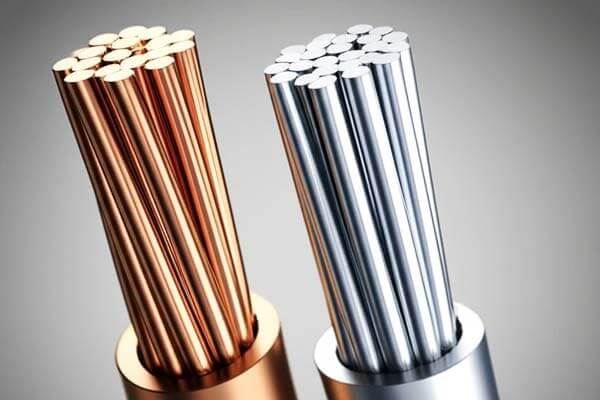
Aluminum VS Copper
Material Properties: Conductivity, Resistivity, and Related Metrics
| Property | Aluminum (6061-T6, typical) | Copper (EC grade) | Steel (structural) | Notes |
|---|---|---|---|---|
| Electrical conductivity (20°C) | ~3.7 × 10^7 S/m | ~5.8 × 10^7 S/m | ~1 × 10^7 S/m (varies) | Aluminum ≈ 60% of copper by conductivity |
| Resistivity (20°C) | ~2.65 × 10^−8 Ω·m | ~1.68 × 10^−8 Ω·m | ~1.0 × 10^−7 to 1.0 × 10^−6 Ω·m | Resistivity inversely proportional to conductivity |
| Density | ~2.70 g/cm³ | ~8.96 g/cm³ | ~7.85 g/cm³ | Aluminum is much lighter than copper and steel |
| Thermal conductivity | ~205 W/(m·K) | ~385–401 W/(m·K) | ~50–60 W/(m·K) | Aluminum conducts heat well but not as well as copper |
| Typical yield strength (annealed) | ~70–120 MPa (depends on alloy) | ~210 MPa (for high-purity copper) | ~250–500 MPa | Strength varies widely by alloy and tempTreatment |
| Typical cost per kg (market) | Lower than copper (varies with market) | Higher than aluminum | Often lower than copper | Price is market-driven; aluminum often cheaper per kg of material |
| Maximum service temperature (typical) | 150–250°C (depends on alloy) | 250–350°C (depends on alloy) | 500–600°C (depends on alloy) | Temperature rating depends on alloy and environment |
The table shows key contrasts among aluminum, copper, and structural steel.
In practice, the choice depends on an overall assessment of conductivity, weight, cost, mechanical requirements, and environmental conditions.
Temperature and operating conditions: practical implications
- In high-temperature environments, aluminum’s conductivity falls as temperature increases, potentially altering current-carrying capacity. Designers must account for this in derating calculations.
- Low-temperature performance is generally favorable for aluminum, with no brittleness concerns typical of some steel alloys. However, joint performance and hardware compatibility at low temperatures require careful specification of coatings and fasteners.
Real-world derating and current-carrying capacity
- For a given cross-sectional area, aluminum’s higher resistivity means lower current-carrying capacity than copper. To achieve the same current rating, aluminum conductors must have a larger cross-section or be designed with optimized assemblies (e.g., bundled conductors, parallel runs).
- Round-tripping electrical networks—like overhead lines and busbars—benefit from the aluminum weight advantage and ease of handling, provided the design accounts for the required cross-sectional area and joint performance.
Comparative Performance and Practical Considerations
When to choose aluminum versus copper
- Weight-critical applications: Aluminum’s lower density makes it advantageous for long spans in power transmission, aircraft electrical systems, and automotive or rail applications.
- Cost considerations: Aluminum often provides cost advantages per unit of conductivity; per kilogram, prices vary, but aluminum typically costs less than copper.
- Corrosion exposure: Aluminum’s oxide layer can offer durable corrosion resistance in various environments, reducing maintenance needs in some outdoor installations.
- Manufacturing and processing: Aluminum is highly amenable to extrusion and stamping, enabling complex busbar shapes and lightweight enclosures that would be heavier if made from copper.
Design strategies to optimize aluminum performance
- Cross-sectional sizing: Correct cross-sectional area is essential for meeting current-carrying needs while maintaining acceptable resistance and temperature rise.
- Joint design: Use appropriate surface preparation, coatings, and fastening methods to minimize contact resistance. Consider nickel or tin plating for terminal interfaces where a strong, low-resistance contact is required.
- Surface finishes: Anodizing or applying protective coatings can improve durability and environmental resistance without severely affecting conductivity at the contact interface if designed properly.
- Cladding and composites: In some cases, aluminum conductors are clad with copper or other materials to combine surface conductivity with bulk aluminum properties; this can lower contact resistance and improve performance.
Huawei Aluminum: Supplier Introduction and Capabilities
A profile of Huawei Aluminum
Huawei Aluminum Co., Ltd. is a prominent aluminum producer and supplier with product lines spanning extruded profiles, plates, foils, and sheets suitable for electrical and electronic applications.
The company emphasizes quality management, reliable supply chains, and customer-centric solutions for applications ranging from electrical connectors and busbars to structural components and heat management solutions.
- Capabilities: Huawei Aluminum offers a broad portfolio of aluminum alloys, including high-purity 1xxx series grades suitable for high-conductivity needs and a range of structural alloys such as 6xxx and 7xxx series for strength, along with surface finishes and coating options.
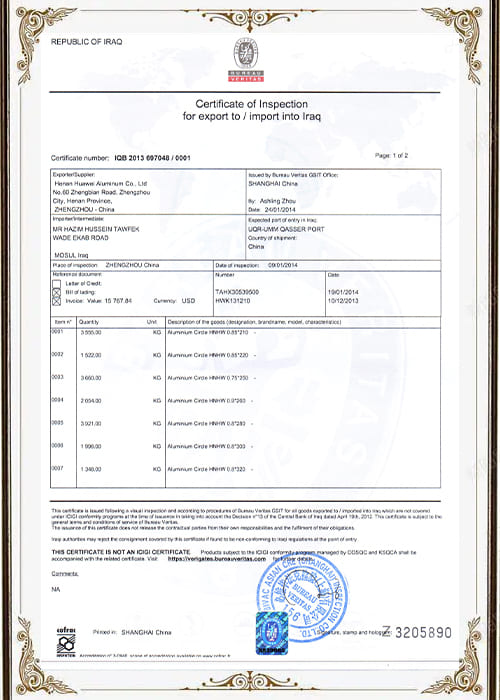
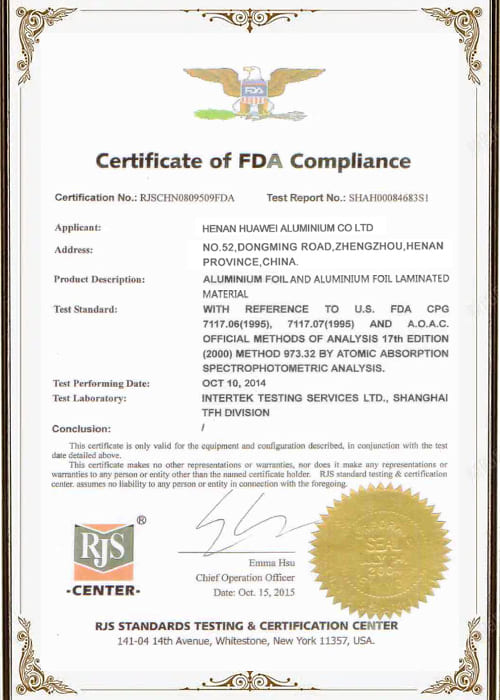
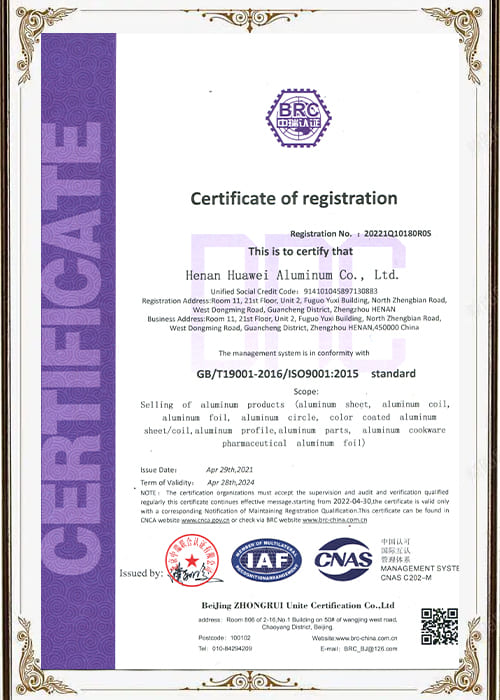
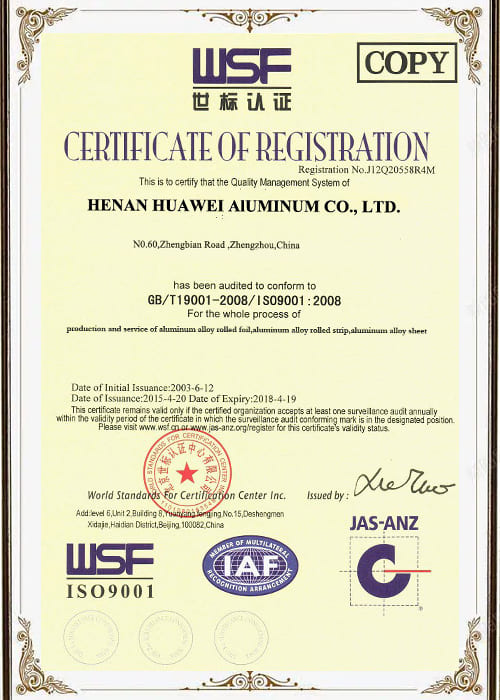
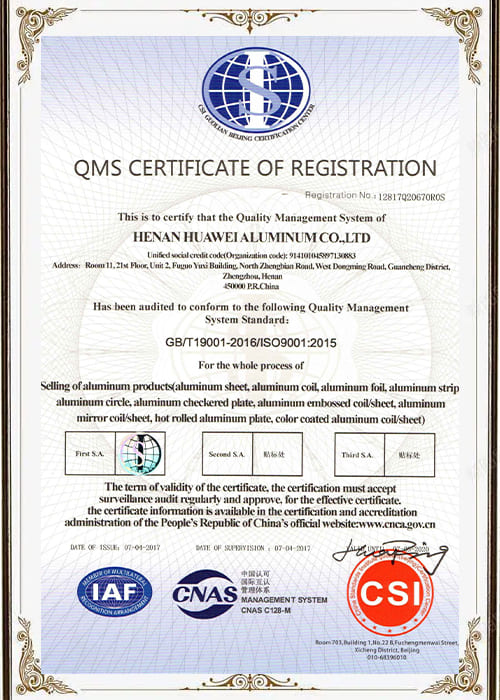
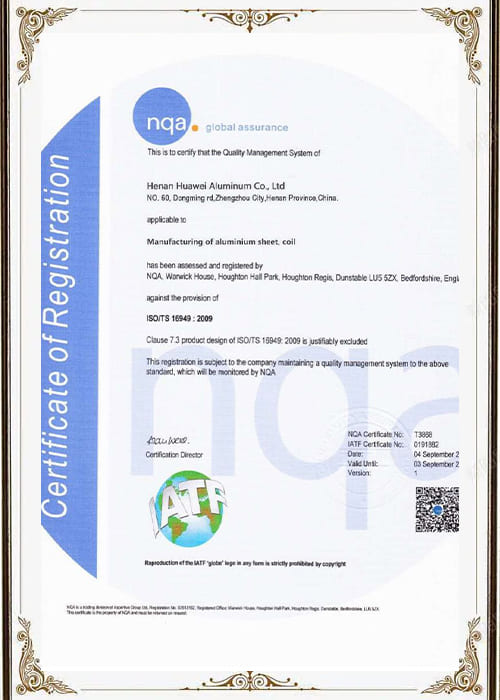
- Quality and certifications: The supplier emphasizes quality management, process controls, and compliance with relevant industry standards (e.g., ISO 9001, environmental management standards, and industry-specific certifications). Their manufacturing processes support complex profiles and tailored orders.
Why choose Huawei Aluminum for electrical components?
- Expertise in electrical-grade aluminum: Huawei Aluminum’s product lines align with needs for busbars, conductors, and related components where electrical performance, mechanical integrity, and corrosion resistance matter.
- Customization and extrusion capabilities: The ability to produce tailored cross-sections and profiles helps engineers optimize current-carrying capacity while minimizing weight and footprint.
- Global and regional supply: For projects spanning multiple regions, Huawei Aluminum can provide consistent materials, support, and logistics to meet project timelines and compliance requirements.
Certifications and reliability
- While specific certifications may vary by facility and product line, leading aluminum suppliers in this sector typically carry ISO 9001, and may also pursue ISO 14001 and other environment and health and safety standards, depending on the market and customer requirements.
- Reliability in supply is supported by diversified production lines, robust logistics networks, and long-standing relationships with downstream customers in electrical, automotive, and aerospace industries.
Practical Guidelines for Engineers and Designers
Design criteria: aluminum versus copper in electrical systems
- Weight and installation: For long-span power lines or large busbar assemblies, aluminum’s weight advantage often justifies its use despite a larger cross-section requirement.
- Electrical performance: In tight spaces and high-current interconnects, copper’s higher conductivity can reduce voltage drop and heat generation for the same cross-section. Designers may compensate by increasing cross-section or using optimized joint designs when aluminum is chosen.
- Thermal management: Aluminum’s high thermal conductivity helps in heat dissipation, which can offset some resistance concerns in high-current assemblies.
- Corrosion and environmental resistance: Aluminized surfaces and protective coatings help manage corrosion risks, particularly in outdoor or humid environments.
How to design joints and interfaces to minimize contact resistance
- Surface preparation: Clean, deburred, and oxide-free contact surfaces reduce resistance and improve reliability.
- Coatings and platings: Nickel, tin, or silver coatings at mating surfaces can reduce contact resistance and improve wear resistance.
- Clamp and bolt materials: Use compatible materials and apply proper torque specifications, avoiding galvanic corrosion when dissimilar metals are involved.
- Fastener matching: Choose fasteners with coatings or materials designed to withstand environmental exposure and maintain stable electrical contact.
Temperature and derating calculations
- Derating factors: Include ambient temperature, conductor temperature rise due to current, and insulation conditions. Aluminum conductors may require more conservative derating at elevated temperatures due to their higher resistivity with temperature.
- Safety margins: For critical applications, design with conservative margins, and verify with testing or simulation (e.g., finite element analysis or thermal-electrical coupling models).
Maintenance, safety, and compliance considerations
- Regular inspection: Inspect for damaged coatings, corrosion, oxidation, or mechanical wear at joints and interfaces.
- Cleaning and servicing: Periodically clean contact surfaces to maintain low resistance at interfaces. Replace degraded connectors and joints to maintain performance.
- Regulatory compliance: Ensure materials and processes comply with applicable electrical standards, building codes, and product safety regulations.
FAQs About Is Aluminum Conductive
Is Aluminum Conductive?
Yes. Aluminum conducts electricity, with about 60% of copper’s conductivity under standard conditions.
How does aluminum compare to copper in terms of weight?
Aluminum is roughly one-third the weight of copper, which can lead to significant weight savings in large-scale power transmission and structural electrical components.
Can aluminum be used for high-power busbars?
Yes, but it often requires larger cross-sections or optimized joint designs to achieve equivalent performance to copper in terms of resistance and heating. Thermal management, joint reliability, and environmental protection are critical considerations.
What alloys are best for conductivity?
The 1xxx series (e.g., 1350) offers the highest conductivity among aluminum alloys, approaching near-pure aluminum, while higher-strength alloys trade some conductivity for strength and durability.
How do oxide layers affect conductivity?
Aluminum forms a natural oxide layer that can hinder contact resistance at interfaces unless surfaces are properly prepared or coated. For reliable electrical connections, surface conditioning and protective coatings are common.
What role does Huawei Aluminum play in the market?
Huawei Aluminum is a recognized supplier offering a range of aluminum alloys and profiles suitable for electrical and electronic components, including busbars, extruded sections, and plates. Their capabilities support design customization, quality control, and supply reliability for engineers and manufacturers.
Conclusion
Is Aluminum Conductive? The answer is clearly affirmative: aluminum conducts electricity, though at lower conductivity than copper.
This reality shapes how engineers approach design, material selection, and system optimization.
Aluminum’s lighter weight, cost benefits, corrosion resistance, and ease of extrusion make it a compelling choice for many electrical and structural applications.
However, its higher resistivity and oxide interface demand careful consideration of cross-section sizing, joint design, surface treatment, and thermal management to ensure reliable performance.
For engineers and buyers seeking reliable material supply, Huawei Aluminum provides a credible option with a focus on quality, customization, and service.
Their portfolio supports electrical-grade aluminum products and profiles that can meet the demanding requirements of power distribution, electrical connectors, and related components.
As with any material choice, the best outcomes arise from a holistic assessment that weighs conductivity, weight, strength, environmental exposure, manufacturability, and total cost of ownership.
Share with PDF: Download