1. Introduction
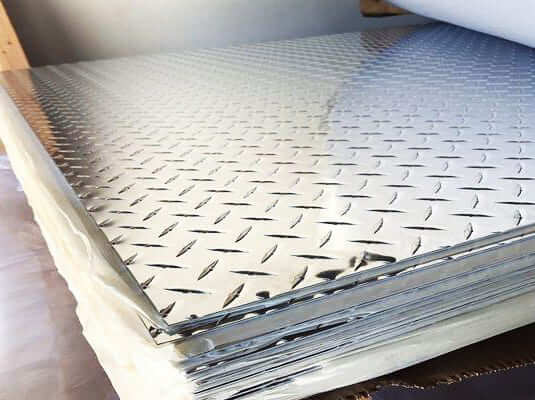
3003 H22 aluminum diamond plate is a patterned aluminum product designed for applications that require a combination of lightweight construction, surface traction, corrosion resistance, and practical fabrication performance.
It consists of 3003 aluminum-manganese alloy with a raised diamond tread pattern on one side.
The 3003 alloy offers better strength than commercially pure aluminum while retaining good formability and corrosion resistance.
Its H22 temper provides a partially annealed, strain-hardened condition, giving the material a balance of strength and workability for many general-purpose applications.
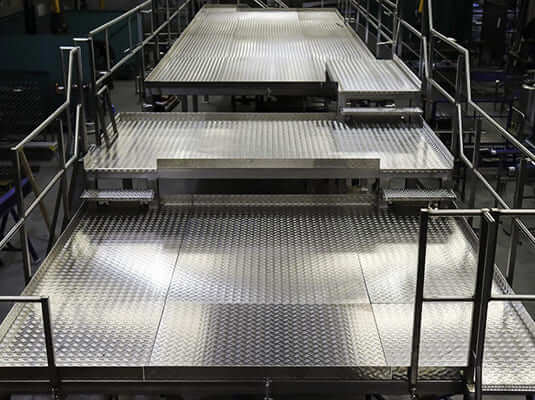
The raised diamond pattern helps improve grip underfoot and makes the plate suitable for floors, walkways, steps, ramps, truck components, and equipment platforms.
Its relatively low density also helps reduce structural weight compared with conventional steel tread plate.
For buyers and fabricators, selecting the right 3003 H22 aluminum diamond plate involves more than choosing an alloy and thickness.
Base-metal thickness, tread height, pattern design, sheet dimensions, surface quality, and installation conditions all affect the finished product’s performance.
3003 H22 Aluminum Diamond Plate
2. What Is 3003 H22 Aluminum Diamond Plate?
3003 H22 aluminum diamond plate is a non-heat-treatable aluminum tread plate made from 3003 aluminum alloy.
It combines the mechanical characteristics of an aluminum-manganese alloy with a raised diamond pattern that provides additional surface texture.
Each part of its designation describes a different aspect of the product: 3003 identifies the alloy, H22 identifies the temper, and diamond plate describes the surface pattern.
2.1 Understanding 3003 Aluminum Alloy
3003 aluminum belongs to the 3xxx series of aluminum alloys, in which manganese serves as the principal alloying element.
Compared with 1xxx series commercially pure aluminum, 3003 generally offers higher strength while maintaining good corrosion resistance and forming characteristics.
The alloy works well in common fabrication operations such as cutting, bending, rolling, and forming.
It also offers good weldability when fabricators select suitable welding procedures and filler materials.
These characteristics make 3003 a practical material for general-purpose tread plate.
It is commonly selected for applications where moderate strength, low weight, corrosion resistance, and ease of fabrication matter more than high structural strength.
2.2 What Does H22 Temper Mean?
The H22 designation describes the material’s mechanical condition after strain hardening and partial annealing.
- H: The material has undergone strain hardening to increase its strength.
- 2: The material has been partially annealed after strain hardening.
- 2: The final digit indicates a quarter-hard temper.
This temper provides a balance between strength and formability. Compared with a softer O temper, H22 offers higher strength.
Compared with harder strain-hardened tempers, it generally allows easier forming.
2.3 Understanding the Diamond Tread Pattern
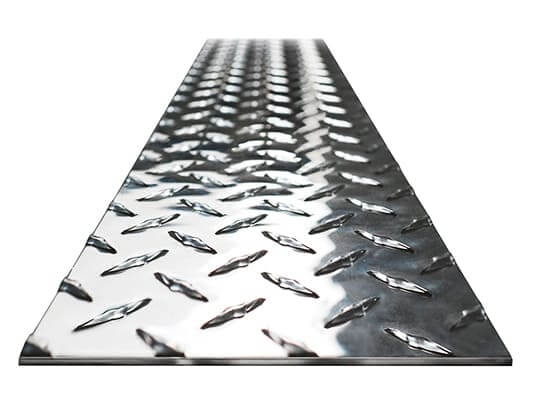
The diamond pattern consists of raised projections on the plate surface.
These raised areas create a textured contact surface that can improve traction compared with a smooth aluminum sheet.
The pattern also gives the plate a distinctive industrial appearance and can help conceal minor surface marks that occur during ordinary handling.
When specifying aluminum diamond tread plate, buyers should distinguish between two thickness measurements:
- Base-metal thickness: The thickness of the aluminum sheet beneath the raised pattern.
- Overall thickness: The measured thickness from the bottom surface to the top of the raised pattern.
This distinction is important because suppliers may quote plate thickness based on the base metal rather than the overall patterned thickness.
Buyers should confirm the measurement method before placing an order.
3. Specifications of 3003 H22 Aluminum Diamond Plate
The specifications of 3003 H22 aluminum diamond plate cover its alloy, temper, base-metal thickness, sheet dimensions, tread pattern, and surface finish.
These details determine the plate’s weight, fabrication behavior, appearance, and suitability for different applications.
| Item | Typical Range / Options |
|---|---|
| Alloy | 3003 |
| Temper | H22 (also O, H14, H24, H26 on request) |
| Standard | ASTM B209, EN 485 / EN 573, GB/T 3880 |
| Base thickness | about 1.0–6.0 mm [confirm] |
| Common thicknesses | 1.0, 1.5, 2.0, 2.5, 3.0, 4.0, 5.0 mm |
| Overall thickness | Base thickness + pattern height |
| Width | about 1000–1500 mm (wider on request) |
| Length | about 2000–6000 mm, or coil |
| Common sheet sizes | 1000 × 2000, 1220 × 2440, 1250 × 2500, 1500 × 3000 mm |
| Coil supply | Width about 1000–1500 mm, core ID 305 / 405 / 508 mm [confirm] |
| Pattern type | Diamond (two-bar), five-bar, three-bar, lentil, orange-peel |
| Pattern height | about 0.5–1.5 mm, depending on thickness |
| Embossed side | One side (mill-finish smooth back) |
| Surface finish | Mill finish, anodized, painted, film-coated |
| Protective film | PE film or interleaving paper |
| Thickness tolerance | Per standard, or as agreed |
| Width / length tolerance | Per standard, or as agreed |
| Flatness / camber | Per standard, or as agreed |
| Edge condition | Sheared, slit, or saw-cut |
| Custom cutting | To drawing |
| Packaging | Interleaving paper, film, wooden pallet or case, moisture protection |
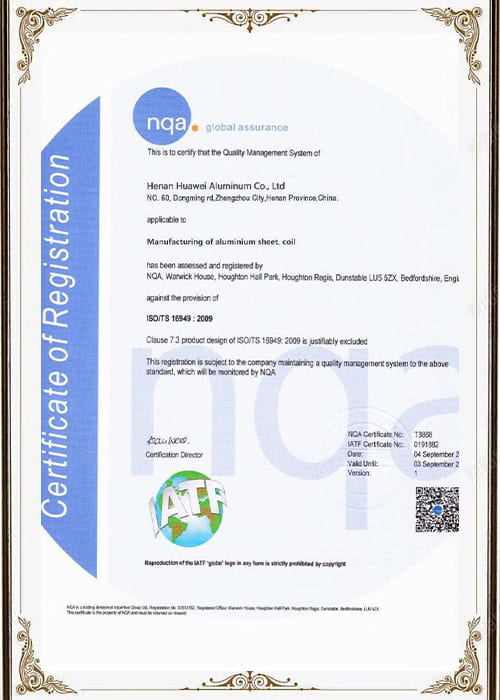
| Certificates | Mill test certificate (EN 10204 3.1) |
4. Chemical Composition of 3003 Aluminum
Chemical composition is the first item to confirm on a mill test certificate. For 3003, the manganese content is the defining feature.
4.1 Typical composition limits (weight %)
| Element | Limit |
|---|---|
| Aluminum (Al) | Remainder (about 96.8–99.0) |
| Manganese (Mn) | 1.0–1.5 |
| Iron (Fe) | ≤ 0.70 |
| Silicon (Si) | ≤ 0.60 |
| Copper (Cu) | 0.05–0.20 |
| Zinc (Zn) | ≤ 0.10 |
| Other elements, each | ≤ 0.05 |
| Other elements, total | ≤ 0.15 |
Limits follow common international standards such as ASTM B209 and EN 573. Confirm against the standard stated in your contract.

Properties of 3003 H22 Aluminum Diamond Plate
5. Mechanical and Physical Properties of 3003 H22 Aluminum Diamond Plate
Mechanical and physical properties decide whether a plate performs well in real use.
For 3003 H22, they come from two sources: the manganese in the alloy and the partial-anneal temper.
5.1 Mechanical properties
Typical reference ranges for 3003 in common tempers (flat sheet basis):
| Temper | Tensile Strength (MPa) | Yield Strength (MPa) | Elongation (%) |
|---|---|---|---|
| O | 95-130 | ≥ 35 | ≥ 20-23 |
| H22 | 120-160 | ≥ 85 | ≥ 8-12 |
| H24 | 140-180 | ≥ 115 | ≥ 6-10 |
| H14 | 145-185 | ≥ 125 | ≥ 5-8 |
Indicative only. Exact limits depend on thickness and the standard used (ASTM B209, EN 485-2, GB/T 3880). Always request the actual values on the mill test certificate.
How to read these properties
- Tensile strength is the maximum stress before fracture.
- Yield strength is where permanent deformation begins. For flooring and treads, this matters more than tensile strength.
- Elongation shows how far the plate can stretch. Higher elongation means better bending performance.
H22 sits between O and H24: firm enough to resist denting, yet ductile enough to bend cleanly.
5.2 Physical Properties
The physical properties of 3003 aluminum influence its weight, heat transfer, dimensional stability, and performance under changing temperatures.
| Physical Property | Typical Value | Unit |
|---|---|---|
| Density | 2.73 | g/cm³ |
| Thermal Conductivity | Approx. 190 | W/(m·K) |
| Electrical Conductivity | Approx. 40–42 | % IACS |
| Specific Heat Capacity | Approx. 900 | J/(kg·K) |
| Elastic Modulus | Approx. 69–70 | GPa |
| Linear Thermal Expansion | Approx. 23 | ×10⁻⁶/K |
| Melting Range | Approx. 643–655 | °C |
Values are approximate room-temperature references for 3003 aluminum alloy.
Actual properties may vary with composition, temper, and testing conditions.
6. Key Advantages of 3003 H22 Aluminum Diamond Plate
3003 H22 aluminum diamond plate combines a lightweight structure, good corrosion resistance, and practical formability with a raised tread pattern.
These characteristics make it suitable for various industrial, commercial, and transportation applications.
6.1 Improved Surface Traction
The raised diamond pattern provides a textured surface that improves grip compared with smooth aluminum sheet.
It is commonly used for walkways, steps, ramps, and vehicle floors. Actual slip resistance depends on surface conditions, pattern design, and maintenance.
6.2 Lightweight and Easy to Handle
With a density of approximately 2.73 g/cm³, 3003 aluminum is much lighter than steel.
Its low weight helps reduce the overall mass of vehicles, equipment, and flooring systems while making transportation and installation easier.
6.3 Good Corrosion Resistance
3003 aluminum naturally forms a protective oxide layer that helps resist oxidation in ordinary atmospheric environments.
This makes it suitable for many indoor and outdoor applications, although harsh chemicals and prolonged saltwater exposure require additional consideration.
6.4 Balanced Strength and Formability
The H22 temper provides a practical balance between strength and workability.
The plate can undergo common fabrication operations, including cutting, drilling, bending, and welding with suitable procedures.
Its formability makes it useful for customized panels, steps, and equipment covers.
6.5 Convenient Fabrication and Installation
3003 H22 diamond plate supports common metalworking processes and can be supplied in customized dimensions.
Its lightweight structure also simplifies handling, fastening, and installation, helping improve fabrication efficiency.
6.6 Attractive Industrial Appearance
The raised diamond pattern creates a distinctive metallic finish that combines practical surface texture with a clean industrial appearance.
Bright and mill-finish options support different functional and decorative requirements.
Overall, 3003 H22 aluminum diamond plate offers a practical combination of traction, low weight, corrosion resistance, and fabrication flexibility for general-purpose applications.
3003 H22 Aluminum Diamond Plate for Industrial Flooring
7. Typical Applications of 3003 H22 Aluminum Diamond Plate
3003 H22 aluminum diamond plate serves a wide range of industrial, transportation, commercial, and equipment applications.
Its lightweight construction, raised surface pattern, corrosion resistance, and fabrication flexibility make it suitable for products that require a durable textured metal surface.
7.1 Industrial Flooring and Walkways
Industrial facilities use aluminum diamond plate for selected flooring and access areas where a textured metal surface is desirable.
Typical applications include:
- Factory and workshop walkways
- Equipment maintenance platforms
- Warehouse access areas
- Machine service floors
- Protective floor panels
The raised diamond pattern provides additional surface texture, while aluminum’s low weight helps reduce the dead load of suitable structures.
For industrial flooring, designers should evaluate the plate thickness, support spacing, expected traffic, concentrated loads, and required slip-resistance performance.
7.2 Truck and Trailer Manufacturing
Transportation manufacturers use aluminum diamond plate in selected vehicle components because it combines low weight with a textured surface.
Common applications include:
- Truck bed flooring
- Trailer floors and access panels
- Vehicle steps and running boards
- Cargo-area protective panels
- Toolboxes and storage compartments
Reducing vehicle component weight can help improve payload efficiency and simplify handling.
The raised surface also provides additional traction for operators accessing truck beds and service areas.
For heavy-duty vehicle applications, buyers should compare 3003 H22 with 5052 H32 and other suitable alloys according to load requirements, impact exposure, and forming needs.

Trailer Used 3003 H22 Aluminum Diamond Plate
7.3 Stairs, Steps, and Ramps
Aluminum diamond plate is commonly used to manufacture steps, stair treads, ramps, and landing panels.
Its textured surface provides additional grip for people moving between different working levels.
Its relatively low weight also makes it suitable for portable access equipment and lightweight platforms.
Typical applications include:
- Industrial stair treads
- Equipment access steps
- Loading ramps
- Maintenance ladders and platforms
- Commercial service-area steps
When used in public or industrial access systems, the plate should meet the project’s applicable structural and slip-resistance requirements.
Patterned aluminum alone does not guarantee compliance with a specific safety standard.
7.4 Equipment Covers and Protective Panels
Manufacturers use 3003 H22 diamond plate for protective panels and covers that need a textured, lightweight metal surface.
Examples include:
- Machinery covers
- Equipment access panels
- Protective enclosures
- Maintenance compartment doors
- Tool cabinets and storage boxes
The material’s formability supports customized cutting and bending, while its corrosion resistance makes it useful in many indoor and general outdoor environments.
For electrical cabinets and precision equipment enclosures, manufacturers should also consider grounding, electrical insulation requirements, fastening design, and dimensional tolerances.

Protective Panels Aluminum Diamond Plate
7.5 Commercial Buildings and Public Facilities
Commercial and public facilities use aluminum tread plate in areas that require practical access surfaces and protective metal panels.
Typical applications include:
- Utility room flooring
- Building maintenance corridors
- Service platforms
- Access covers
- Decorative wall and floor panels
Its metallic appearance works well in industrial-style interiors and utility spaces.
The lightweight structure also simplifies installation in selected non-structural applications.
7.6 Marine and Recreational Equipment
3003 H22 diamond plate may also be used in selected recreational and marine-related equipment, such as:
- Recreational vehicle flooring
- Camper and trailer access panels
- Storage compartments
- Selected boat interior panels
- Lightweight equipment platforms
However, continuous saltwater exposure and marine service conditions require careful material evaluation.
For more demanding marine environments, alloys such as 5052 or 5083 may offer more appropriate corrosion-resistance and strength characteristics, depending on the application.

3003 H22 Aluminum Diamond Plate for Building
8. 3003 H22 Aluminum Diamond Plate vs. Other Aluminum Alloys
Choosing the right aluminum diamond plate requires evaluating mechanical strength, corrosion resistance, formability, weight, and cost.
Although different aluminum alloys may share similar tread patterns, their chemical compositions and tempers result in different performance characteristics.
3003 H22 is generally suitable for general-purpose applications requiring moderate strength and convenient fabrication.
However, 5052 H32 and 6061 T6 may be more appropriate when projects demand higher strength or specific structural properties.
8.1 Comparison of Key Characteristics
The following table compares four commonly considered aluminum materials for tread plate and related fabrication applications.
| Property | 3003 H22 | 5052 H32 | 6061 T6 | 1100 H14 |
|---|---|---|---|---|
| Alloy Series | 3xxx | 5xxx | 6xxx | 1xxx |
| Main Alloying Elements | Mn | Mg, Cr | Mg, Si | Cu (minor) |
| Density (g/cm³) | 2.73 | 2.68 | 2.70 | 2.70 |
| Tensile Strength (MPa) | Approx. 120–180 | Approx. 220–260 | Approx. 290–310 | Approx. 110–145 |
| Yield Strength (MPa) | Approx. 80–90 | Approx. 160–190 | Approx. 240–276 | Approx. 90–120 |
| Elongation (%) | Approx. 4–7 | Approx. 8–12 | Approx. 8–12 | Approx. 5–10 |
| Corrosion Resistance | Good | Very Good | Good | Very Good |
| Formability | Good | Good | Fair | Very Good |
| Weldability | Good | Good | Good, with procedure considerations | Good |
| Typical Advantage | Balanced performance and workability | Higher strength and marine suitability | High strength and machinability | High purity and excellent workability |
Note: Mechanical values are approximate comparison ranges, not guaranteed minimums for every thickness.
Tread-plate product data, sheet or plate standards, and temper-specific requirements may differ.
Verify the actual product specification and MTC before material substitution.
9. Manufacturing Process of 3003 H22 Aluminum Diamond Plate
Diamond plate quality is built step by step. For 3003 H22, three things need particular care: the manganese level, the partial annealing that creates the H22 temper, and the embossing stage.
This section focuses on what is specific to this alloy and temper.
9.1 Melting and alloy control
Production starts with primary aluminum ingot, to which manganese is added to reach the 3003 range of 1.0 to 1.5%.
- The melt is analyzed with a spectrometer, and composition is adjusted before casting.
- Manganese must be evenly distributed, since segregation causes uneven strength and surface defects later.
- Refining and degassing remove hydrogen and inclusions that would otherwise cause surface flaws.
9.2 Casting
The refined metal is cast by one of two common routes:
- DC (direct chill) casting: produces thick slabs for hot rolling, usually preferred for wider, thicker, and more demanding plate.
- Continuous casting (CC): produces strip directly, with lower energy use and cost, suited to many standard thickness ranges.
The choice affects grain structure, surface quality, and cost. A manufacturer should be able to explain which route applies to your order.
9.3 Homogenizing and hot rolling
- DC slabs are heated (homogenized) to even out the manganese distribution in the structure.
- Hot rolling then reduces the slab to an intermediate thickness and breaks down the cast structure.
9.4 Cold rolling
Cold rolling brings the sheet to the target thickness, improves surface finish and flatness, and strain-hardens the metal.
Strict gauge control keeps thickness consistent along the full length and width.
9.5 Partial annealing to reach H22
This is the step that defines the temper.
- The sheet is cold rolled beyond the final hardness level.
- It is then partially annealed at a controlled temperature and time, softening it back to the quarter-hard H22 level.
The result is a plate with moderate strength and better ductility than one hardened only to the same level (H12).
Temperature and time must be tightly controlled. Poor annealing leads to coil-to-coil variation in hardness, which shows up as inconsistent bending behavior.
9.6 Embossing
Embossing creates the raised pattern.
- The sheet passes between a patterned roll and a smooth or counter roll.
- Pressure presses the pattern into one surface.
- Pattern height depends on roll design, pressure, and the base temper.
9.7 Leveling, slitting, and cutting
- Tension or roller leveling removes waviness and residual stress.
- Slitting and cutting bring the plate to ordered width and length with clean edges.
- Edge burrs and camber (sideways bow) are checked.
9.8 Surface protection and packaging
- Protective film or interleaving paper is applied where required.
- Plates are stacked on wooden pallets or packed in cases, with moisture-proof wrapping and edge protection for export.
Huawei Aluminum Diamond Plate Display
10. Factors Affecting the Price of 3003 H22 Aluminum Diamond Plate
Aluminum diamond plate pricing moves with the metal market, so this section explains the mechanism instead of quoting prices, which date quickly.
| Factor | How It Affects Price |
|---|---|
| Aluminum market price | The largest share. Follows LME aluminum and regional premiums |
| Alloying cost | Manganese addition makes 3003 slightly costlier than 1060 |
| Processing premium | Rolling, annealing, and embossing add cost on top of metal value |
| Thickness | Thicker plate uses more metal per sheet, although thin gauges can carry a higher processing premium |
| Temper | H22 requires an extra partial-annealing step compared with some tempers |
| Pattern type and height | Special patterns or deeper patterns may need dedicated rolls |
| Width and length | Non-standard sizes reduce production efficiency |
| Surface finish | Anodizing, painting, and film add cost |
| Order quantity | Larger orders spread setup cost across more tonnage |
| Packaging and documents | Special packing, labeling, and third-party inspection add cost |
| Freight and trade terms | FOB, CFR, and CIF differ in what is included |
11. Procure Aluminum Alloy Products from Huawei
Henan Huawei Aluminum Co., Ltd. is an aluminum product supplier established in 2001.
The company focuses on aluminum sheet, plate, coil, foil, strip, and circle products, serving customers in international markets.
For buyers sourcing 3003 H22 aluminum diamond plate and other aluminum alloy products, choosing a supplier involves more than comparing prices.
Material consistency, dimensional accuracy, processing capabilities, quality documentation, and export support all contribute to a reliable purchasing experience.
11.1 Wide Range of Aluminum Alloy Products
Huawei Aluminum supplies various aluminum product forms for industrial, commercial, transportation, packaging, and manufacturing applications.
Its main product categories include:
- Aluminum Sheet and Plate
- Aluminum Coil
- Aluminum Foil and Strip
- Aluminum Circle and Disc
- Embossed and Patterned Aluminum Sheet
Buyers can discuss alloy selection, temper, dimensions, and surface requirements according to their intended applications.
11.2 Customized Specifications and Processing
Different projects require different material dimensions and processing conditions.
Huawei Aluminum can discuss customized aluminum product requirements based on the product type and confirmed production capabilities.
Depending on the product and order requirements, available processing options include:
- Cut-to-size processing
- Slitting and shearing
- Embossing and patterned surfaces
- Color coating
- Anodizing
- Mirror finishing
For 3003 H22 aluminum diamond plate, buyers should confirm the availability of the exact alloy, temper, pattern, dimensions, and finish before placing an order.
11.3 International Export Experience
Established in 2001, Huawei Aluminum has more than two decades of experience in aluminum manufacturing and international trade.
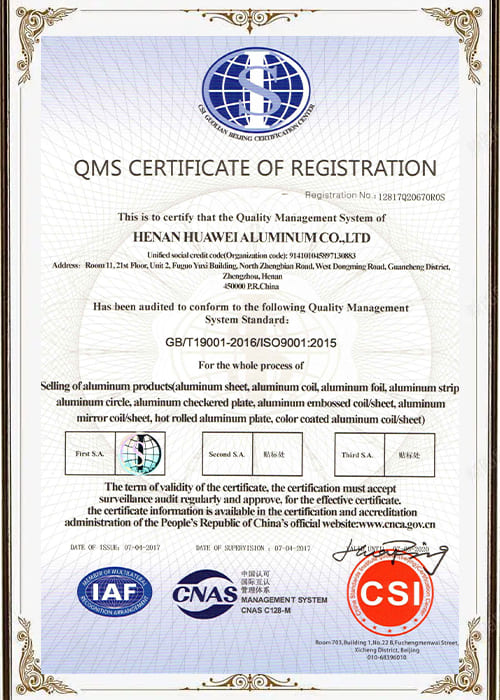
Its products have been exported to more than 70 countries, serving customers across different industrial markets.
The company supports export orders through product communication, specification confirmation, packaging coordination, and shipping arrangements.
For overseas buyers, clear communication about product specifications, inspection requirements, delivery schedules, and packaging helps reduce procurement risks.
11.4 Common Trade Terms Partnering With Huawei
| Term | Supplier handles | Buyer handles | Best for |
|---|---|---|---|
| FOB | Export clearance and delivery on board | Main freight, insurance, import | Buyers with own logistics |
| CIF | Freight and insurance to destination port | Import clearance and onward | Simpler port-to-port buying |
| DDP | Transport, duties and clearance to door | Receipt at named place | Hands-off delivered pricing |
12. Conclusion
3003 H22 aluminum diamond plate combines the lightweight characteristics of aluminum with the practical benefits of a raised tread pattern.
Its good corrosion resistance, moderate strength, and formability make it suitable for industrial flooring, vehicle components, steps, ramps, equipment covers, and other general-purpose applications.
When selecting this material, buyers should consider more than the alloy designation.
Base-metal thickness, pattern height, sheet dimensions, mechanical properties, surface finish, and operating conditions all influence product performance.
Compared with other aluminum alloys, 3003 H22 offers a practical balance of strength, workability, and cost.
For applications requiring higher strength or more demanding corrosion resistance, alternatives such as 5052 H32 or 6061 T6 may be worth evaluating.
Working with an experienced aluminum supplier also helps buyers confirm material specifications, processing requirements, quality documentation, and delivery arrangements.
Huawei Aluminum provides a range of aluminum products and customized processing solutions to support different industrial purchasing needs.
FAQs
1. What is 3003 H22 aluminum diamond plate?
It is a manganese-alloy aluminum tread plate with a raised diamond pattern. It combines moderate strength, good corrosion resistance, and a textured surface for improved traction.
2. What does H22 temper mean?
H22 indicates that the aluminum has undergone strain hardening followed by partial annealing. This temper provides a balance of strength and formability.
3. Is 3003 H22 aluminum diamond plate corrosion-resistant?
Yes. It offers good resistance to corrosion in normal atmospheric conditions, making it suitable for many indoor and outdoor applications. More aggressive environments may require a different alloy.
4. What thicknesses are available?
Common commercial thicknesses are approximately 1.1–6.35 mm. Custom thicknesses and dimensions may be available depending on the supplier.
5. Can 3003 H22 diamond plate be bent and welded?
Yes. It supports common fabrication processes, including cutting, bending, and welding. Proper tooling and welding procedures help maintain the finished product’s quality.
6. How does 3003 H22 compare with 5052 H32?
3003 H22 offers good formability and general-purpose corrosion resistance. 5052 H32 provides higher strength and better performance in demanding environments, including many marine applications.
7. What is the difference between base thickness and overall thickness?
Base thickness measures the aluminum sheet without the raised pattern. Overall thickness includes the raised diamonds. Buyers should confirm which measurement the supplier uses.
8. Which standards apply to 3003 H22 aluminum diamond plate?
ASTM B209 is commonly specified for aluminum sheet and plate. EN 573 and EN 485 series may also apply to alloy composition, mechanical properties, and dimensional requirements.
Casting production process and its introduction
The purpose of melting and casting is to produce alloys with satisfactory composition and high purity of melt, so as to create favorable conditions for casting alloys of various shapes.
Melting and casting process steps: batching --- feeding --- melting --- stirring after melting, slag removal --- pre-analysis sampling --- adding alloy to adjust the composition, stirring --- refining --- static Setting——Guide furnace casting.
Hot rolling production process and its introduction
- 1. Hot rolling generally refers to rolling above the metal recrystallization temperature;
- 2. During the hot rolling process, the metal has both hardening and softening processes. Due to the influence of deformation speed, as long as the recovery and recrystallization process is too late, there will be a certain work hardening;
- 3. The recrystallization of the metal after hot rolling is incomplete, that is, the coexistence of recrystallized structure and deformed structure;
- 4. Hot rolling can improve the processing performance of metals and alloys, reduce or eliminate casting defects.
- 1. The casting and rolling temperature is generally between 680°C and 700°C. The lower the better, the stable casting and rolling line usually stops once a month or more to re-stand. During the production process, it is necessary to strictly control the liquid level of the front tank to prevent low liquid level;
- 2. Lubrication uses C powder with incomplete combustion of gas for lubrication, which is also one of the reasons for the dirty surface of casting and rolling materials;
- 3. The production speed is generally between 1.5m/min-2.5m/min;
- 4. The surface quality of products produced by casting and rolling is generally relatively low, and generally cannot meet products with special physical and chemical performance requirements.
- 1. Cold rolling refers to the rolling production method below the recrystallization temperature;
- 2. There will be no dynamic recrystallization during the rolling process, and the temperature will rise to the recovery temperature at most, and the cold rolling will appear in a work hardening state, and the work hardening rate will be large;
- 3. The cold-rolled sheet and strip have high dimensional accuracy, good surface quality, uniform structure and performance, and products in various states can be obtained with heat treatment;
- 4. Cold rolling can roll out thin strips, but at the same time, it has the disadvantages of high energy consumption for deformation and many processing passes.
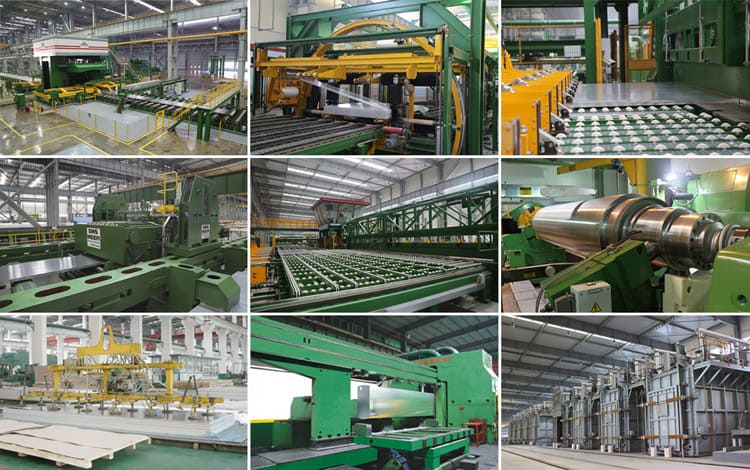
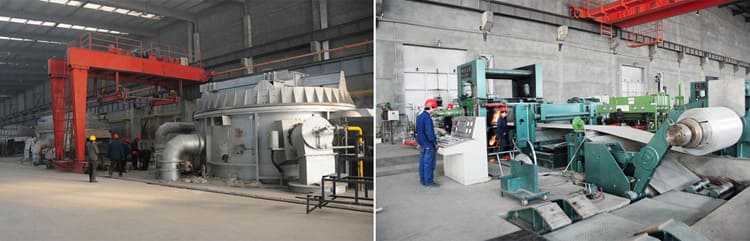
- 1. Finishing is a processing method to make the cold-rolled sheet meet the customer's requirements, or to facilitate the subsequent processing of the product;
- 2. The finishing equipment can correct the defects produced in the hot rolling and cold rolling production process, such as cracked edge, oily, poor plate shape, residual stress, etc. It needs to ensure that no other defects are brought into the production process;
- 3. There are various finishing equipments, mainly including cross-cutting, slitting, stretching and straightening, annealing furnace, slitter, etc.
Casting and rolling process
Casting and rolling process: liquid metal, front box (liquid level control), casting and rolling machine (lubrication system, cooling water), shearing machine, coiling machine.
Cold rolling production process
Introduction to finishing production process
Aluminum alloy has the characteristics of low density, good mechanical properties, good processing performance, non-toxic, easy to recycle, excellent electrical conductivity, heat transfer and corrosion resistance, so it has a wide range of applications.
Aerospace: used to make aircraft skins, fuselage frames, girders, rotors, propellers, fuel tanks, wall panels and landing gear struts, as well as rocket forging rings, spacecraft wall panels, etc.

Aluminum alloy used for aerospace
Transportation: used for car body structure materials of automobiles, subway vehicles, railway passenger cars, high-speed passenger cars, doors and windows, shelves, automotive engine parts, air conditioners, radiators, body panels, wheels and ship materials.

Traffic application
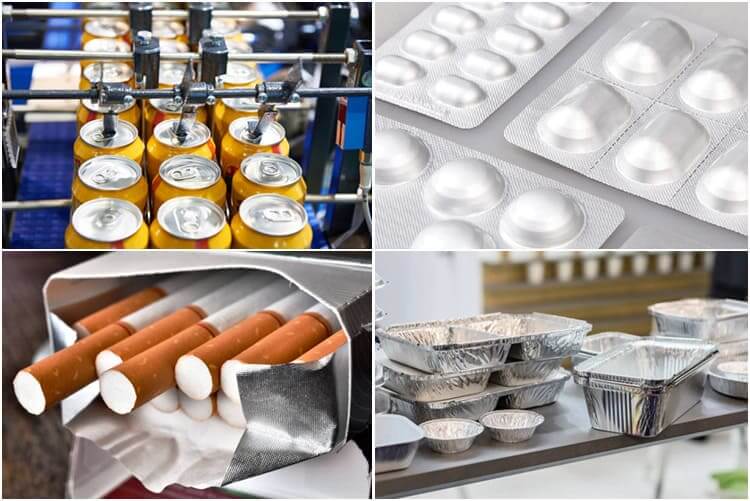
Packaging: All-aluminum pop cans are mainly used as metal packaging materials in the form of thin plates and foils, and are made into cans, lids, bottles, barrels, and packaging foils. Widely used in the packaging of beverages, food, cosmetics, medicines, cigarettes, industrial products, medicines, etc.
Packaging application
Printing: Mainly used to make PS plates, aluminum-based PS plates are a new type of material in the printing industry, used for automatic plate making and printing.
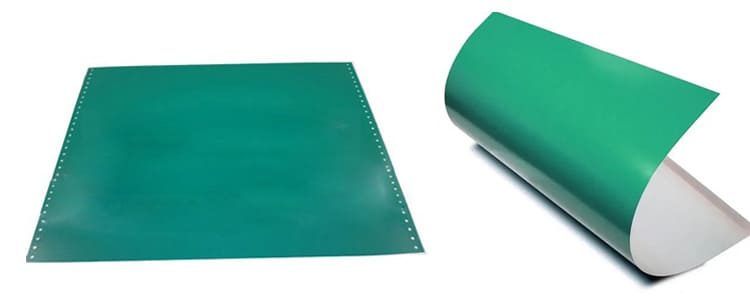
PS printing
Architectural decoration: aluminum alloy is widely used in building structures, doors and windows, suspended ceilings, decorative surfaces, etc. due to its good corrosion resistance, sufficient strength, excellent process performance and welding performance.
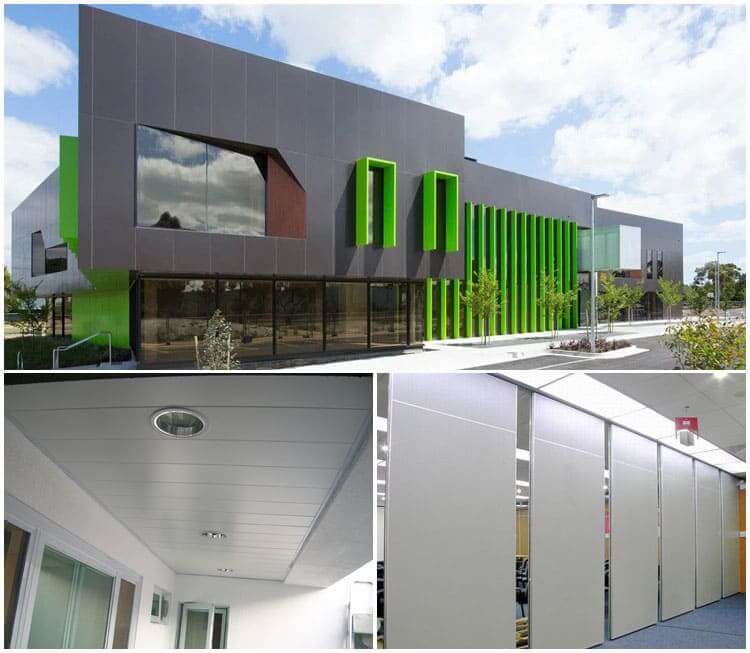
Aluminum alloy construction application
Electronic products: computers, mobile phones, refrigerator shells, radiators, etc.

Electronic product application
Kitchen supplies: aluminum pots, aluminum basins, rice cooker liners, household aluminum foil, etc.
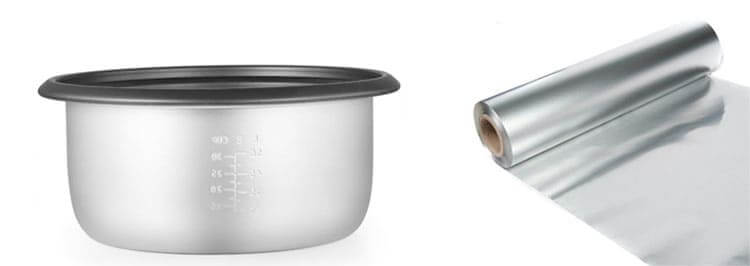
Kitchen application
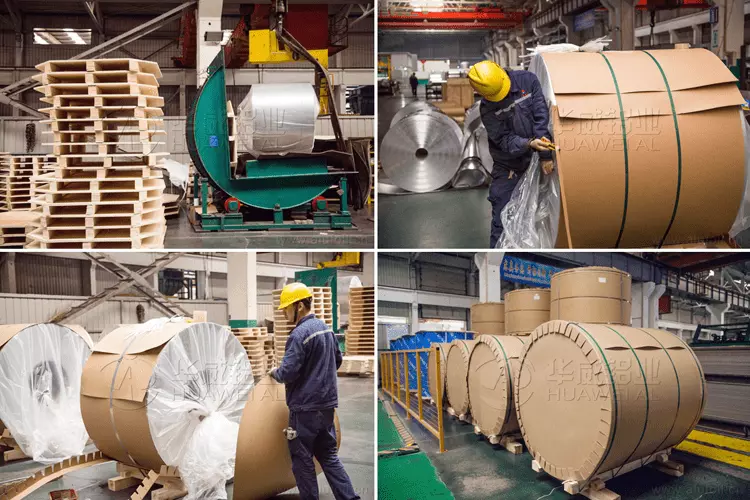
Packaging Of Aluminum Sheet/Coil
Every detail of packaging is where we pursue perfect service. Our packaging process as a whole is as follows:
Lamination: clear film, blue film, micro-mucosal, high-mucosal, laser cutting film (2 brands, Novacell and Polyphem);
Protection: paper corner protectors, anti-pressure pads;
drying: desiccant;
Tray: fumigated harmless wooden tray, reusable iron tray;
Packing: Tic-tac-toe steel belt, or PVC packing belt;
Material Quality: Completely free from defects such as white rust, oil spots, rolling marks, edge damage, bends, dents, holes, break lines, scratches, etc., no coil set.
Port: Qingdao or other ports in China.
Lead time: 15-45 days.
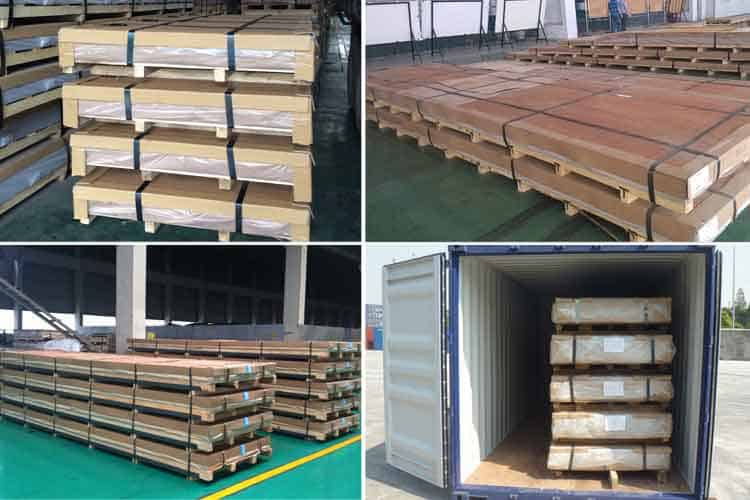
Aluminum sheet/plate packaging process
Aluminum coil packaging process
F: Are you a manufacturer or a trader?
Q: We are a manufacturer, our factory is at No.3 Weier Road, Industrial Zone, Gongyi, Henan, China.
F: What is the MOQ for ordering the product?
Q: Our MOQ is 5 tons, and some special products will have a minimum order quantity of 1 or 2 tons.
F: How long is your lead time?
Q: Generally our lead time is about 30 days.
F: Do your products have quality assurance?
Q: Yes, if there is a quality problem with our products, we will compensate the customer until they are satisfied.
Related Products


Latest Blogs
5052 vs 6061 Aluminum: Key Differences & Best Uses
Compare 5052 vs 6061 aluminum for strength, corrosion resistance, formability, and machining. Discover which alloy best fits your project.
Common Alloys of Reefer Truck Used PE Coated Aluminum Coil
Discover common alloys of reefer truck used PE coated aluminum coil, including 3003, 3004, and 3105. Designed for excellent corrosion resistance, formability, and long-lasting outdoor performance.
Is Aluminum Conductive? Properties, Uses & Benefits Explained
Is aluminum conductive? Discover aluminum's electrical conductivity, key advantages, and why it is widely used in power transmission and industrial applications.
Unlocking Sustainability: The Truth About Aluminum Foil Recycling
Is Aluminum Foil Recyclable? Learn how aluminum foil can be recycled, how to prepare it properly, and why recycling helps reduce waste and save resources.