1. Introduction
Titanium cookware has moved from a niche camping product to a visible category in home kitchens.
Consumers are looking for lightweight pots and pans, uncoated cooking surfaces, and materials that last. Pure titanium fits all three.
Every titanium pot or pan starts as a flat round blank, called a disc or circle. The quality of this disc decides how well the cookware can be formed, how clean its surface looks, and how consistent each batch will be.
Cracks, uneven thickness, or a contaminated surface that appear at the disc stage become expensive scrap later in deep drawing or spinning.
TA1 is the most common titanium grade chosen for this purpose. It is the softest and most formable of the commercially pure grades, and it offers excellent corrosion resistance and good food-contact suitability.
For cookware manufacturers, however, choosing a disc is more complicated than choosing a grade name.
Thickness tolerance, annealed condition, edge quality, surface finish, and material traceability all affect production yield and final product quality.
Marketing claims in the titanium cookware market are also often exaggerated, which makes careful specification even more important.
TA1 Titanium Disc for Cookware
2. What Is a TA1 Titanium Disc for Cookware?
2.1 Definition of TA1 Titanium
TA1 is a commercially pure titanium grade defined under China’s titanium material standards.
It contains a very high proportion of titanium, while controlling small amounts of elements such as iron, oxygen, nitrogen, carbon, and hydrogen.
Unlike titanium alloys that use elements such as aluminum and vanadium to increase strength, TA1 relies primarily on titanium purity and controlled interstitial content to achieve its characteristic properties.
TA1 is particularly valued for its combination of:
- High corrosion resistance in many environments
- Good ductility and cold-forming capability
- Relatively low density
- Good weldability under suitable conditions
- Stable surface behavior due to its natural oxide film
These characteristics make TA1 a candidate material for cookware components that require corrosion resistance, lightweight construction, and forming flexibility.
2.2 What Is a TA1 Titanium Disc?
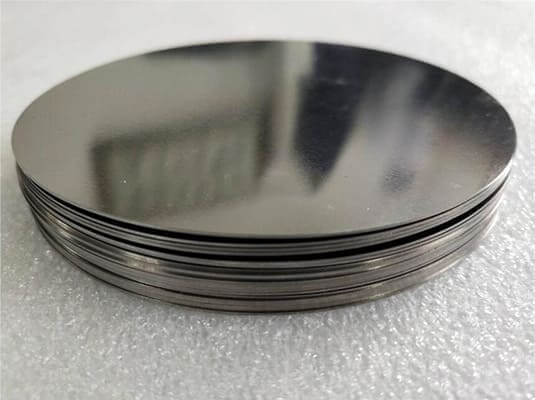
A TA1 titanium disc is a circular flat blank manufactured from TA1 titanium sheet or plate.
Manufacturers cut the material into the required diameter and thickness before using it in downstream forming operations.
The disc serves as the starting material for producing cookware shapes.
Depending on the product design and manufacturing process, manufacturers can use stamping, deep drawing, hydraulic pressing, or metal spinning to form the blank into a pan body, pot body, bowl, or other component.
2.3 Chemical Composition of TA1 Titanium
The chemical composition of TA1 determines its purity, mechanical behavior, and corrosion performance.
Oxygen and iron are particularly important because their content can influence strength and ductility.
The following table presents commonly referenced TA1 composition limits.
Buyers should verify the exact values against the applicable edition of GB/T 3620.1 or the material standard stated in the purchase order.
| Element | Composition Limit (wt.%) |
|---|---|
| Titanium (Ti) | Balance |
| Iron (Fe) | ≤0.20 |
| Oxygen (O) | ≤0.18 |
| Carbon (C) | ≤0.08 |
| Nitrogen (N) | ≤0.03 |
| Hydrogen (H) | ≤0.015 |
3. Key Properties and Advantages of TA1 Titanium Disc for Cookware
TA1 titanium offers a useful combination of corrosion resistance, low density, and good ductility.
These properties make it suitable for cookware components that require lightweight construction, durability, and reliable forming performance.
3.1 Excellent Corrosion Resistance
TA1 titanium naturally forms a stable oxide film on its surface, protecting the underlying metal from corrosion.
It performs well in many food-related environments, including exposure to water, salt, and common acidic ingredients.
Key benefits include:
- Good resistance to corrosion during daily cooking and cleaning.
- Stable surface performance over long-term use.
- Reduced risk of rust and material degradation.
3.2 Lightweight and Durable
With a density of approximately 4.51 g/cm³, TA1 titanium is much lighter than stainless steel and copper.
Its favorable strength-to-weight ratio makes it suitable for lightweight frying pans, cooking pots, and outdoor cookware.
Manufacturers can use TA1 titanium to reduce product weight while maintaining suitable structural strength through proper thickness and design selection.
3.3 Good Ductility and Formability
TA1 is a commercially pure titanium grade with good ductility and elongation. It can undergo several forming processes, including:
- Stamping and pressing
- Deep drawing under suitable conditions
- Metal spinning
- Hydraulic forming
Its formability supports the production of different cookware shapes.
However, manufacturers should consider springback, tooling design, lubrication, and forming conditions when processing titanium discs.
3.4 High Temperature Resistance
TA1 titanium has a melting point of approximately 1,668°C, allowing it to withstand temperatures far above normal cookware operating conditions.
However, titanium has relatively low thermal conductivity compared with aluminum and copper.
Therefore, pure titanium cookware may distribute heat less evenly. Manufacturers often consider multilayer structures with aluminum or other conductive materials to improve heating performance.
3.5 Stable Surface and Food-Contact Potential
The natural oxide film helps maintain titanium’s surface stability and corrosion resistance.
TA1 can also receive polished, brushed, or other surface finishes to meet different cookware design requirements.
For food-contact applications, manufacturers should verify the compliance of the finished cookware, including surface treatments, coatings, and joining materials, with relevant market regulations.
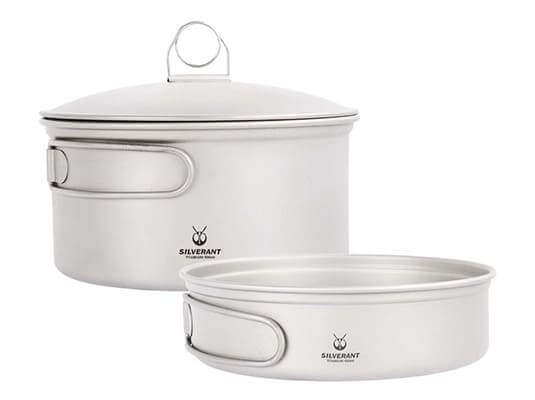
Different Types of Titanium Cookware
4. Specifications of TA1 Titanium Disc for Cookware
The specifications of a TA1 titanium disc directly affect its suitability for cookware manufacturing.
Buyers should define the material grade, thickness, diameter, delivery condition, surface finish, and dimensional tolerances according to the final product design.
Unlike standard off-the-shelf metal circles, industrial titanium discs are often produced to customer drawings or customized dimensions.
4.1 Core Specifications of TA1 Titanium Disc
| Parameter | Specification |
|---|---|
| Material Grade | TA1 (Commercially Pure Titanium Grade 1) |
| Titanium Content | Balance |
| Density | 4.51 g/cm³ |
| Thickness | 0.5–10 mm (customized) |
| Diameter | 50–1,000 mm (customized) |
| Delivery Condition | Annealed (M), or as agreed |
| Tensile Strength | ≥240 MPa (Grade 1 reference) |
| Yield Strength (0.2%) | ≥138 MPa (Grade 1 reference) |
| Elongation | ≥24% (Grade 1 reference) |
| Surface Finish | Hot-Rolled, Cold-Rolled, Pickled, Polished, Brushed |
| Cutting Method | Mechanical Blanking, Laser Cutting, Waterjet Cutting |
| Edge Condition | As-Cut, Deburred, or Customized |
| Applicable Standards | GB/T 3621, ASTM B265 |
| Inspection | Chemical Composition, Mechanical Properties, Dimensions, Surface Quality |
| Certification | Mill Test Certificate (MTC) |
| Packaging | Protective Film, Interleaving, Wooden Cases or Pallets |
Note: Thickness and diameter ranges are indicative customization ranges, not guaranteed standard stock sizes.
Mechanical properties should be confirmed against the applicable standard, product thickness, and delivery condition.
GB/T 3621 and ASTM B265 cover titanium flat products; the finished disc’s dimensions and tolerances should be agreed separately.
5. Manufacturing Process of TA1 Titanium Discs for Cookware
The production of TA1 titanium discs involves several controlled processes to ensure consistent material quality, dimensional accuracy, and surface finish.
A typical manufacturing process includes the following steps.
5.1 Raw Material Preparation and Melting
Manufacturers select qualified titanium raw materials and control the content of iron, oxygen, carbon, nitrogen, and hydrogen to meet TA1 requirements.
The material then undergoes vacuum melting, such as vacuum arc remelting (VAR), to produce titanium ingots with consistent chemical composition and internal quality.
5.2 Hot Rolling and Cold Rolling
Titanium ingots are processed into slabs and sheets through hot rolling and cold rolling.
- Hot rolling: Reduces material thickness and produces titanium sheet or plate.
- Cold rolling: Improves thickness accuracy, surface quality, and dimensional consistency.
- Intermediate annealing: Restores ductility when necessary during repeated rolling.
These processes establish the material properties required for subsequent cookware forming.
5.3 Annealing and Pickling
Annealing reduces work hardening and improves ductility, making the titanium material more suitable for stamping, drawing, and spinning.
Pickling removes surface oxide and scale, providing a cleaner surface for further processing.
5.4 Disc Cutting and Blanking
Manufacturers cut titanium sheets or plates into circular blanks according to customer specifications.
Common cutting methods include:
- Mechanical blanking for repeat production.
- Laser cutting for flexible dimensions and customized designs.
- Waterjet cutting for heat-free cutting applications.
The cutting method depends on material thickness, production volume, dimensional tolerance, and edge-quality requirements.
5.5 Surface Finishing and Edge Processing
After cutting, manufacturers can apply pickling, polishing, or brushing to achieve the required surface appearance. Deburring removes sharp edges and cutting defects.
Proper cleaning and surface treatment help improve appearance and reduce defects during cookware forming.
5.6 Final Inspection and Packaging
Before delivery, manufacturers inspect disc thickness, diameter, flatness, edge quality, and surface condition.
Chemical composition and mechanical properties should also meet the agreed material standard.
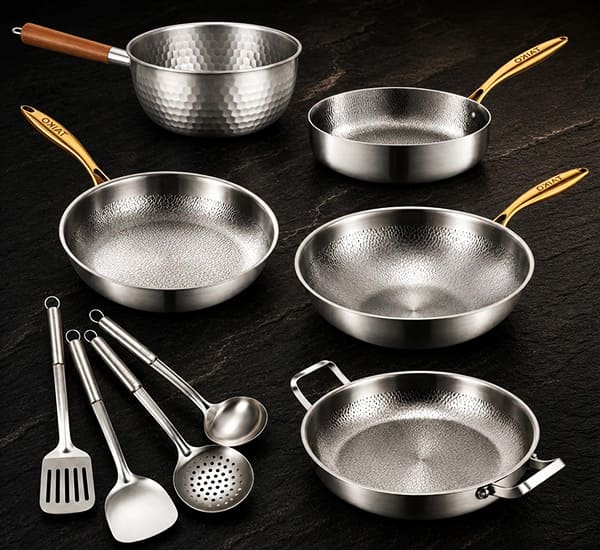
Titanium Frying Pans Display
6. Applications of TA1 Titanium Discs in Cookware Manufacturing
TA1 titanium discs provide a lightweight, corrosion-resistant starting material for various cookware and kitchenware components.
Their good ductility supports forming operations, while their relatively low density helps manufacturers develop portable products.
However, cookware design must also account for titanium’s relatively low thermal conductivity.
For applications requiring more uniform heating, manufacturers may combine titanium with aluminum or other heat-conductive materials.
6.1 Titanium Frying Pans
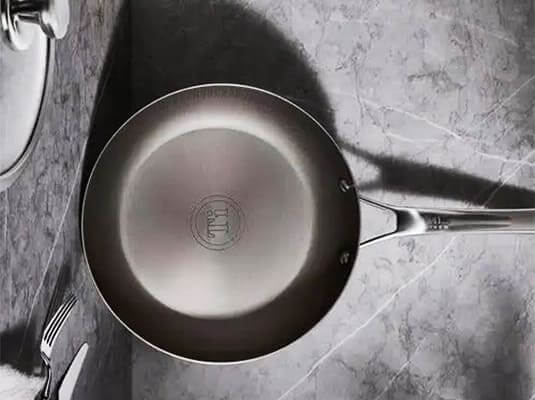
TA1 titanium discs can serve as blanks for forming frying pan bodies and selected pan components.
Their corrosion resistance supports repeated exposure to food ingredients and cleaning conditions.
In addition, titanium’s relatively low density helps reduce the weight of the finished pan.
Typical applications include:
- Lightweight titanium frying pans.
- Outdoor and camping frying pans.
- Specialty cookware with titanium food-contact surfaces.
- Titanium layers in composite frying pans.
6.2 Titanium Cooking Pots and Saucepan Components
Manufacturers can use TA1 titanium discs to produce cooking pot bodies, saucepan components, and other circular kitchenware parts.
TA1’s ductility supports pressing and drawing processes, while its corrosion resistance helps maintain material stability during repeated cooking and washing.
Typical applications include:
- Titanium cooking pots.
- Saucepan bodies and components.
- Lightweight boiling pots.
- Specialized food preparation vessels.
6.3 Titanium Camping and Outdoor Cookware
Lightweight construction makes TA1 titanium particularly attractive for portable cookware.
Camping and outdoor products often prioritize low weight, corrosion resistance, and easy maintenance.
Titanium discs can be formed into compact cookware products without adding unnecessary material weight.
Typical applications include:
- Camping pots and pans.
- Titanium bowls and cups.
- Portable cooking containers.
- Lightweight outdoor kitchenware.
Outdoor Titanium Cookware
6.4 Titanium Bowls and Food Containers
TA1 titanium discs can also serve as starting blanks for bowls, food containers, and other circular kitchenware.
Their corrosion resistance and stable oxide surface make them suitable candidates for products that repeatedly contact food and water.
Common applications include:
- Titanium mixing bowls.
- Food storage containers.
- Serving bowls.
- Lightweight kitchenware for outdoor use.
6.5 Multilayer and Composite Cookware
Titanium’s corrosion resistance and low density can complement the thermal properties of other cookware materials.
For example, manufacturers may combine titanium with aluminum to improve heat distribution while retaining a titanium surface or structural layer.
Typical constructions include:
- Titanium and aluminum multilayer cookware.
- Titanium-clad cookware structures.
- Composite pan bases with a conductive aluminum core.
- Customized cookware combining different metal layers.
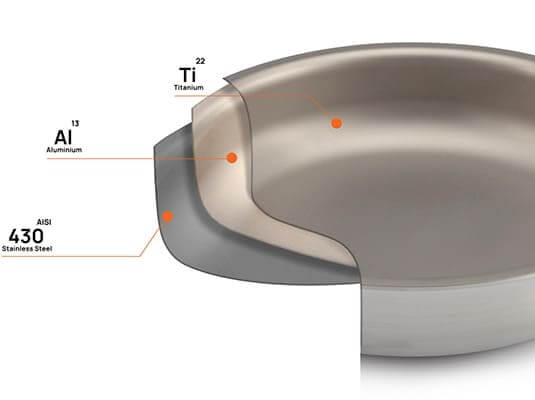
Titanium Alloy Composite Cookware
7. Quality Control and Inspection Standards for TA1 Titanium Discs
Titanium is costly and failure often appears late, during or after forming. Strong quality control and clear documents protect both the buyer and the supplier.
7.1 Incoming material control
- Sheet or coil is checked against its mill certificate on receipt.
- Chemical composition, including oxygen, nitrogen, hydrogen, carbon, and iron, is verified.
- Each lot is recorded for traceability.
7.2 In-process control
| Stage | Control Points |
|---|---|
| Rolling | Thickness gauge, flatness |
| Annealing | Atmosphere and temperature records, property uniformity |
| Pickling | Surface condition, residual scale |
| Cutting | Diameter, edge condition, burr height |
| Cleaning | Residue and cleanliness check |
7.3 Finished disc tests
| Test | Purpose | Typical Method |
|---|---|---|
| Chemical composition | Confirm TA1 limits | Spectrometry and gas analysis (O, N, H) |
| Tensile strength, yield, elongation | Verify annealed properties | Tensile testing |
| Hardness | Check temper and uniformity | Hardness tester |
| Formability | Predict deep-drawing behavior | Cupping (Erichsen) test, bend test |
| Thickness | Confirm gauge and uniformity | Micrometer or thickness gauge |
| Diameter and roundness | Fit forming tools | Calipers, measuring fixtures |
| Flatness | Prevent feeding and wrinkling issues | Flatness gauge or table |
| Surface and edge | Detect scratches, stains, burrs, cracks | Visual and magnified inspection |
7.4 Certificates and documents
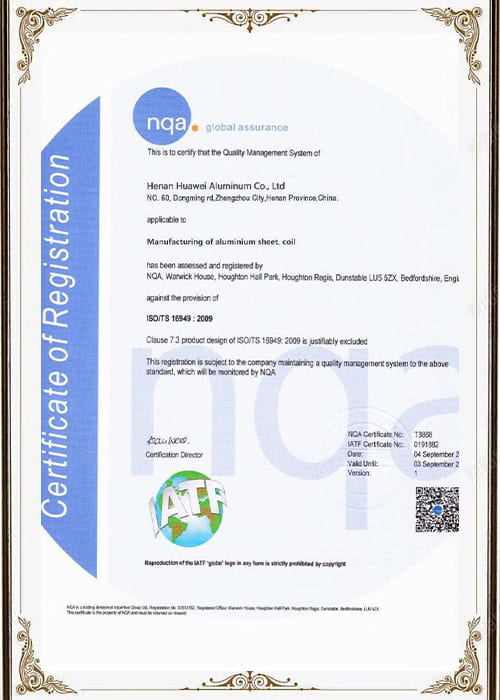
- Mill test certificate (MTC): typically EN 10204 3.1, listing chemistry and mechanical results by heat or lot
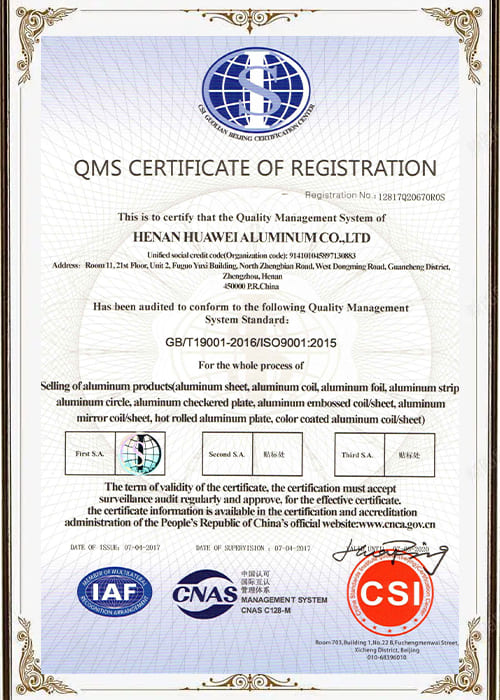
- Quality system: ISO 9001, only if actually held
- Third-party inspection: SGS, BV, or similar, on buyer request
- Traceability record: linking discs to sheet, heat number, and production batch
8. TA1 Titanium Disc vs. Other Materials for Cookware
Choosing the right cookware material requires balancing weight, strength, corrosion resistance, thermal conductivity, formability, and cost.
8.1 Quick comparison
| Property | TA1 Titanium | 304 Stainless Steel | Aluminum 1050 | Aluminum 3003 | Cast Iron |
|---|---|---|---|---|---|
| Density (g/cm³) | about 4.5 | about 7.9 | about 2.71 | about 2.73 | about 7.2 |
| Weight (same size) | Light | Heavy | Lightest | Lightest | Very heavy |
| Corrosion resistance | Excellent | Very good | Good (reacts with acids unless anodized or coated) | Good (slightly lower than 1050; same acid caution) | Poor (rusts, needs seasoning) |
| Thermal conductivity (W/m·K) | about 16–22 | about 15–16 | about 230 | about 190 | about 50 |
| Heat distribution | Poor alone | Poor alone | Excellent | Very good | Good, slow |
| Strength and durability | Excellent | Excellent | Low (soft, dents easily) | Moderate (firmer than 1050) | Excellent |
| Formability (deep drawing) | Good, needs careful tooling | Good | Excellent | Very good | Not formed (cast) |
| Relative material cost | High | Medium | Low | Low | Low |
| Typical use | Camping, light cookware | General cookware | Pots and pans where maximum heat spread is wanted | General cookware, frying pans, pots, composite bases | Skillets, Dutch ovens |
Values are general references and vary by temper and product design. 1060 is a close alternative to 1050, and the two are often interchangeable in cookware circles.
9. How to Choose the Right TA1 Titanium Disc for Cookware
Choosing the right TA1 titanium disc helps ensure smooth forming, consistent product quality, and reliable cookware performance. Buyers should focus on the following key factors.
9.1 Confirm Material Grade and Standards
Verify that the titanium disc meets the required TA1 chemical composition and material standard.
Common references include GB/T 3621 and ASTM B265. Since TA1 and ASTM Grade 1 are not automatically interchangeable, check the chemical composition, mechanical properties, and material test certificate before ordering.
9.2 Select the Right Thickness and Diameter
Choose disc dimensions according to the cookware design and forming process.
- Thickness: Consider cookware size, forming depth, strength, and target weight.
- Diameter: Match the blank size to the finished cookware dimensions and forming allowance.
- Tolerance: Specify thickness, diameter, and flatness requirements.
- Edge Condition: Select as-cut or deburred edges according to subsequent processing needs.
9.3 Consider Heat Transfer and Cookware Structure
TA1 titanium offers good corrosion resistance, but its thermal conductivity is relatively low compared with aluminum and copper.
For better heat distribution, manufacturers can consider multilayer cookware structures that combine titanium with an aluminum or copper core.
9.4 Choose a Reliable Supplier
A qualified supplier should provide consistent material quality, technical documentation, and customized dimensions. Before purchasing, check:
- Chemical composition and mechanical test reports.
- Dimensional and surface inspection records.
- Material traceability and mill test certificates.
- Customized thickness, diameter, and cutting services.
- Protective packaging and delivery arrangements.
For large orders, requesting samples and conducting forming trials can help verify material suitability before mass production.
10. Customized TA1 Titanium Disc for Cookware and Aluminum Disc Solutions from Huawei Aluminum
Henan Huawei Aluminum Co., Ltd. was established in 2001 and has more than 20 years of experience in aluminum manufacturing and sales.
The company exports products to customers in 72 countries and specializes in aluminum sheets, plates, coils, foil, strips, circles, and embossed sheets.
For cookware manufacturers looking for TA1 Titanium Disc products, material specifications and supply capabilities are important considerations.
TA1 titanium offers corrosion resistance, low density, and good formability, making it suitable for various cookware applications.
10.1 TA1 Titanium Disc Supply and Customization Requirements
A customized TA1 Titanium Disc should match the cookware design and forming process.
Buyers can specify the following requirements when discussing a titanium disc project:
| Parameter | Requirements |
|---|---|
| Material Grade | TA1 |
| Thickness | Customized according to application |
| Diameter | Customized according to cookware design |
| Delivery Condition | Annealed or as agreed |
| Surface Finish | Hot-Rolled, Cold-Rolled, Pickled, Polished, or Brushed |
| Cutting Method | Mechanical Blanking, Laser Cutting, or Waterjet Cutting |
| Edge Condition | As-Cut or Deburred |
| Inspection | Chemical Composition, Mechanical Properties, Dimensions, and Surface Quality |
| Certification | Mill Test Certificate (MTC) |
Note: TA1 titanium sourcing and OEM processing availability should be confirmed directly with the supplier.
Huawei Aluminum primarily focuses on aluminum manufacturing and does not claim in-house TA1 titanium production.
10.2 Customized Aluminum Disc Solutions for Cookware
In addition to titanium cookware materials, Huawei Aluminum provides customized aluminum circles and discs for cookware manufacturing.
Aluminum offers excellent thermal conductivity, low density, and good formability, making it suitable for frying pans, cooking pots, and other kitchenware.
| Parameter | Customization Options |
|---|---|
| Aluminum Alloy | 1050, 1060, 3003, 3004, and other suitable grades |
| Temper | O, H12, H14, H16, H18, H24, or as required |
| Thickness | Customized |
| Diameter | Customized |
| Surface Finish | Mill Finish, Polished, Brushed, or other available finishes |
| Processing | Cutting, Embossing, Anodizing, and Color Coating |
| Packaging | Protective Film, Interleaving, Wooden Cases, or Pallets |
10.3 Contact Huawei Aluminum for Customized Cookware Discs
Whether you are evaluating TA1 Titanium Disc materials or sourcing customized aluminum discs, clearly defining the application, dimensions, material requirements, and order quantity helps suppliers provide a more suitable solution.
Contact Huawei Aluminum to discuss customized aluminum cookware discs, technical specifications, and material alternatives for your project.
11. Conclusion
TA1 titanium discs offer cookware manufacturers a combination of corrosion resistance, low density, and good formability.
They can serve as blanks for frying pans, cooking pots, bowls, and outdoor cookware.
However, buyers should consider titanium’s relatively low thermal conductivity when designing cookware structures.
The right disc depends on material specifications, thickness, diameter, mechanical properties, surface quality, and forming requirements.
Clear technical agreements, material certificates, and production trials help ensure consistent results.
For cookware manufacturers comparing titanium and aluminum, Huawei Aluminum can provide customized aluminum disc solutions and technical support based on specific product requirements.
FAQs
1. What is a TA1 titanium disc for cookware?
A TA1 titanium disc is a circular blank made from commercially pure titanium sheet or plate. Manufacturers use it to produce frying pans, cooking pots, bowls, and other cookware.
2. What are the main advantages of TA1 titanium?
TA1 titanium offers good corrosion resistance, low density, and good ductility. These properties make it suitable for cookware forming and applications requiring durability.
3. Is TA1 titanium equivalent to ASTM Grade 1?
Not automatically. Although both are commercially pure titanium grades, their chemical composition and mechanical requirements may differ. Always verify the applicable standards before purchasing.
4. What thickness and diameter are available?
Both dimensions can be customized according to cookware design and forming requirements. Buyers should confirm available sizes and tolerances with the supplier.
5. Can TA1 titanium discs be deep drawn?
Yes. TA1 has good ductility and supports deep drawing under suitable conditions. Tooling, lubrication, forming speed, and material thickness all affect the results.
6. What surface finishes are available?
Common finishes include hot-rolled, cold-rolled, pickled, polished, and brushed surfaces. The choice depends on appearance and processing requirements.
7. Is TA1 titanium suitable for food-contact cookware?
TA1 has a stable natural oxide film and good corrosion resistance. However, food-contact compliance must be evaluated for the complete finished cookware, including coatings, surface treatments, and joints.
8. Is TA1 titanium better than aluminum for cookware?
They offer different advantages. TA1 provides good corrosion resistance, while aluminum has much higher thermal conductivity and lower density. The best choice depends on heating performance, weight, cost, and product design.
9. What standards apply to TA1 titanium discs?
GB/T 3621 and ASTM B265 are commonly referenced for titanium flat products. Finished disc dimensions and cutting tolerances should be agreed upon separately.
10. Can Huawei Aluminum supply TA1 titanium discs?
Huawei Aluminum primarily specializes in aluminum products, including customized aluminum circles and discs for cookware. Customers interested in TA1 titanium discs should confirm titanium sourcing or OEM supply availability directly with the company.
Casting production process and its introduction
The purpose of melting and casting is to produce alloys with satisfactory composition and high purity of melt, so as to create favorable conditions for casting alloys of various shapes.
Melting and casting process steps: batching --- feeding --- melting --- stirring after melting, slag removal --- pre-analysis sampling --- adding alloy to adjust the composition, stirring --- refining --- static Setting——Guide furnace casting.
Hot rolling production process and its introduction
- 1. Hot rolling generally refers to rolling above the metal recrystallization temperature;
- 2. During the hot rolling process, the metal has both hardening and softening processes. Due to the influence of deformation speed, as long as the recovery and recrystallization process is too late, there will be a certain work hardening;
- 3. The recrystallization of the metal after hot rolling is incomplete, that is, the coexistence of recrystallized structure and deformed structure;
- 4. Hot rolling can improve the processing performance of metals and alloys, reduce or eliminate casting defects.
- 1. The casting and rolling temperature is generally between 680°C and 700°C. The lower the better, the stable casting and rolling line usually stops once a month or more to re-stand. During the production process, it is necessary to strictly control the liquid level of the front tank to prevent low liquid level;
- 2. Lubrication uses C powder with incomplete combustion of gas for lubrication, which is also one of the reasons for the dirty surface of casting and rolling materials;
- 3. The production speed is generally between 1.5m/min-2.5m/min;
- 4. The surface quality of products produced by casting and rolling is generally relatively low, and generally cannot meet products with special physical and chemical performance requirements.
- 1. Cold rolling refers to the rolling production method below the recrystallization temperature;
- 2. There will be no dynamic recrystallization during the rolling process, and the temperature will rise to the recovery temperature at most, and the cold rolling will appear in a work hardening state, and the work hardening rate will be large;
- 3. The cold-rolled sheet and strip have high dimensional accuracy, good surface quality, uniform structure and performance, and products in various states can be obtained with heat treatment;
- 4. Cold rolling can roll out thin strips, but at the same time, it has the disadvantages of high energy consumption for deformation and many processing passes.
- 1. Finishing is a processing method to make the cold-rolled sheet meet the customer's requirements, or to facilitate the subsequent processing of the product;
- 2. The finishing equipment can correct the defects produced in the hot rolling and cold rolling production process, such as cracked edge, oily, poor plate shape, residual stress, etc. It needs to ensure that no other defects are brought into the production process;
- 3. There are various finishing equipments, mainly including cross-cutting, slitting, stretching and straightening, annealing furnace, slitter, etc.
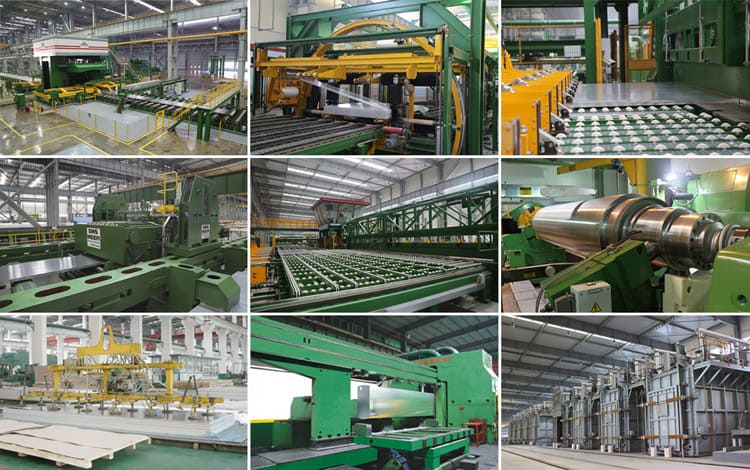
Casting and rolling process
Casting and rolling process: liquid metal, front box (liquid level control), casting and rolling machine (lubrication system, cooling water), shearing machine, coiling machine.
Cold rolling production process
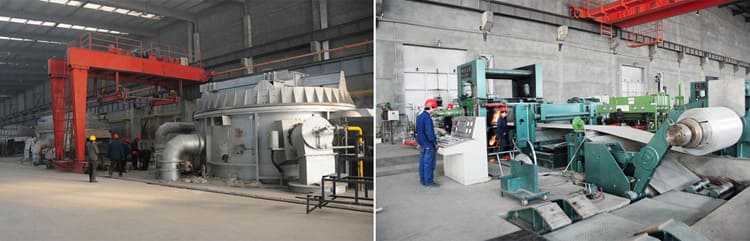
Introduction to finishing production process
Aluminum alloy has the characteristics of low density, good mechanical properties, good processing performance, non-toxic, easy to recycle, excellent electrical conductivity, heat transfer and corrosion resistance, so it has a wide range of applications.
Aerospace: used to make aircraft skins, fuselage frames, girders, rotors, propellers, fuel tanks, wall panels and landing gear struts, as well as rocket forging rings, spacecraft wall panels, etc.
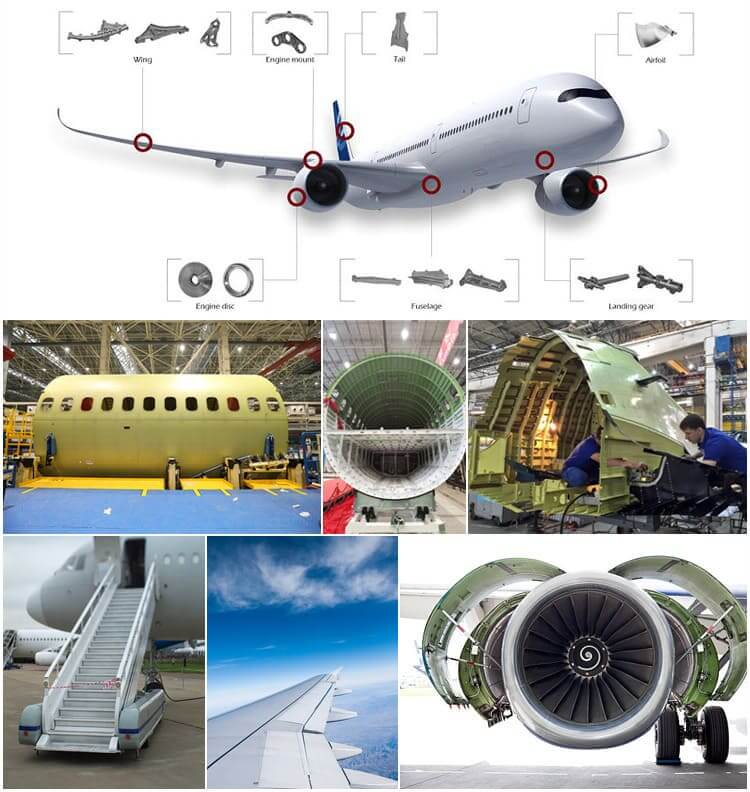
Aluminum alloy used for aerospace
Transportation: used for car body structure materials of automobiles, subway vehicles, railway passenger cars, high-speed passenger cars, doors and windows, shelves, automotive engine parts, air conditioners, radiators, body panels, wheels and ship materials.
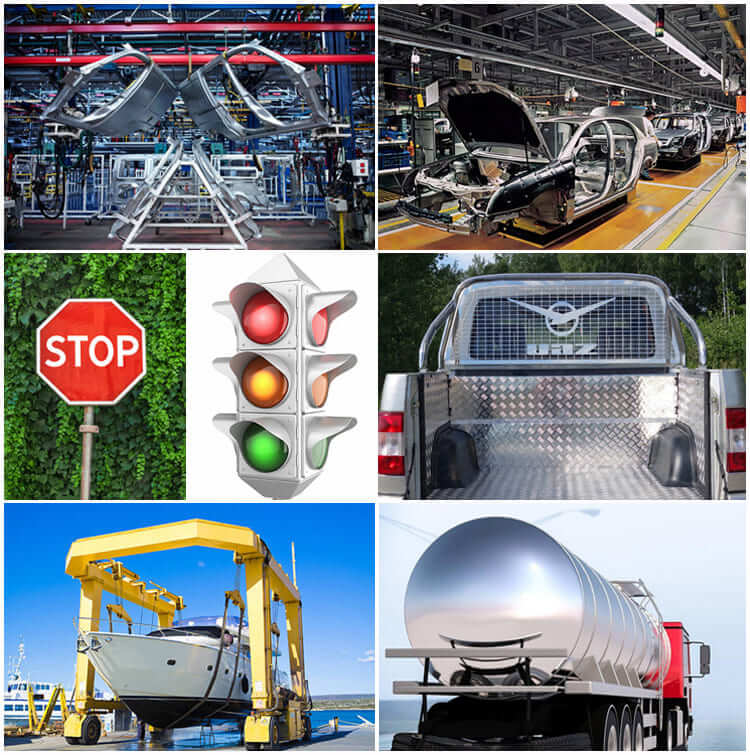
Traffic application
Packaging: All-aluminum pop cans are mainly used as metal packaging materials in the form of thin plates and foils, and are made into cans, lids, bottles, barrels, and packaging foils. Widely used in the packaging of beverages, food, cosmetics, medicines, cigarettes, industrial products, medicines, etc.
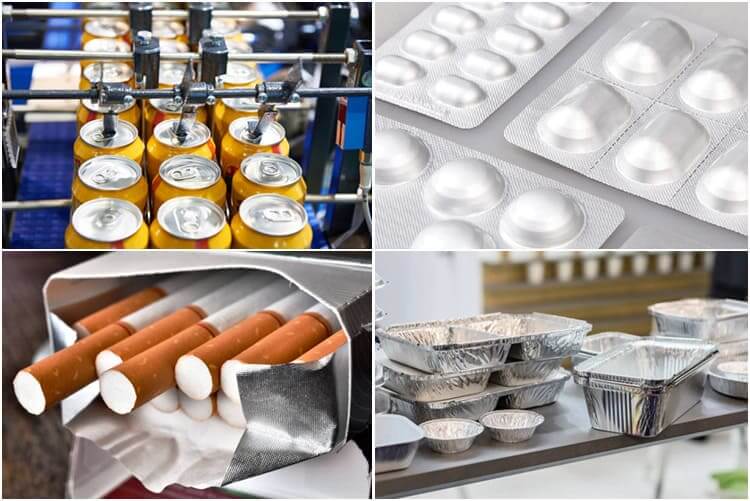
Packaging application
Printing: Mainly used to make PS plates, aluminum-based PS plates are a new type of material in the printing industry, used for automatic plate making and printing.
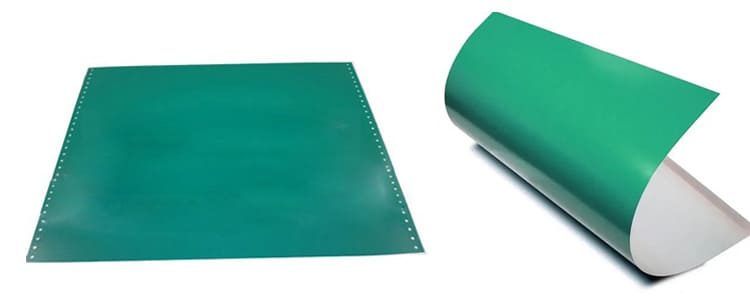
PS printing
Architectural decoration: aluminum alloy is widely used in building structures, doors and windows, suspended ceilings, decorative surfaces, etc. due to its good corrosion resistance, sufficient strength, excellent process performance and welding performance.

Aluminum alloy construction application
Electronic products: computers, mobile phones, refrigerator shells, radiators, etc.
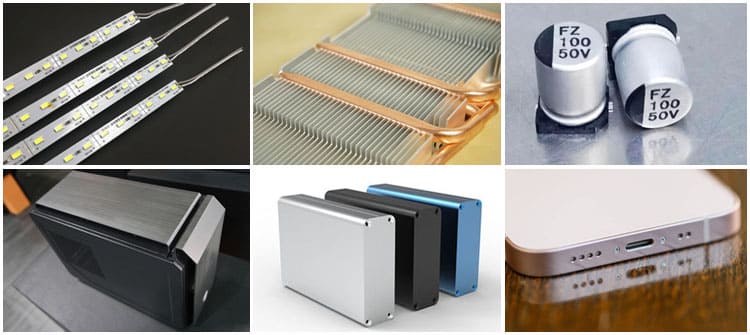
Electronic product application
Kitchen supplies: aluminum pots, aluminum basins, rice cooker liners, household aluminum foil, etc.
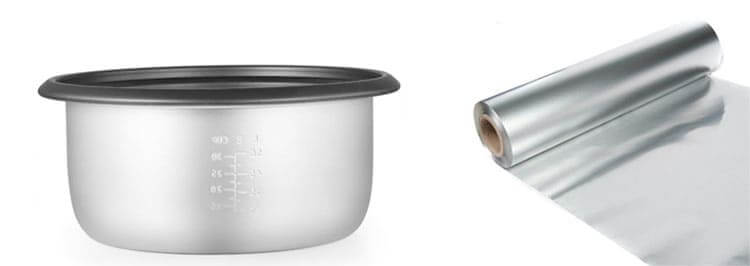
Kitchen application
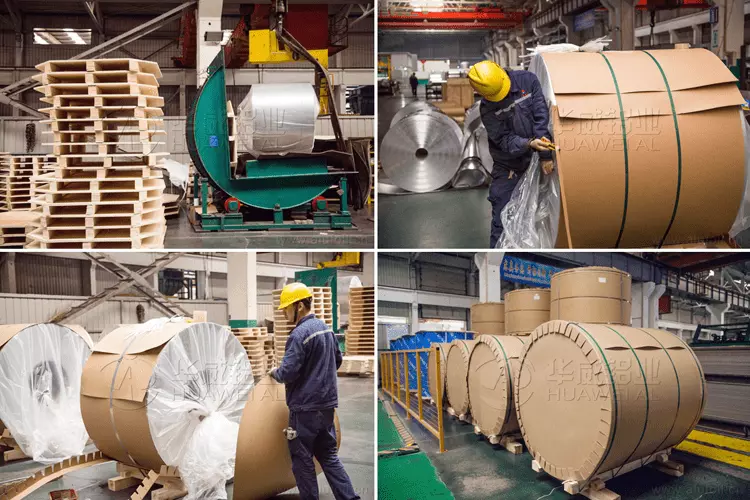
Packaging Of Aluminum Sheet/Coil
Every detail of packaging is where we pursue perfect service. Our packaging process as a whole is as follows:
Lamination: clear film, blue film, micro-mucosal, high-mucosal, laser cutting film (2 brands, Novacell and Polyphem);
Protection: paper corner protectors, anti-pressure pads;
drying: desiccant;
Tray: fumigated harmless wooden tray, reusable iron tray;
Packing: Tic-tac-toe steel belt, or PVC packing belt;
Material Quality: Completely free from defects such as white rust, oil spots, rolling marks, edge damage, bends, dents, holes, break lines, scratches, etc., no coil set.
Port: Qingdao or other ports in China.
Lead time: 15-45 days.
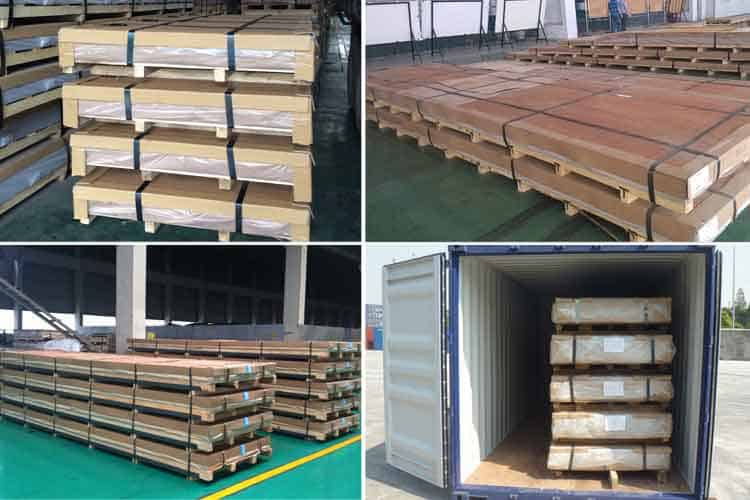
Aluminum sheet/plate packaging process
Aluminum coil packaging process
F: Are you a manufacturer or a trader?
Q: We are a manufacturer, our factory is at No.3 Weier Road, Industrial Zone, Gongyi, Henan, China.
F: What is the MOQ for ordering the product?
Q: Our MOQ is 5 tons, and some special products will have a minimum order quantity of 1 or 2 tons.
F: How long is your lead time?
Q: Generally our lead time is about 30 days.
F: Do your products have quality assurance?
Q: Yes, if there is a quality problem with our products, we will compensate the customer until they are satisfied.
Related Products


Latest Blogs
5052 vs 6061 Aluminum: Key Differences & Best Uses
Compare 5052 vs 6061 aluminum for strength, corrosion resistance, formability, and machining. Discover which alloy best fits your project.
Common Alloys of Reefer Truck Used PE Coated Aluminum Coil
Discover common alloys of reefer truck used PE coated aluminum coil, including 3003, 3004, and 3105. Designed for excellent corrosion resistance, formability, and long-lasting outdoor performance.
Is Aluminum Conductive? Properties, Uses & Benefits Explained
Is aluminum conductive? Discover aluminum's electrical conductivity, key advantages, and why it is widely used in power transmission and industrial applications.
Unlocking Sustainability: The Truth About Aluminum Foil Recycling
Is Aluminum Foil Recyclable? Learn how aluminum foil can be recycled, how to prepare it properly, and why recycling helps reduce waste and save resources.