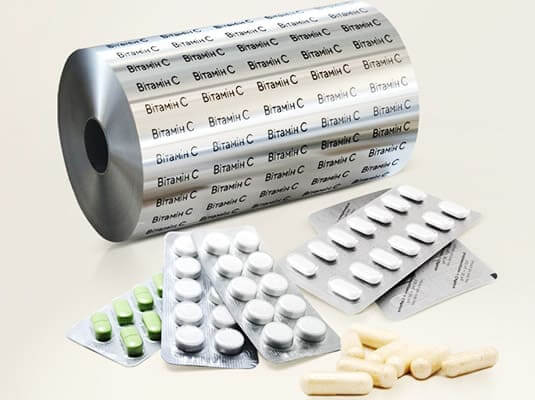
1. Introduction
20 Micron Aluminum Foil is a thin aluminum material with a nominal thickness of 20 micrometers (0.020 mm).
It offers a practical combination of flexibility, low weight, and barrier performance, making it suitable for selected flexible packaging and industrial applications.
Manufacturers use this foil in packaging structures, laminated materials, insulation facings, and other products where a thin metal layer provides useful protection or functional properties.
The exact application depends on the alloy, temper, surface condition, and any additional coating or laminate.
Thickness alone does not determine foil performance. Alloy composition, pinhole control, mechanical properties, surface cleanliness, and converting conditions all influence how the foil performs in the finished product.
For buyers, selecting the right 20 micron aluminum foil means matching the material specification to the intended use.
Food packaging, pharmaceutical packaging, and industrial applications may have different requirements for barrier integrity, coating compatibility, cleanliness, and processing performance.
Henan Huawei Aluminum Co., Ltd. supplies aluminum products for different industrial and packaging needs.
By specifying the intended application alongside the required thickness, alloy, temper, and roll dimensions, buyers can more effectively identify a suitable foil grade.
20 Micron Aluminum Foil
2. What Is 20 Micron Aluminum Foil?
2.1 Definition and Thickness Conversion
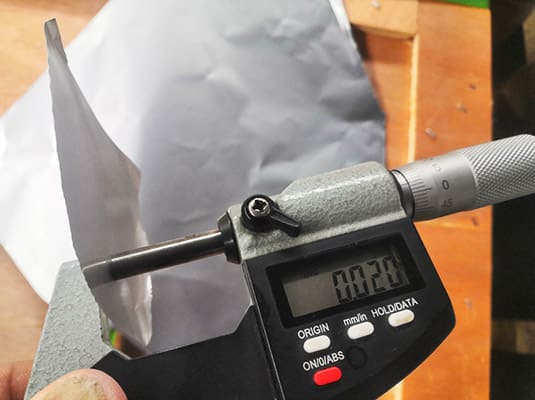
20 Micron Aluminum Foil refers to aluminum foil with a nominal thickness of 20 μm.
| Measurement | Equivalent Value |
|---|---|
| Micrometers | 20 μm |
| Millimeters | 0.020 mm |
| Meters | 0.000020 m |
| Inches | Approximately 0.000787 in |
One micron equals 0.001 millimeters. Therefore, 20 micron aluminum foil is 0.020 mm thick—not 0.20 mm.
At this gauge, the foil remains flexible and can be slit, rewound, printed, coated, or laminated when the alloy and temper suit the conversion process.
Actual handling performance also depends on tension control, equipment settings, and the requirements of the finished product.
2.2 Main Product Forms
20 micron aluminum foil is available in different forms according to the customer’s processing needs.
- Plain aluminum foil: An uncoated metal surface for applications that require aluminum itself as the functional layer.
- Coated aluminum foil: Foil with a surface coating, such as a primer, lacquer, or heat-seal coating, selected for a specific function.
- Printed aluminum foil: Foil with printed graphics or identification, subject to suitable surface preparation and ink compatibility.
- Laminated aluminum foil: Aluminum foil combined with paper, plastic film, or other materials to create a multilayer structure.
- Slit aluminum foil rolls: Narrow rolls produced to the widths required by packaging and industrial converting equipment.
These products are not interchangeable in every application.
For example, plain foil does not automatically provide heat-sealing capability; that function depends on the packaging design and compatible sealing materials.
Micrometer measurement 20 Micron Aluminum Foil
3. Key Specifications of 20 Micron Aluminum Foil
A good purchase order defines the foil by more than thickness. The tables below group the key parameters by theme, so you can check each one before placing an order.
All values are typical industry ranges. Actual capability varies by mill, so confirm against the supplier’s datasheet and mill certificate.
3.1 Dimensions and Weight
| Parameter | Typical value or range |
|---|---|
| Nominal thickness | 20 µm (0.020 mm) |
| Thickness in imperial units | About 0.79 mil (0.00079 inch) |
| Density of aluminum | 2.70 g/cm³ |
| Theoretical weight | About 54 g/m² |
| Area per kilogram | About 18.5 m²/kg |
| Thickness tolerance | Commonly ±5% to ±8%, per standard or agreement |
| Width range | Roughly 100 mm to 1,600 mm, depending on the mill |
| Roll length | Set by roll weight and customer requirement |
4. Alloys and Tempers of 20 Micron Aluminum Foil
Alloy and temper decide how the foil behaves. They affect strength, elongation (how far the foil stretches before breaking), pinhole resistance and formability.
Two foils with the same 20 µm thickness can perform very differently.
All values are typical industry ranges. Actual figures vary by mill, so confirm against the supplier’s datasheet and mill certificate.
4.1 Common Alloys at a Glance
| Alloy | Alloy family | Main alloying elements | Key characteristics | Typical applications |
|---|---|---|---|---|
| 8011 | 8xxx (Al-Fe-Si) | Iron, silicon | Balanced strength and formability; good rolling performance | Laminates, lidding, household foil, general packaging |
| 1235 | 1xxx (high purity) | Min. 99.35% aluminum | High flexibility; excellent barrier; good conductivity | Flexible laminates, cable shielding |
| 8079 | 8xxx (Al-Fe-Si) | Iron (higher level), silicon | Good pinhole resistance and elongation | Pharmaceutical packaging, formed foil, laminates |
| 3003 | 3xxx (Al-Mn) | Manganese | Higher strength and stiffness | Containers, HVAC, rigid applications |
| 1145 | 1xxx (high purity) | Min. 99.45% aluminum | High purity; soft and ductile | Insulation, general packaging |
4.2 Temper Designations Explained
| Temper | Name | Condition | Strength | Elongation | Formability |
|---|---|---|---|---|---|
| O | Annealed (soft) | Fully heat-treated after rolling | Low | High | Excellent |
| H22 | Semi-hard | Strain-hardened, then partially annealed | Medium | Medium | Good |
| H24 | Semi-hard (firmer) | Strain-hardened, then partially annealed | Medium to high | Medium to low | Moderate |
| H18 | Full hard | Fully work-hardened, no anneal | High | Low | Limited |
4.3 How to Select the Right Alloy and Temper
The selection process should begin with the intended end use rather than thickness alone.
- For flexible packaging: Evaluate flexibility, surface cleanliness, pinhole control, and compatibility with printing or lamination.
- For coated or heat-seal foil: Confirm coating adhesion, sealing requirements, and compatibility with the packaging structure.
- For pharmaceutical packaging: Define the specific packaging format, barrier requirements, converting process, and applicable compliance requirements.
- For industrial applications: Consider mechanical strength, electrical or thermal requirements, surface condition, and operating environment.
Buyers should also confirm whether the product will be used as plain foil or as part of a multilayer structure.
This distinction can affect both material selection and performance testing.
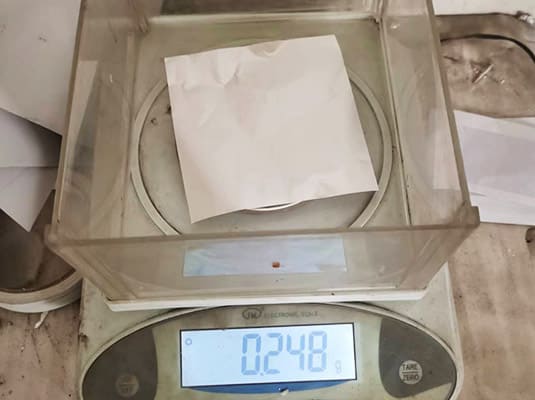
Basis Weight Calculation
5. Key Properties and Performance Advantages
20 micron aluminum foil is chosen for a combination of properties that few other materials match at this weight and cost.
This section explains each property and what it means in practice.
5.1 Barrier Performance
Aluminum is one of the few materials that blocks light, oxygen, moisture and aromas almost completely.
Plastic films let small amounts of oxygen and water vapor pass through. Aluminum does not, as long as the foil is free of defects.
That is why foil protects food, medicine and electronics from spoilage and degradation.
Pinholes and thickness
Pinholes are the main weakness of thin foil. As foil gets thinner, the number of pinholes per square meter rises.
At 20 µm, pinhole levels are low enough for many demanding uses.
When foil is laminated to plastic layers, the plastic covers the remaining micro-defects. This is why 20 µm foil works well in laminated pouches and lids.
5.2 Mechanical Strength and Formability
The foil must survive unwinding, printing, lamination and filling without tearing. At 20 µm, it handles these steps far better than ultra-thin foil.
Soft temper foil bends, folds and conforms to shapes. Hard temper foil keeps its shape and tears cleanly. The right temper lets one thickness serve very different jobs.
5.3 Thermal Properties
Aluminum conducts heat well and reflects radiant heat strongly. Both properties are useful, but in different settings.
- In cooking and food service, good conductivity spreads heat evenly.
- In insulation and HVAC, a bright foil surface reflects radiant heat and helps reduce energy loss.
- In packaging, the foil tolerates the heat of sealing and sterilization processes when laminated correctly.
5.4 Hygiene and Food Safety
Aluminum foil is non-toxic, odorless and tasteless. It does not support microbial growth. The rolling and annealing process leaves the surface clean.
Food-contact suitability still depends on the alloy, surface treatment and any coating or adhesive used. Request compliance documents for your target market.
5.5 Electrical and Shielding Behavior
Aluminum conducts electricity and blocks electromagnetic interference.
Foil laminated to PET film is widely used as shielding tape for cables and electronics.
5.6 Sustainability
Aluminum is infinitely recyclable without losing its core properties. Recycling aluminum takes only a small fraction of the energy needed to produce primary metal.
Thin foil also uses little material per package, which supports lightweight packaging goals.
Recycling foil in practice depends on local collection systems and on whether the foil is mixed with plastic layers.
5.7 Summary of Advantages
| Property | Advantage | Why it matters |
|---|---|---|
| Barrier to light, oxygen, moisture | Near-total protection when pinhole-free | Longer shelf life |
| Formability (soft temper) | Folds and shapes without cracking | Wraps, laminates, formed lids |
| Strength (hard temper) | Holds shape; tears cleanly | Push-through lidding |
| Thermal conductivity | Even heat transfer | Cooking and heat-seal processes |
| Heat reflectivity | Reflects radiant heat | Insulation facing |
| Hygiene | Non-toxic, no microbial growth | Food and pharma safety |
| Conductivity | Electromagnetic shielding | Cable and electronics use |
| Recyclability | Retains properties after recycling | Sustainability goals |
6. How 20 Micron Aluminum Foil Is Made
Making 20 µm foil is a precision rolling process. Each stage controls a specific quality factor, such as thickness, pinholes or surface cleanliness.
6.1 Production Process Overview
| Stage | What happens | Why it matters |
|---|---|---|
| 1. Melting and alloying | Aluminum is melted and alloying elements are adjusted | Sets alloy composition |
| 2. Casting | Molten metal is cast into a slab or continuous-cast coil | Determines internal quality and defects |
| 3. Hot rolling (if slab cast) | Slab is rolled down to a thick coil | Reduces thickness efficiently |
| 4. Cold rolling | Coil is rolled to a thin gauge at room temperature | Builds strength and surface quality |
| 5. Intermediate annealing | Coil is heat-treated to soften it | Restores formability for further rolling |
| 6. Foil rolling | Material is rolled to final thickness | Achieves target gauge |
| 7. Slitting | Wide rolls are cut to customer widths | Defines width and edge quality |
| 8. Final annealing | Heat treatment removes rolling oil and sets the temper | Controls softness and surface cleanliness |
| 9. Inspection and packing | Thickness, pinholes and appearance are checked | Protects quality before shipment |
7. Applications of 20 Micron Aluminum Foil
20 Micron Aluminum Foil serves packaging and industrial applications that require a thin, flexible metal layer.
Its suitability depends on the required barrier performance, mechanical properties, product-contact conditions, and converting process.
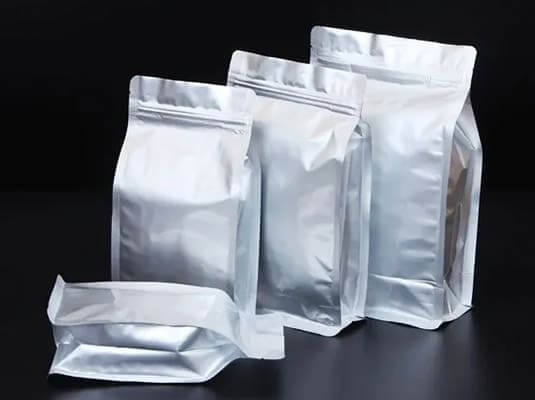
20 Micron Aluminum Foil for Flexible Packaging
7.1 Food and Flexible Packaging
20 micron aluminum foil can be used in selected flexible packaging structures for dry foods, powders, snacks, and other products requiring protection from light, moisture, or gases.
Common product formats include:
- Laminated pouches and sachets.
- Composite packaging films.
- Printed packaging materials.
- Selected food wrapping structures.
The foil may be combined with plastic films, paper, adhesives, or sealant layers to provide the required mechanical strength and packaging functionality.
Food-contact compliance and sealing performance should be verified for the complete structure.
7.2 Pharmaceutical Packaging
Aluminum foil is widely used in pharmaceutical packaging, but the suitability of 20 μm foil depends on the specific packaging design and performance requirements.
Potential applications include selected laminated packaging materials and specialized foil structures.
Pharmaceutical blister lidding, for example, requires suitable mechanical properties, coating compatibility, and reliable sealing performance.
For cold-forming Alu-Alu blister packaging, the foil specification must be selected for the forming process; 20 μm should not be assumed suitable for every cold-forming application.
Buyers should confirm the required alloy, temper, thickness, and regulatory compliance with the packaging manufacturer.
7.3 Insulation and Thermal Applications
Aluminum foil can serve as a reflective facing or barrier layer in insulation products, duct insulation, and multilayer thermal-control materials.
Its effectiveness depends on surface emissivity, air gaps, the insulation system, and installation conditions.
A thin foil layer does not provide substantial thermal insulation by itself; the overall system determines the thermal performance.
7.4 Cable and Electrical Applications
Selected cable and electrical products use aluminum foil as a shielding or functional layer.
Depending on the design, foil may be combined with polymer films or other conductive materials.
The required electrical continuity, shielding performance, flexibility, and bonding characteristics should guide alloy and temper selection.
A coated or laminated foil may behave differently from bare aluminum in electrical contact applications.
7.5 Industrial Laminates and Specialty Products
20 micron aluminum foil may also be incorporated into multilayer industrial materials where a lightweight metal barrier is useful.
Potential uses include composite packaging, protective laminates, and specialized converted foil products.
Each application requires a suitable combination of foil properties, surface treatment, and downstream processing.
Application selection tip: Confirm the finished product’s performance requirements before choosing 20 μm foil.
Barrier testing, converting trials, and compatibility checks can help determine whether the thickness is appropriate.
Pharmaceutical Packaging Used Printed aluminum foil
8. Plain vs. Coated vs. Laminated 20 Micron Aluminum Foil
20 µm foil is sold in three main forms. Choosing the right form often matters as much as choosing the alloy.
8.1 Comparison Table
| Feature | Plain aluminum foil | Coated aluminum foil | Laminated aluminum foil |
|---|---|---|---|
| Structure | Bare aluminum | Aluminum with a thin lacquer or coating | Aluminum bonded to plastic, paper or other layers |
| Typical added layer | None | Heat-seal lacquer, primer, protective lacquer, color | PET, PE, PA, CPP, paper and others |
| Heat sealable | No | Yes, with heat-seal lacquer | Yes, through the sealant layer |
| Printable | Limited | Yes, with suitable coating | Yes, on the outer film |
| Strength | Depends on temper | Similar to plain foil | Much higher |
| Pinhole cover | None | Partial | Strong, plastic layers cover micro-defects |
| Cost | Lowest | Medium | Highest |
| Typical use | Household wrap, cooking, general use, base for converting | Lidding, blister foil, colored foil | Pouches, sachets, tapes, insulation facing |
8.2 Plain Aluminum Foil
Plain Aluminum foil is bare aluminum with no added layer. It is the base material for converting and the product sold for household use.
It is simple, economical and fully recyclable. Its limits are that it cannot be heat sealed on its own, and it is more easily damaged by creasing or tearing.
8.3 Coated Aluminum Foil
Coated Aluminum foil carries a thin layer of lacquer on one or both sides.
- Heat-seal lacquer lets the foil bond to plastic containers, such as yogurt cups or blister bases.
- Primer improves adhesion for printing or further coating.
- Protective lacquer shields the surface from scratches or food contact reactions.
- Colored coating is used for decoration and branding.
Coated foil keeps the thin, light structure of plain foil while adding the functions packaging lines need.
The lacquer must match the substrate and the sealing conditions.
8.4 Laminated Aluminum Foil
Laminated Aluminum foil combines aluminum with other materials to build a complete packaging structure.
Two common bonding methods are used:
- Adhesive lamination uses a solvent-based or solvent-free adhesive to join the layers.
- Extrusion lamination uses molten polymer to bond the layers.
Laminates combine the barrier of foil with the strength, printability and sealability of plastics or paper.
The foil surface must be clean and wettable, or the layers can separate.
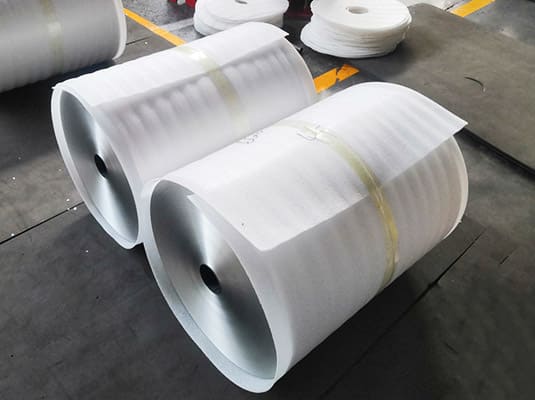
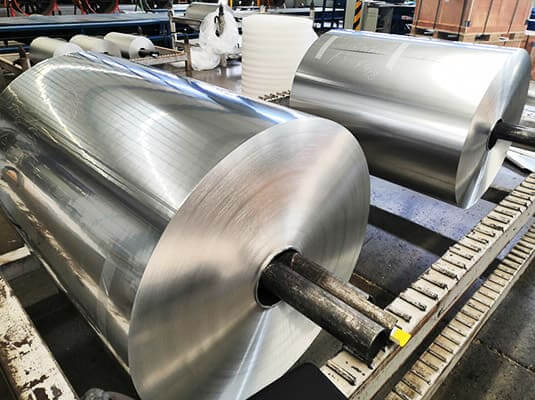
Huawei 20 Micron Aluminum Foil Display
9. Quality Control and Testing Standards
Quality control decides whether a roll of 20 µm foil runs smoothly on your line or causes rejects.
This section covers what to inspect, how it is tested and which standards apply.
9.1 Key Quality Parameters
| Parameter | What it affects | Typical test method |
|---|---|---|
| Thickness and uniformity | Barrier, weight, cost, coating consistency | Micrometer, weighing method, online gauge |
| Pinholes | Barrier performance, shelf life | Light-transmission inspection in a dark room |
| Tensile strength and elongation | Tearing, forming, lamination behavior | Tensile test |
| Wettability (dyne level) | Adhesion of coating, ink and adhesive | Dyne pen or test-liquid method |
| Surface cleanliness | Printing, lamination, food contact | Visual inspection, wettability test |
| Flatness and edge quality | Web tracking, telescoping, tearing | Visual and roll inspection |
| Alloy composition | Mechanical and barrier properties | Spectrometer analysis |
9.2 Common Defects, Causes and Prevention
| Defect | Common cause | Prevention |
|---|---|---|
| Pinholes | Inclusions in the metal, rolling conditions, thin gauge | Clean melt, controlled rolling, agreed pinhole limit |
| Oil spots or stains | Incomplete annealing, contamination | Proper annealing, clean storage and handling |
| Wrinkles and waves | Uneven tension or roll profile | Tension control, roll profile adjustment |
| Telescoping rolls | Poor winding or edge alignment | Correct winding tension and core fit |
| Edge burr or tears | Dull or misaligned slitting knives | Knife maintenance and setup checks |
| Poor adhesion | Low surface wettability | Check dyne level and annealing quality |
| Scratches | Rough handling or contaminated rolls | Careful handling, clean rolls and guides |
9.3 Reference Standards and Compliance
| Standard or regulation | Scope |
|---|---|
| GB/T 3198 | Aluminum and aluminum alloy foil (China) |
| ASTM B479 | Annealed aluminum foil for flexible barrier applications (USA) |
| EN 546 | Aluminum and aluminum alloy foil (Europe) |
| EU Regulation 1935/2004 | General requirements for food-contact materials in the EU |
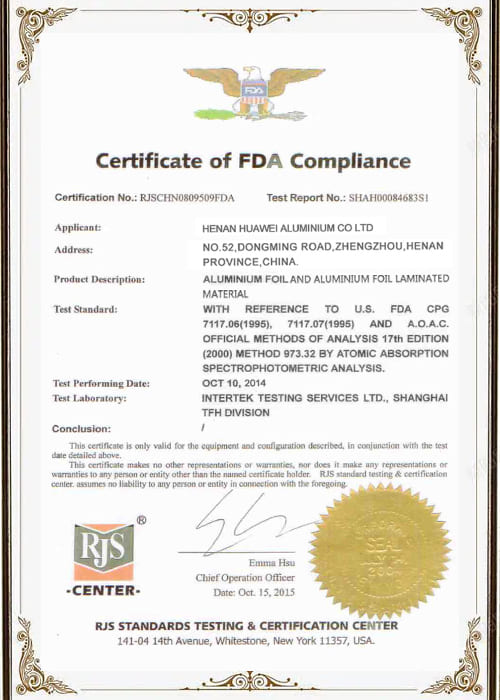
| FDA requirements | Food-contact materials in the USA |
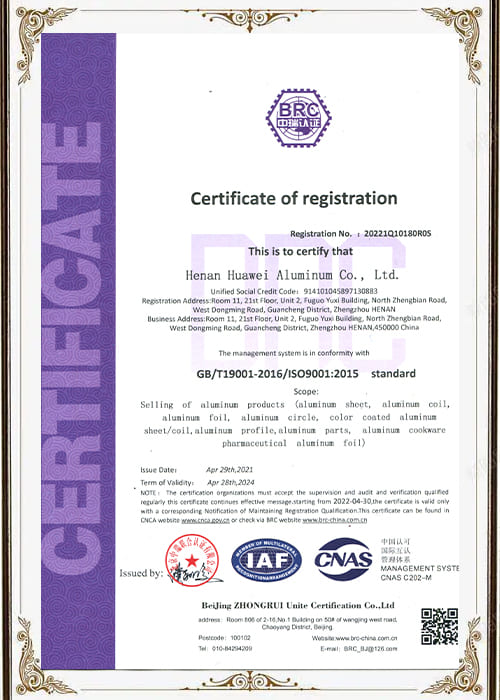
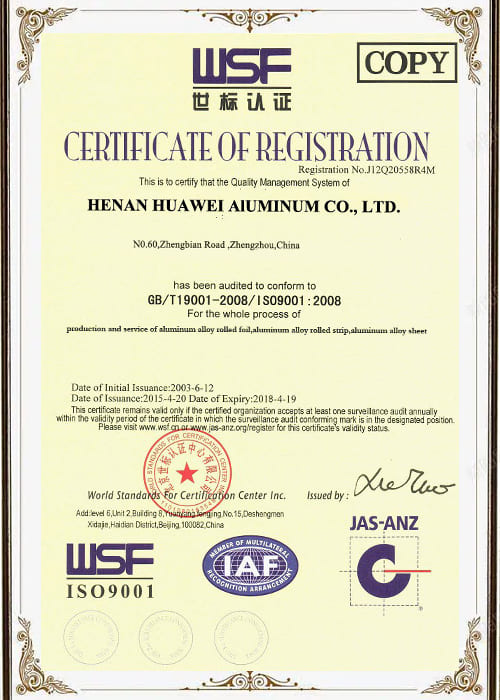
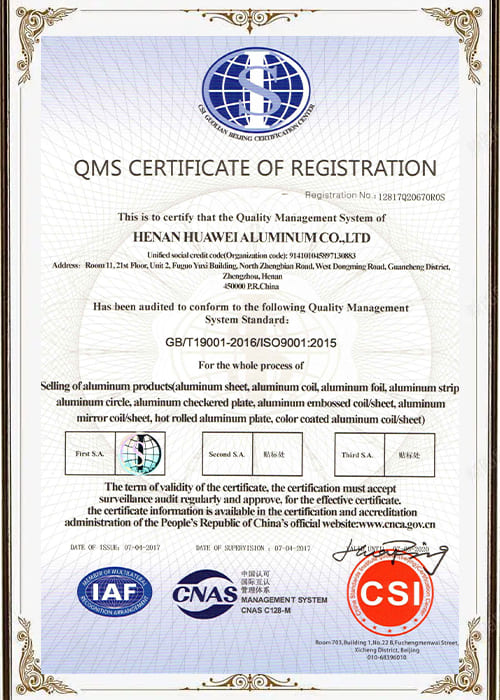
| ISO 9001 | Quality management system |
| ISO 22000, BRC, FSSC 22000 | Food safety management, where required by the customer |
Standards change over time. Confirm the current edition of each, and agree in writing which one governs your order.
10. Customized 20 Micron Aluminum Foil Solutions from Huawei Aluminum
Henan Huawei Aluminum Co., Ltd. was established in 2001 and has more than 20 years of experience in aluminum production and sales.
The company serves international customers with aluminum products for packaging and industrial applications.
For 20 Micron Aluminum Foil, customers can discuss material selection, dimensions, surface requirements, and order-specific quality criteria based on their intended use.
10.1 Customized Material and Dimensions
Buyers can specify the required alloy and temper according to their processing needs.
Common alloy options to discuss include 1235, 8011, and 8079, subject to product requirements and availability.
Customized requirements may include:
- Nominal thickness of 20 μm.
- Required roll width and winding dimensions.
- Roll inner diameter and target roll weight.
- Surface finish and edge condition.
- Plain foil or suitable downstream processing options.
All specifications should be confirmed before production.
10.2 Surface Treatment and Further Processing
Depending on production capability and the agreed order, customers may request plain foil or discuss suitable coating, printing, or lamination requirements.
For coated or laminated products, buyers should provide details of the intended function, sealing conditions, outer materials, and applicable compliance requirements.
This information helps determine whether the proposed structure is suitable for the finished product.
10.3 Quality Requirements and Export Packaging
Huawei Aluminum can discuss order-specific inspection requirements, including thickness tolerance, dimensional accuracy, surface quality, and relevant material documentation.
Customers should identify any special pinhole limits, mechanical-property requirements, or testing standards before production.
Export packaging should also match the shipping route, storage conditions, and handling requirements.
11. Conclusion
20 Micron Aluminum Foil provides a lightweight, flexible aluminum layer for selected packaging and industrial applications.
Its barrier properties, processability, and suitability for further conversion make it useful in products that require a thin metal layer.
However, thickness alone does not determine performance. Alloy, temper, surface quality, pinhole control, coating compatibility, and processing conditions all influence the final result.
For buyers, the best approach is to define the intended application, confirm the required technical specification, and select a supplier that can meet the agreed quality and delivery requirements.
A well-matched foil specification helps improve converting consistency and control overall material costs.
FAQs
How thick is 20 micron aluminum foil?
It has a nominal thickness of 20 μm, equivalent to 0.020 mm.
Which alloys are commonly used for 20 micron aluminum foil?
Common options include 1235, 8011, and 8079. The best choice depends on the application and required properties.
Is 20 micron aluminum foil suitable for food packaging?
Yes, it can be used in suitable food packaging structures, subject to material compliance and packaging performance requirements.
Can 20 micron aluminum foil be used for pharmaceutical packaging?
It may suit selected pharmaceutical packaging structures if it meets the required barrier, mechanical, coating, and compliance specifications.
What is the difference between plain and laminated aluminum foil?
Plain foil consists of the aluminum layer alone, while laminated foil combines aluminum with materials such as plastic film or paper to provide additional functionality.
What factors affect the price of 20 micron aluminum foil?
The main factors include alloy, temper, width, order quantity, surface treatment, roll dimensions, and packaging requirements.
How can buyers ensure foil quality?
Check thickness tolerance, surface condition, pinhole requirements, alloy specifications, and relevant inspection reports.
What information is needed for a quotation?
Provide the required alloy, temper, thickness tolerance, width, roll dimensions, surface treatment, application, and order quantity.
Casting production process and its introduction
The purpose of melting and casting is to produce alloys with satisfactory composition and high purity of melt, so as to create favorable conditions for casting alloys of various shapes.
Melting and casting process steps: batching --- feeding --- melting --- stirring after melting, slag removal --- pre-analysis sampling --- adding alloy to adjust the composition, stirring --- refining --- static Setting——Guide furnace casting.
Hot rolling production process and its introduction
- 1. Hot rolling generally refers to rolling above the metal recrystallization temperature;
- 2. During the hot rolling process, the metal has both hardening and softening processes. Due to the influence of deformation speed, as long as the recovery and recrystallization process is too late, there will be a certain work hardening;
- 3. The recrystallization of the metal after hot rolling is incomplete, that is, the coexistence of recrystallized structure and deformed structure;
- 4. Hot rolling can improve the processing performance of metals and alloys, reduce or eliminate casting defects.
- 1. The casting and rolling temperature is generally between 680°C and 700°C. The lower the better, the stable casting and rolling line usually stops once a month or more to re-stand. During the production process, it is necessary to strictly control the liquid level of the front tank to prevent low liquid level;
- 2. Lubrication uses C powder with incomplete combustion of gas for lubrication, which is also one of the reasons for the dirty surface of casting and rolling materials;
- 3. The production speed is generally between 1.5m/min-2.5m/min;
- 4. The surface quality of products produced by casting and rolling is generally relatively low, and generally cannot meet products with special physical and chemical performance requirements.
- 1. Cold rolling refers to the rolling production method below the recrystallization temperature;
- 2. There will be no dynamic recrystallization during the rolling process, and the temperature will rise to the recovery temperature at most, and the cold rolling will appear in a work hardening state, and the work hardening rate will be large;
- 3. The cold-rolled sheet and strip have high dimensional accuracy, good surface quality, uniform structure and performance, and products in various states can be obtained with heat treatment;
- 4. Cold rolling can roll out thin strips, but at the same time, it has the disadvantages of high energy consumption for deformation and many processing passes.
- 1. Finishing is a processing method to make the cold-rolled sheet meet the customer's requirements, or to facilitate the subsequent processing of the product;
- 2. The finishing equipment can correct the defects produced in the hot rolling and cold rolling production process, such as cracked edge, oily, poor plate shape, residual stress, etc. It needs to ensure that no other defects are brought into the production process;
- 3. There are various finishing equipments, mainly including cross-cutting, slitting, stretching and straightening, annealing furnace, slitter, etc.
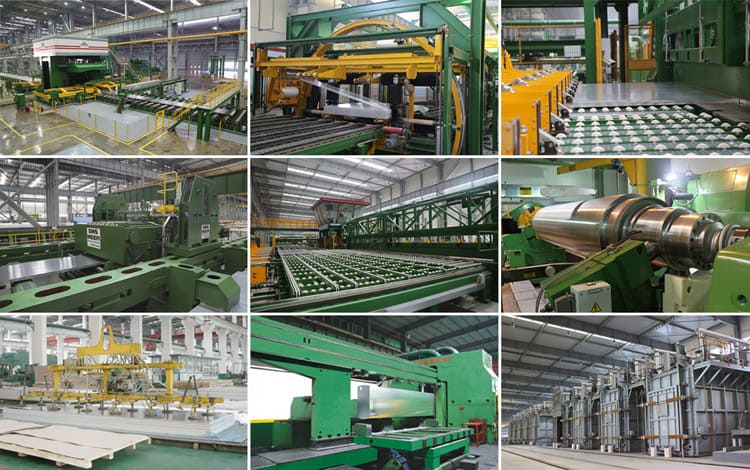
Casting and rolling process
Casting and rolling process: liquid metal, front box (liquid level control), casting and rolling machine (lubrication system, cooling water), shearing machine, coiling machine.
Cold rolling production process
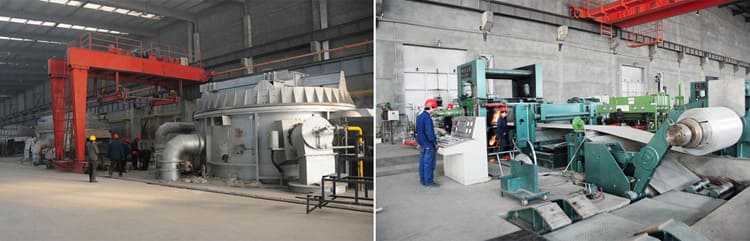
Introduction to finishing production process
Aluminum alloy has the characteristics of low density, good mechanical properties, good processing performance, non-toxic, easy to recycle, excellent electrical conductivity, heat transfer and corrosion resistance, so it has a wide range of applications.
Aerospace: used to make aircraft skins, fuselage frames, girders, rotors, propellers, fuel tanks, wall panels and landing gear struts, as well as rocket forging rings, spacecraft wall panels, etc.

Aluminum alloy used for aerospace
Transportation: used for car body structure materials of automobiles, subway vehicles, railway passenger cars, high-speed passenger cars, doors and windows, shelves, automotive engine parts, air conditioners, radiators, body panels, wheels and ship materials.
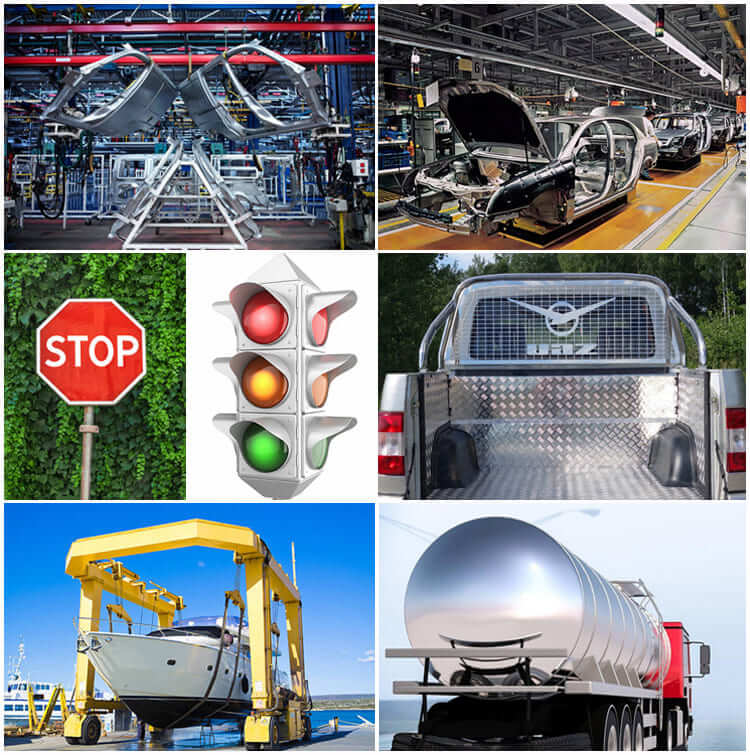
Traffic application
Packaging: All-aluminum pop cans are mainly used as metal packaging materials in the form of thin plates and foils, and are made into cans, lids, bottles, barrels, and packaging foils. Widely used in the packaging of beverages, food, cosmetics, medicines, cigarettes, industrial products, medicines, etc.
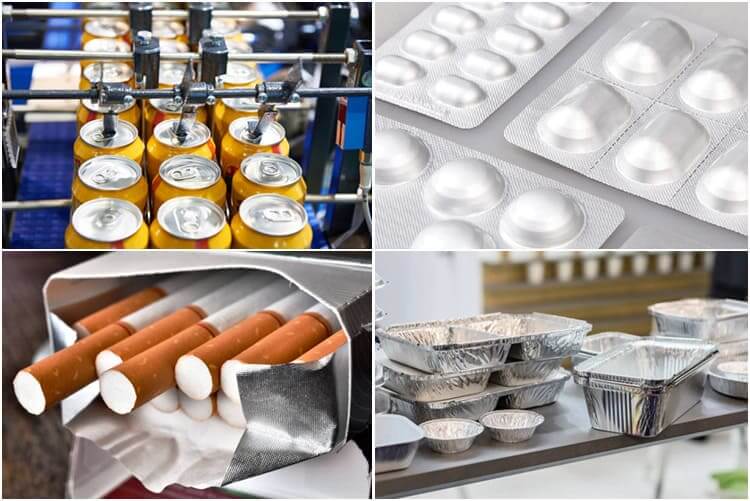
Packaging application
Printing: Mainly used to make PS plates, aluminum-based PS plates are a new type of material in the printing industry, used for automatic plate making and printing.
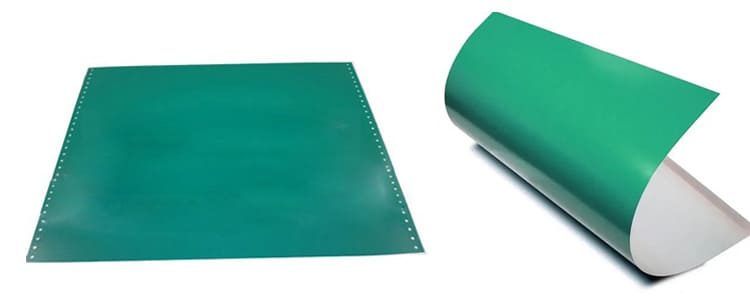
PS printing
Architectural decoration: aluminum alloy is widely used in building structures, doors and windows, suspended ceilings, decorative surfaces, etc. due to its good corrosion resistance, sufficient strength, excellent process performance and welding performance.

Aluminum alloy construction application
Electronic products: computers, mobile phones, refrigerator shells, radiators, etc.
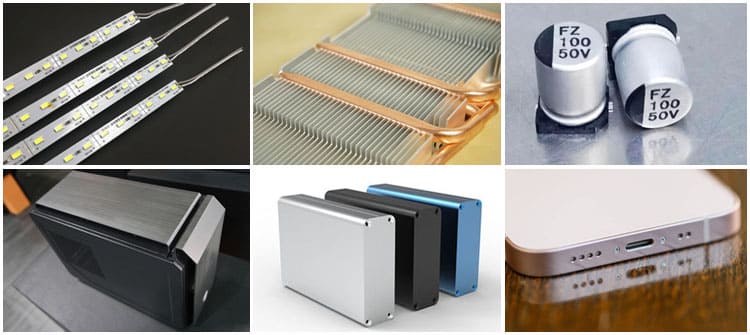
Electronic product application
Kitchen supplies: aluminum pots, aluminum basins, rice cooker liners, household aluminum foil, etc.
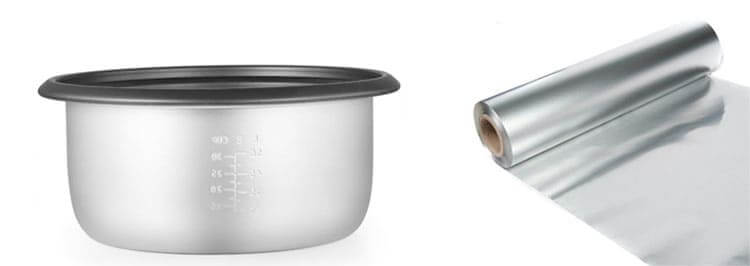
Kitchen application
Packaging Of Aluminum Sheet/Coil
Every detail of packaging is where we pursue perfect service. Our packaging process as a whole is as follows:
Lamination: clear film, blue film, micro-mucosal, high-mucosal, laser cutting film (2 brands, Novacell and Polyphem);
Protection: paper corner protectors, anti-pressure pads;
drying: desiccant;
Tray: fumigated harmless wooden tray, reusable iron tray;
Packing: Tic-tac-toe steel belt, or PVC packing belt;
Material Quality: Completely free from defects such as white rust, oil spots, rolling marks, edge damage, bends, dents, holes, break lines, scratches, etc., no coil set.
Port: Qingdao or other ports in China.
Lead time: 15-45 days.
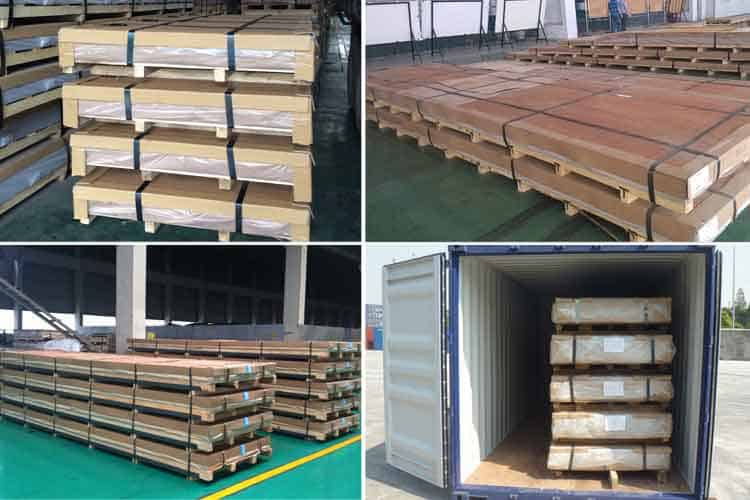
Aluminum sheet/plate packaging process
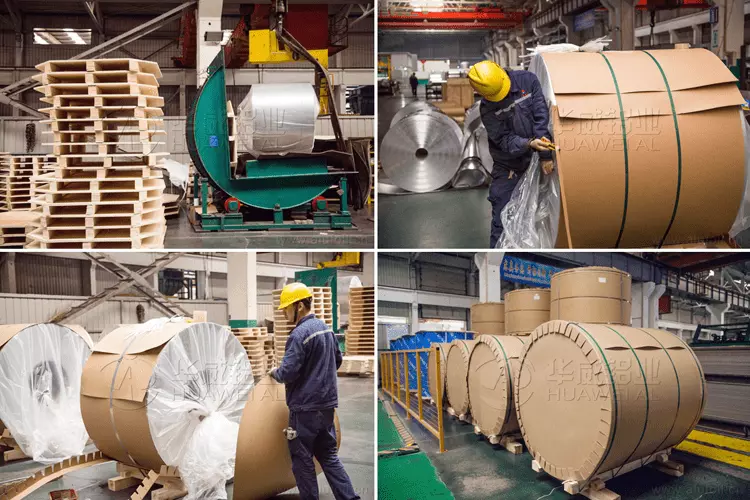
Aluminum coil packaging process
F: Are you a manufacturer or a trader?
Q: We are a manufacturer, our factory is at No.3 Weier Road, Industrial Zone, Gongyi, Henan, China.
F: What is the MOQ for ordering the product?
Q: Our MOQ is 5 tons, and some special products will have a minimum order quantity of 1 or 2 tons.
F: How long is your lead time?
Q: Generally our lead time is about 30 days.
F: Do your products have quality assurance?
Q: Yes, if there is a quality problem with our products, we will compensate the customer until they are satisfied.
Related Products


Latest Blogs
5052 vs 6061 Aluminum: Key Differences & Best Uses
Compare 5052 vs 6061 aluminum for strength, corrosion resistance, formability, and machining. Discover which alloy best fits your project.
Common Alloys of Reefer Truck Used PE Coated Aluminum Coil
Discover common alloys of reefer truck used PE coated aluminum coil, including 3003, 3004, and 3105. Designed for excellent corrosion resistance, formability, and long-lasting outdoor performance.
Is Aluminum Conductive? Properties, Uses & Benefits Explained
Is aluminum conductive? Discover aluminum's electrical conductivity, key advantages, and why it is widely used in power transmission and industrial applications.
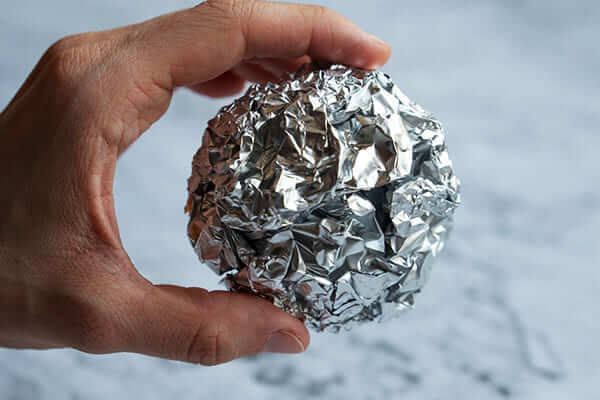
Unlocking Sustainability: The Truth About Aluminum Foil Recycling
Is Aluminum Foil Recyclable? Learn how aluminum foil can be recycled, how to prepare it properly, and why recycling helps reduce waste and save resources.