I. Panimula
Marine grade 5086 H116 aluminum plate occupies a uniquely valuable position in the aluminum shipbuilding material spectrum — one that is frequently underappreciated precisely because it sits between two more prominently specified alloys.
More corrosion-resistant and formable than the 6061 serye ng mga, yet more workable and weldable than the high-strength 5083, 5086 H116 delivers a combination of properties that makes it irreplaceable across a broad range of marine applications: recreational fishing boats with complex hull forms, sailboat hulls requiring flared topsides, commercial workboat secondary structure, offshore platform walkways, and military vessel superstructures.
This article delivers a comprehensive, authoritative examination of marine grade 5086 H116 aluminum plate across eighteen analytical dimensions — metallurgy, temper science, pagmamanupaktura, mga katangian, corrosion performance, the critical 5086-versus-5083 comparison, structural design, vessel applications, gawa gawa lang, corrosion protection, quality standards, regulatory frameworks, supply chain economics, Sustainability, and innovation.
II. Metallurgical Foundation: Ang 5086 aluminyo haluang metal
2.1 The 5xxx Series: Magnesium’s Marine Chemistry
Aluminum alloys in the 5xxx series achieve their strength and corrosion performance through magnesium dissolved in solid solution within the aluminum matrix.
Magnesium atoms, slightly larger than aluminum atoms, distort the crystal lattice, impeding dislocation movement and thereby increasing strength — a mechanism called solid solution strengthening that requires no heat treatment to activate and never diminishes through thermal exposure (below the sensitization range).
This non-heat-treatable character defines the marine performance logic of 5xxx alloys: their properties remain stable throughout vessel service life, unlike heat-treated alloys whose precipitation hardening can be partially reversed by the thermal cycles of welding and fire.
Magnesium’s second marine gift is electrochemical: it shifts the alloy’s natural corrosion potential in seawater toward more negative (anodic) values, improving resistance to pitting corrosion by making the passive film more stable and reducing the differential between the alloy matrix and the cathodic intermetallic particles that serve as pit initiation sites.
Higher magnesium content generally means better seawater corrosion resistance — which is why 5083 (4.0–4.9% Mg) outperforms 5052 (2.2–2.8% Mg) in long-term marine service.
5086 sits between these two: its 3.5–4.5% magnesium range delivers seawater corrosion resistance clearly superior to 5052 and approaching 5083, while keeping the magnesium content low enough to reduce the sensitization risk that becomes a primary engineering concern in high-Mg alloys.
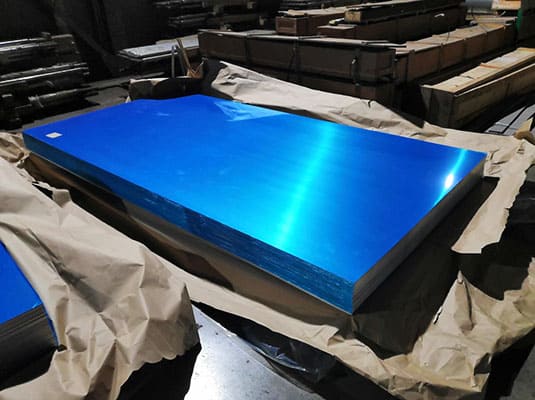
Marine Grade 5086 H116 Aluminum Plate
2.2 Komposisyon ng Kemikal: Every Element Engineered for the Sea
The composition of 5086 aluminyo, defined by ASTM B209, EN 573-3, GB/T 3880, and JIS H4000, reflects deliberate marine engineering at every element:
| Elemento | Composition Range (%) | Marine Engineering Function |
|---|---|---|
| Aluminyo (Al) | Natitira (~94.2–95.7) | Primary matrix; passive oxide film formation and repair |
| Magnesium (Mg) | 3.5 – 4.5 | Matibay na solusyon pagpapalakas; seawater corrosion resistance |
| Mga mangganeso (Mn) | 0.20 – 0.70 | Grain structure control; Al₆Mn dispersoid formation |
| Chromium (Cr) | 0.05 – 0.25 | Inhibits recrystallization; stabilizes grain boundaries |
| bakal na bakal (Fe) | ≤ 0.50 | Impurity; forms cathodic Al₃Fe particles — controlled tightly |
| Silicon (Si Si) | ≤ 0.40 | Impurity; interacts with Mg in Mg₂Si formation |
| Tanso (Cu) | ≤ 0.10 | Strictly minimized — elevates pitting and galvanic corrosion risk |
| Sink (Zn) | ≤ 0.25 | Impurity ceiling; excess degrades SCC resistance |
| Titanium (Ti) | ≤ 0.15 | Casting grain refiner; controlled for property consistency |
| Ang iba naman (each/total) | ≤0.05/≤0.15 | Aggregate impurity limit |
2.3 Comparative Alloy Analysis for Marine Applications
Selecting the right marine aluminum alloy requires understanding where each falls on the performance-formability-sensitization spectrum:
| haluang metal | Mg (%) | Min UTS (H116, MPa) | Min YS (H116, MPa) | Sensitization Risk | Formability | Best Marine Application |
|---|---|---|---|---|---|---|
| 5052-H32 | 2.2–2.8 | 228 | 193 | Very low | Napakahusay | Light structure; non-hull |
| 5086-H116 | 3.5–4.5 | 270 | 193 | Low-moderate | Very good | Hull topsides; complex forms; secondary structure |
| 5083-H116 | 4.0–4.9 | 303 | 214 | Katamtaman | Mabuti na lang | Primary hull structure; bottom plating |
| 5456-H116 | 4.7–5.5 | 317 | 228 | Moderate-high | Fair | High-strength hull; careful monitoring |
| 5059-H116 | 5.0–6.0 | 330 | 240 | Mababa ang (optimized) | Fair | Premium naval; highest strength marine |
| 6061-T6 | 0.8–1.2 Mg | 310 | 276 | N / A | Katamtaman | Non-marine structural; avoid seawater immersion |
5086 occupies the formability optimum of the marine alloy family. It bends more readily than 5083, welds with slightly less HAZ strength reduction, and carries equivalent sensitization protection in H116 temper — making it the logical choice whenever complex geometry, curved hull forms, or superior cold workability matters more than the 10–12% strength premium that 5083 provides.
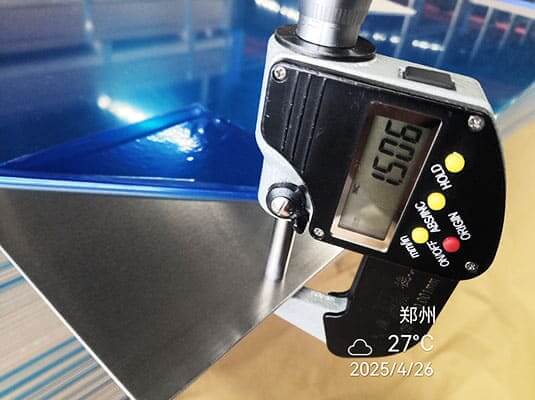
5086 H116 Aluminum Plate Thickness Measurement
III. The H116 Temper: Marine-Specific Engineering of 5086
3.1 A Temper Born from Operational Experience
The H116 temper specification for marine aluminum alloys did not emerge from theoretical materials science — it emerged from a documented history of premature corrosion failures in vessels constructed from 5xxx alloys in tempers that passed mechanical property specifications but lacked the microstructural control needed to resist seawater’s specific corrosion mechanisms.
Exfoliation of hull plating, stress corrosion cracking in welded joints, and intergranular attack in plate that had been mildly sensitized during fabrication all contributed to the industry’s recognition that marine aluminum needed a temper designation specifically engineered around corrosion resistance, not merely around strength.
The result — codified in ASTM B928 (first published 2004, regularly revised) — defines H116 as a strain-hardened condition for 5xxx series alloys with ≥3% magnesium specifically engineered to provide resistance to exfoliation corrosion and stress corrosion cracking.
The standard mandates sensitization testing on every production lot, making H116 the only aluminum temper in routine commercial production where corrosion testing is a mandatory lot-acceptance requirement rather than an optional supplementary test.
3.2 H116 Production Pathway: Controlled Cold Work
Producing 5086 H116 requires precise control over the cold reduction applied after hot rolling — a percentage that simultaneously achieves three objectives that would normally be in tension: adequate tensile strength (UTS ≥270 MPa), adequate ductility (elongation ≥10%), and the specific dislocation structure that disrupts continuous beta-phase grain boundary coverage.
The critical thermal discipline during H116 cold rolling is maintaining the plate temperature below 65°C throughout the cold reduction passes.
Cold rolling generates heat through plastic deformation, and without adequate coolant application and inter-pass cooling, rolling heat alone can drive the plate into the sensitization range — a process excursion that would produce H116-tempered mechanical properties in material that has already begun the grain boundary precipitation that H116 is designed to prevent.
3.3 Paghahambing ng 5086 Mga Temper: The Marine-Critical Distinctions
| Temper | Kahulugan | NAMLT Required | Exfoliation Resistance | SCC Resistance | Marine Use |
|---|---|---|---|---|---|
| O | Fully annealed | Hindi | Mga Maralita | Mga Maralita | Deep forming only; not for seawater immersion |
| H32 | Strain-hardened + partial anneal | Hindi | Katamtaman | Katamtaman | Not marine-grade — general structural only |
| H34 | Strain-hardened + partial anneal (mas mataas) | Hindi | Katamtaman | Katamtaman | Not marine-grade |
| H116 | Strain-hardened; marine-controlled | Oo nga (≤15 mg/cm²) | Napakahusay | Napakahusay | Primary marine structural specification |
| H321 | Strain-hardened + stabilized | Oo nga (≤15 mg/cm²) | Napakahusay | Napakahusay | Alternative to H116; plate >38 mm |
| H112 | As-fabricated; controlled properties | Hindi | Not tested | Not tested | Non-marine structural applications |
3.4 Mechanical Property of Marine Grade 5086 H116 Aluminum Plate
| Pag-aari | Halaga | Test Standard | Design Application |
|---|---|---|---|
| Mga UTS (minimum na) | 270 MPa (39 ksi) | ASTM E8 | Hull panel strength; structural member design |
| Yield Lakas (0.2%) (min) | 193 MPa (28 ksi) | ASTM E8 | Elastic design limit; buckling assessment |
| Pagpapahaba (min) | 10% | ASTM E8 | Ductility reserve for forming and impact tolerance |
| Gupitin ang lakas (tipikal na) | ~165 MPa | — | Rivet and weld shear design |
| Brinell tigas na tigas (tipikal na) | 60–75 HB | ASTM E10 | Temper verification; incoming inspection |
| Lakas ng pagkapagod (unwelded, 5×10⁸) | ~117 MPa | ASTM E466 | Parent metal fatigue assessment |
| Lakas ng pagkapagod (welded joint) | ~45–62 MPa | Eurocode 9/DNV | Governing design criterion for marine hulls |
| Charpy impact (−40°C) | >15 J | ASTM E23 | Cold climate service qualification |
| Modulus ng Pagkalastiko | 70.3 GPa | — | Deflection and stiffness calculations |
IV. Manufacturing Process of Marine Grade 5086 H116 Aluminum Plate
4.1 From Melt to Marine Certification: The Production Sequence
Certified 5086 H116 marine plate requires disciplined process control across six manufacturing stages, because the H116 temper’s primary function — corrosion resistance through controlled microstructure — can be destroyed by a single thermal excursion or inadequate cold reduction at any point in the sequence.
The following traces the production process from alloy preparation to certification.
4.2 Alloy Preparation and DC Casting
Ang 5086 melt is prepared by combining primary aluminum (≥99.7% Al) with precisely weighed additions of magnesium metal (achieving 3.5–4.5% Mg target) and manganese master alloy (0.20–0.70% Mn target).
Chromium addition (0.05–0.25% Cr) requires careful control — too little sacrifices the grain boundary stabilization function; too much risks chromium-bearing precipitate formation that can embrittle the alloy. Optical emission spectrometry (OES) verifies melt chemistry from ladle samples before every cast.
Direct chill (D at T) semi-continuous casting produces rolling slabs typically 400–550 mm thick and 1,000–2,000 mm wide.
The DC process’s controlled solidification rate produces a fine, relatively uniform microstructure with manageable composition gradients — superior to the coarser, more segregated structure produced by continuous casting methods.
For marine plate production, DC casting is the required production route; producers attempting continuous casting of 5086 for marine applications cannot achieve the microstructural uniformity required for consistent H116 corrosion performance.
4.3 Homogenization: Building the Microstructural Foundation
Homogenization at 460–510°C for 8–18 hours accomplishes three functions simultaneously for 5086 slabs:
Segregation elimination: Solidification produces composition gradients across dendrite spacings (typically 50–200 μm). Holding at elevated temperature allows diffusion to redistribute magnesium, mangganeso, and chromium into a more uniform distribution, ensuring consistent properties throughout the plate thickness.
Dispersoid precipitation: During slow cooling from homogenization temperature, Al₆Mn and Al₁₂Mg₂Cr dispersoid particles (0.05–0.5 μm) nucleate and grow. These particles are the microstructural agents responsible for inhibiting recrystallization during hot rolling and grain growth during annealing — directly controlling the final grain structure of the H116 plate.
Non-equilibrium phase dissolution: As-cast 5086 contains metastable magnesium-rich intermetallic phases at dendrite boundaries. Homogenization dissolves these into solid solution, preparing a uniform starting microstructure for hot rolling.
4.4 mainit na pagulong: Building Thickness Reduction with Microstructural Control
Following homogenization, scalped slabs (surface-machined to remove the segregated outer 10–20 mm) are preheated to 430–500°C and hot-rolled.
The hot rolling pass schedule reduces the slab from ~400–550 mm to the hot band gauge of typically 3–20 mm through a sequence of breakdown passes (large reduction per pass, mataas na temperatura) and finishing passes (smaller reduction, controlled exit temperature).
Hot rolling exit temperature — the temperature at which the strip leaves the final rolling stand — is particularly significant for 5086 H116 production.
If exit temperature is too high (above approximately 320°C), the strip recrystallizes extensively to a coarse grain structure that produces inferior surface finish in the final product.
If exit temperature is too low (below approximately 220°C), incomplete recrystallization leaves a partially worked structure that causes variable properties after subsequent annealing.
For consistent 5086 H116 properties, most producers target exit temperatures of 250–310°C with ±20°C control across the strip width.
4.5 Cold Rolling to H116 Condition
After hot band cooling to below 100°C (ensuring no sensitization during transition), cold rolling applies the controlled reduction that defines H116.
The production discipline during cold rolling encompasses three simultaneous requirements:
- Reduction control: Achieve the specific percentage reduction (proprietary to each producer, typically 5–20% for 5086 H116) that produces UTS ≥270 MPa, YS ≥193 MPa, elongation ≥10%, and dislocation density sufficient for NAMLT ≤15 mg/cm²
- Temperature control: Maintain plate temperature below 65°C at all times — verified by contact thermometers on the exit side of each cold rolling pass
- Lubricant management: Apply rolling oil uniformly to control friction, heat generation, and surface cleanliness — excess lubricant contributes to surface hydrocarbon contamination that compromises subsequent coating adhesion
4.6 Quality Control Integration: Sensitization Testing at the Production Stage
ASTM B928 requires that every production lot of 5086 H116 undergo NAMLT testing before release. A “lot” is defined as all plate of the same alloy, Pamahiin, and thickness produced from the same cast (init) in the same rolling sequence.
The practical implication for large rolling mills producing multiple lots simultaneously is that NAMLT testing can represent a meaningful certification cycle time — typically adding 2–3 working days to delivery schedules.
Procurement teams must build this timeline into shipyard material delivery schedules rather than pressuring suppliers for pre-certification release.
The production quality control testing sequence before plate release:
- Komposisyon ng kemikal (by OES): Every heat → accept/reject versus ASTM B209 / EN 573-3 limits
- Tensile testing (ASTM E8): Every lot → UTS, YS, elongation versus H116 minimums
- NAMLT (ASTM G67): Every lot → mass loss ≤15 mg/cm²
- Ang katigasan ng ulo (Brinell): Every lot (spot check) → 60–75 HB range confirmation
- Dimensional inspection: Every plate → thickness, lapad ng katawan, haba, patag na, camber
- Ultrasonic testing (ASTM B594): As specified → internal lamination and inclusion detection
V. Physical and Mechanical Properties: The Complete Profile
5.1 Structural Properties Comparison: 5086 H116 vs. Key Alternatives
Understanding Marine Grade 5086 H116 Aluminum Plate in isolation is less useful than understanding it in context.
The following comparison positions 5086 H116 against its most common marine alternatives across the properties that govern structural design decisions:
| Pag-aari | 5086-H116 | 5083-H116 | 5052-H32 | 6061-T6 |
|---|---|---|---|---|
| UTS min (MPa) | 270 | 303 | 228 | 310 |
| YS min (MPa) | 193 | 214 | 193 | 276 |
| Pagpapahaba min (%) | 10 | 10 | 12 | 8 |
| Densidad ng katawan (g/cm³) | 2.66 | 2.66 | 2.68 | 2.70 |
| E (GPa) | 70.3 | 70.3 | 70.3 | 68.9 |
| HAZ YS (typ., MPa) | ~105 | ~115 | ~90 | ~160 (T4-equiv.) |
| Min bend radius (3mm plate) | ~1.5t | ~2t | ~1t | ~2.5t |
| Seawater corrosion | Napakahusay | Napakahusay | Very good | Katamtaman |
| Sensitization risk | Low-moderate | Katamtaman | Very low | N / A |
| ASTM B928 required | Oo nga | Oo nga | Hindi | Hindi |
The HAZ yield strength row reveals one of 5086’s underappreciated advantages: its welded joint HAZ properties, while lower than the parent plate, compare favorably with 5083’s HAZ values because the lower starting yield strength translates into a more favorable HAZ joint efficiency ratio.
For a structural panel where welded joint efficiency (HAZ YS / parent YS) governs the design, 5086 achieves approximately 54% joint efficiency versus approximately 54% for 5083 — essentially equivalent.
Gayunpaman, the absolute stress level in the 5086 HAZ (~105 MPa) is lower, which means that for a given structural load, 5086 HAZ connections require slightly thicker plate or closer stiffener spacing than equivalent 5083 connections.
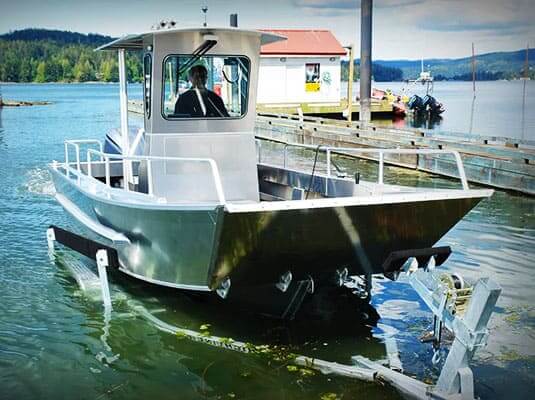
5086 H116 Aluminum Plate for Sailboat Hulls
5.2 Physical Properties for Marine Design
| Pag-aari | Halaga | Unit | Marine Design Implication |
|---|---|---|---|
| Densidad ng katawan | 2.66 | g/cm³ | 34% of steel; enables lightweight hull construction |
| Modulus ng Pagkalastiko | 70.3 | GPa | Lower than steel; governs deflection in large panels |
| Gupitin ang Modulus | 26.4 | GPa | Torsional stiffness; panel shear buckling design |
| Koepisyent ng thermal expansion | 23.8 | µm/m·°C | Tropical-to-Arctic thermal joint design requirement |
| Thermal kondaktibiti | 127 | W/m·K | Heat distribution; fire engineering analysis |
| Kondaktibiti ng kuryente | 31 | % IACS | Cathodic protection current distribution design |
| Melting range | 585–641 | °C | Fire safety: lower than steel; passive protection needed |
| Tiyak na kapasidad ng init | 900 | J/kg·K | Thermal mass for fire duration calculations |
Ang density ng 2.66 g/cm³ is the number that ultimately drives the business case for aluminum over steel in most marine applications.
Translating this into a hull structural weight comparison: a 5086 H116 hull panel of equivalent bending stiffness to a marine steel panel weighs approximately 45–55% of the steel panel’s weight.
On a 15-meter recreational vessel, this weight saving of 600–900 kg in hull structure directly reduces fuel consumption by approximately 15–22% at cruising speed — a substantial operational economy over a 20–30 year vessel service life.
5.3 Formability: 5086’s Competitive Differentiator
5086 H116’s formability advantage over 5083 H116 is not subtle — it is the primary engineering reason to specify 5086 when complex hull geometry is required.
The mechanism behind the advantage is straightforward: 5086’s lower magnesium content (3.5–4.5% vs. 4.0–4.9% for 5083) produces a lower yield strength, and lower yield strength directly translates to better cold formability because the stress required to plastically deform the material is lower relative to its fracture stress.
Minimum bend radius comparison (material thickness 4 mm):
| Bend Direction | 5086-H116 | 5083-H116 | Advantage |
|---|---|---|---|
| Transverse to rolling direction | 1.5t (6 mm) | 2t (8 mm) | 5086: 25% tighter radius |
| Parallel to rolling direction | 2t (8 mm) | 2.5t (10 mm) | 5086: 20% tighter radius |
For hull construction involving pronounced deadrise angles, flared topsides, compound-curved bow sections, and tight-radius bilge turns, this formability advantage is operationally decisive.
Fabricators working with 5086 H116 report 30–40% fewer cracking incidents during cold bending of hull frames and hull shell panels compared with equivalent 5083 H116 operations — a quality and productivity improvement that more than compensates for the modest material cost difference between the two alloys.
5.4 Fatigue Design Properties for Marine Structures
The welded joint fatigue properties of 5086 H116 follow the same Eurocode 9 / DNV S-N curve framework as 5083 H116, since both are welded aluminum alloys and the fatigue performance of welded joints depends primarily on weld geometry and quality rather than on the specific alloy:
| Structural Detail | Detail Category Δσ_C (MPa) | Representative Hull Location |
|---|---|---|
| Parent plate, remote from welds | 70 | Mid-panel, away from stiffeners |
| Full penetration butt weld (quality A) | 40–50 | Hull strake longitudinal joints |
| Full penetration butt weld (quality B) | 35–45 | Frame and transverse joints |
| Stiffener termination — with bracket | 28–35 | Frame end connections |
| Stiffener termination — without bracket | 20–28 | Short stiffener terminations |
| Fillet weld, cruciform joint | 25–32 | Deck hardware attachment |
Crucially, 5086 at 5083 welded joints in the same detail category deliver equivalent fatigue life at equivalent stress ranges.
The choice between the two alloys does not significantly affect the fatigue design outcome, provided the weld quality and detail geometry are equivalent.
This equivalence means that designers can freely substitute 5086 for 5083 in fatigue-governed structural applications without redesigning weld details — an important practical simplification.
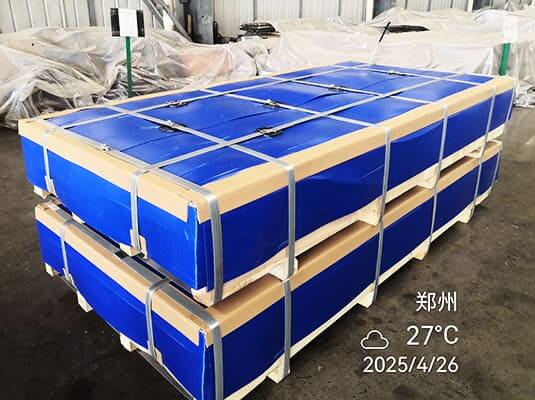
Export Packaging of Marine Grade 5086 H116 Aluminum Plate
VI. Marine Corrosion Performance: Scientific Analysis
6.1 5086’s Electrochemical Position in Seawater
Marine Grade 5086 H116 Aluminum Plate in seawater develops a natural open circuit potential (OCP) of approximately −0.85 V versus the saturated calomel electrode (SCE) — marginally more noble (positive) kaysa sa 5083 (approximately −0.87 V), reflecting the slightly lower magnesium content.
This small difference is practically insignificant for most marine design purposes, as both alloys occupy the same general position in the galvanic series and respond similarly to the same cathodic protection systems.
The passive film on 5086 in seawater is a thin (2–8 nm), amorphous aluminum oxide layer that forms spontaneously on exposure to oxygen-containing environments and maintains itself through a dynamic balance of dissolution and repassivation.
The key performance metric is the pitting potential — the electrochemical potential above which pits nucleate — and 5086’s pitting potential in seawater at 25°C falls at approximately −0.65 to −0.75 V versus SCE.
Since the natural OCP (−0.85 V) is significantly more negative than the pitting potential, 5086 in normal seawater service operates with approximately 100–200 mV of cathodic protection from its own bulk potential — a self-protective buffer that provides baseline resistance to pit nucleation.
6.2 The Three Critical Corrosion Modes and 5086’s Defense Mechanisms
Exfoliation Corrosion: The Primary H116 Defense
Exfoliation attacks 5xxx alloys through the elongated, pancake-shaped grain boundaries produced by rolling — intergranular seawater penetration progressively lifts successive plate layers along rolling planes, creating the characteristic blistered, delaminating appearance that gives exfoliation its name.
The mechanism requires three conditions simultaneously: a sensitized grain boundary network (continuous beta-phase coverage); an electrolyte (tubig dagat) capable of penetrating the grain boundary; and the geometric constraint of elongated grains that forces the corrosion product expansion to express as inter-layer delamination rather than dispersed general attack.
5086 H116 attacks this mechanism at its first prerequisite. By controlling cold reduction to produce an interrupted, discontinuous grain boundary beta-phase distribution, H116 temper removes the continuous intergranular pathway that seawater requires for progressive exfoliation.
Dagdag pa, 5086’s lower magnesium content (versus 5083) means that even without H116 temper control, the grain boundary beta-phase tends to form more slowly and in a more discontinuous pattern — providing an additional margin of safety that explains why 5086 in H32 temper shows better exfoliation resistance than 5083 in H32 temper, despite neither meeting the ASTM B928 certification requirement.
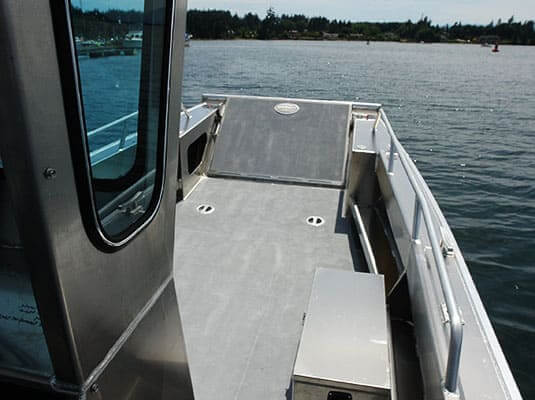
Ship Deck Used 5086 H116 Aluminum Plate
Stress Corrosion Cracking (SCC): Where 5086 Outperforms 5083
SCC combines sustained tensile stress with an active corrosive environment to propagate cracks at stress intensities far below the fracture toughness of unstressed material.
In sensitized 5xxx alloys, the continuous grain boundary beta-phase film enables anodic dissolution crack propagation. 5086 H116’s SCC resistance benefits from two reinforcing mechanisms: the H116 temper’s disruption of continuous grain boundary beta-phase (same as for exfoliation), and the lower magnesium content’s inherently slower sensitization kinetics.
Published data from long-term SCC testing of 5086 H116 demonstrates resistance to cracking at sustained stress levels up to 60% of yield strength in alternate immersion testing (ASTM G44) — superior to 5083 H116 (typically resistant to approximately 50% of yield strength) and dramatically superior to sensitized H32 material (which can crack at 20–25% of yield strength).
For hull structures carrying residual welding stresses of 30–50 MPa, this SCC resistance margin is adequate for normal marine service — but not unlimited. Any sustained tensile stress combined with a sensitization-promoting thermal environment deserves engineering attention.
Pitting Corrosion: The Baseline Seawater Attack
Pitting initiates at sites where the passive film is weakest: intermetallic particle-matrix interfaces, grain boundary emergence points, and surface scratches that expose fresh aluminum.
For Marine Grade 5086 H116 Aluminum Plate, the dominant pit initiation sites are Al₃Fe and Al₆Mn intermetallic particles, which are cathodic to the aluminum matrix and create local galvanic cells that dissolve the surrounding aluminum.
The iron impurity limit of ≤0.50% for 5086 (versus ≤0.40% for 5083) means that 5086 can in principle contain more Al₃Fe particles — a minor corrosion resistance disadvantage compared with 5083. In practice, most marine-grade 5086 producers hold iron below 0.30%, making this theoretical difference negligible.
Long-term immersion test data for 5086 in synthetic seawater (ASTM D1141) demonstrates average pit depths of 0.10–0.25 mm after 5 years — a corrosion rate of 0.02–0.05 mm/year that comfortably accommodates the plate thickness reserve available in marine hull plating.
VII. Marine Applications and Vessel Types
7.1 Recreational and Sport Boats: The Dominant Application Domain
The recreational boating market accounts for the largest proportion of 5086 H116 consumption globally, driven by the alloy’s exceptional combination of formability, seawater corrosion resistance, and weight efficiency for the vessel types and sizes that dominate recreational construction (6–18 m LOA).
Offshore aluminum fishing boats in the 6–12 m range represent the archetype 5086 H116 application. These vessels need compound-curved hulls with pronounced deadrise (typically 18–24°) and flared bows for offshore sea-keeping, seawater corrosion resistance for topsides that may not be painted for years between refits, and structural strength adequate for offshore service without excessive weight that would compromise performance with smaller outboard or stern-drive powerplants. Marine Grade 5086 H116 Aluminum Plate in 3.0–5.0 mm gauge satisfies all three requirements simultaneously.
Sailboat hulls present some of the most geometrically complex challenges in aluminum boat building — swept keels, curved transom sections, flared topsides, and pronounced tumblehome all require tight-radius bending that 5086 handles more reliably than 5083. Dagdag pa, sailboat structural loads are generally lower than equivalent-length powerboat loads (no slamming; lower speed), making the 10% yield strength difference between 5086 at 5083 structurally irrelevant for most sailing vessel applications. Experienced aluminum sailboat builders — including specialists in Europe and New Zealand — consistently specify 5086 H116 for topsides and above-waterline structure, reserving 5083 H116 for keel attachment areas and waterline/bottom plating where structural demands justify the extra strength.
Center console and walkaround boats (7–10 m) benefit from 5086’s formability when producing the deep-sided console structures, fish box surrounds, and freeboard sections that define these hull types. Builders report significantly fewer weld repairs from cracking during forming of these complex profiles when using 5086 H116 versus 5083 H116 — a direct production cost saving that more than compensates for any minor material cost premium.
7.2 Commercial Workboats: Combining Structural Performance with Formability
Commercial workboats — the practical, utilitarian vessels that service offshore platforms, transfer crew, conduct surveys, and support harbor operations — represent the second major consumption domain for 5086 H116.
Crew transfer vessels (CTVs) for offshore wind farm maintenance demonstrate the alloy selection optimization strategy most clearly. A typical 24 m CTV hull design often employs 5083 H116 (6–8 mm) for the bottom plating — where slamming loads from repeated turbine access at low sea states impose high cyclic stresses — and 5086 H116 (5–6 mm) for topsides and superstructure panels, where the lower structural demand allows the more formable alloy and where the complex crew accommodation geometry benefits from 5086’s tighter bending radius capability.
Pilot boats and harbor service craft (12–22 m) present particularly favorable conditions for 5086 H116: moderate structural loads (displacement rather than planing operation in most cases), complex hull forms typical of round-bilge displacement design, and the regular freshwater hosing-down of topsides that characterizes harbor vessel maintenance. The lower sensitization risk of 5086 H116 versus 5083 is a secondary advantage in harbor vessels that experience deck steam cleaning — a potential sensitization-temperature exposure that is entirely absent from the specification of hull construction alloys in most shipyards.
7.3 Marine Structures and Offshore Applications
Beyond boat hulls themselves, 5086 H116 plate serves extensively in marine structural applications where aluminum’s corrosion resistance and light weight are valued but maximum structural performance is secondary:
Floating marina finger docks and pontoons use 5086 H116 for their exceptional corrosion resistance in the aggressive environment of marina waters (elevated pollutant levels from fuel spills, antifouling paint runoff, and organic contamination from berthed vessels). The lower structural demands of floating dock construction make 5083’s extra strength unnecessary, while 5086’s formability simplifies the fabrication of the pontoon shapes and connection brackets that characterize marina dock systems.
Offshore platform walkways, handrails, and gratings — where the primary function is corrosion resistance and personnel safety rather than structural load-carrying — use 5086 H116 for its combination of adequate strength (sufficient for walkway loading per applicable codes), excellent corrosion resistance without painting (reducing maintenance in remote offshore locations), at magaan ang timbang (reducing the deadweight imposed on platform topside structure).
Gangways and access ramps for vessel-to-platform and vessel-to-shore transfer present formability demands that favor 5086: the articulating sections, curved guide rails, and angled landing platforms of modern gangway systems require bending operations where 5086’s tighter minimum bend radius enables designs that would require pre-annealing of 5083.
Habang 5083 H116 dominates primary hull structural applications in naval vessel construction, 5086 H116 finds substantial use in naval vessel secondary structure and superstructure:
Superstructure panels and enclosures on fast patrol craft and support vessels benefit from 5086’s formability when producing the non-planar, compound-curved surfaces that characterize modern naval vessel superstructure aesthetics (designed for reduced radar cross-section). Naval architects designing to stealth criteria specify curved, angled superstructure panels that challenge fabricators working with 5083; the transition to 5086 for these elements significantly improves first-pass fabrication success rates.
Mine countermeasure vessel (MCMV) auxiliary structure — non-structural panels, internal accommodation dividers, deck machinery housings — frequently uses 5086 H116 where weight reduction and corrosion resistance matter but maximum structural performance does not. The non-magnetic requirement that drives MCMV hull material selection to aluminum (or GRP) also applies to secondary structure, paggawa ng 5086 a natural fit.
Amphibious craft combined construction strategies increasingly employ 5086 H116 for topsides, ramp side panels, and crew compartment structure, reserving 5083 H116 for the bottom shell and structural frames that carry the concentrated loads of vehicle loading during beach landing operations.
XIII. Quality Standards, Pagsubok, and Certification
Certified Marine Grade 5086 H116 Aluminum Plate sits within a framework of complementary standards that address composition, mga katangian, sensitization, and documentation:
| Pamantayan | Issuing Body | Scope | Critical Requirement for 5086 |
|---|---|---|---|
| ASTM B928 | ASTM International | 5xxx alloys for marine service | NAMLT ≤15 mg/cm² on every lot |
| ASTM B209 | ASTM International | Al sheet and plate: dimensions and properties | Komposisyon ng kemikal; mekanikal na mga katangian |
| ASTM G67 | ASTM International | NAMLT sensitization test | Test procedure for B928 compliance |
| ASTM G66 | ASTM International | ASSET exfoliation test | Visual rating of exfoliation resistance |
| EN 485 | CEN | European sheet/plate: dimensions and tolerances | Dimensional tolerance framework |
| EN 573-3 | CEN | European alloy composition standards | 5086 composition limits |
| MIL-DTL-24093 | US DoD | Military marine aluminum | Naval vessel material qualification |
| EN 10204 | CEN | Material certificate types | 3.1 / 3.2 certification documentation |
IX. Pangwakas na Salita
The most important conclusion of this comprehensive examination is a reframing of how Marine Grade 5086 H116 Aluminum Plate is perceived. Too often described as “the less strong alternative to 5083 for applications where reduced strength is acceptable,” Marine Grade 5086 H116 Aluminum Plate is more accurately understood as the precision material choice for applications where superior formability, equivalent long-term marine corrosion resistance in certified H116 temper, and marginally better sensitization robustness combine to deliver better engineering outcomes than 5083 H116 would achieve.
The applications that specifically benefit from 5086 H116 are numerous and commercially significant: recreational aluminum boats with complex hull forms (the largest volume sector in marine aluminum consumption), sailboat hulls and topsides, commercial workboat secondary structure, offshore platform aluminum structures, mixed-alloy hull construction strategies, and the rapidly expanding battery-electric vessel market. In all these applications, 5086 H116 is not a fallback — it is the correct engineering answer.
Proseso ng paghahagis ng produksyon at ang pagpapakilala nito
Ang layunin ng pagtunaw at paghahagis ay upang makabuo ng mga haluang metal na may kasiya siyang komposisyon at mataas na kadalisayan ng matunaw, upang lumikha ng mga kanais nais na kondisyon para sa paghahagis ng mga haluang metal ng iba't ibang mga hugis.
Mga hakbang sa proseso ng pagtunaw at paghahagis: mga ka batch --- pagpapakain --- natutunaw na --- pagpapakilos pagkatapos matunaw, pag alis ng slag --- sampling bago ang pagsusuri --- pagdaragdag ng haluang metal upang ayusin ang komposisyon, nakakapukaw ng damdamin --- pagpipino --- static na Setting——Guide furnace casting.
Mainit na proseso ng produksyon ng pagulong at ang pagpapakilala nito
- 1. Mainit na pagulong sa pangkalahatan ay tumutukoy sa paggulong sa itaas ng metal recrystallization temperatura;
- 2. Sa panahon ng mainit na proseso ng pagulong, ang metal ay may parehong mga proseso ng pagpapatigas at paglambot. Dahil sa impluwensya ng bilis ng pagpapapangit, basta huli na ang recovery at recrystallization process, magkakaroon ng tiyak na gawaing pagpapatigas;
- 3. Ang recrystallization ng metal pagkatapos ng mainit na pagulong ay hindi kumpleto, na ang ibig sabihin ay, ang magkakasamang buhay ng recrystallized istraktura at deformed istraktura;
- 4. Ang mainit na pagulong ay maaaring mapabuti ang pagganap ng pagproseso ng mga metal at haluang metal, bawasan o alisin ang mga depekto sa paghahagis.
- 1. Ang temperatura ng paghahagis at pagulong ay karaniwang nasa pagitan ng 680 o C at 700 o C. Ang mas mababa ang mas mahusay na, Ang matatag na paghahagis at rolling line ay karaniwang tumitigil nang isang beses sa isang buwan o higit pa upang muling tumayo. Sa panahon ng proseso ng produksyon, kinakailangang mahigpit na kontrolin ang antas ng likido ng front tank upang maiwasan ang mababang antas ng likido;
- 2. Ang pagpapadulas ay gumagamit ng C powder na may hindi kumpletong pagkasunog ng gas para sa pagpapadulas, na isa rin sa mga dahilan ng maruming ibabaw ng casting at rolling materials;
- 3. Ang bilis ng produksyon ay karaniwang sa pagitan ng 1.5m / min-2.5m / min;
- 4. Ang kalidad ng ibabaw ng mga produkto na ginawa sa pamamagitan ng paghahagis at paggulong ay karaniwang medyo mababa, at sa pangkalahatan ay hindi maaaring matugunan ang mga produkto na may espesyal na pisikal at kemikal na mga kinakailangan sa pagganap.
- 1. Ang malamig na pagulong ay tumutukoy sa paraan ng paggulong ng produksyon sa ibaba ng temperatura ng recrystallization;
- 2. Hindi magkakaroon ng dynamic na recrystallization sa panahon ng proseso ng paggulong, at ang temperatura ay tataas sa temperatura ng pagbawi sa karamihan, at ang malamig na paggulong ay lilitaw sa isang trabaho hardening estado, at ang trabaho hardening rate ay magiging malaki;
- 3. Ang malamig na ginulong sheet at strip ay may mataas na dimensional na katumpakan, magandang kalidad ng ibabaw, unipormeng istraktura at pagganap, at mga produkto sa iba't ibang estado ay maaaring makuha sa heat treatment;
- 4. Malamig na pagulong ay maaaring i roll out manipis na strips, pero sabay sabay, ito ay may mga disadvantages ng mataas na pagkonsumo ng enerhiya para sa pagpapapangit at maraming mga pasa sa pagproseso.
- 1. Ang pagtatapos ay isang paraan ng pagproseso upang matugunan ng malamig na ginulong sheet ang mga kinakailangan ng customer, o upang mapadali ang kasunod na pagproseso ng produkto;
- 2. Ang mga kagamitan sa pagtatapos ay maaaring iwasto ang mga depekto na ginawa sa mainit na pagulong at malamig na proseso ng produksyon, tulad ng basag na gilid, may langis na, mahina ang hugis ng plato, natitirang stress, atbp. Kailangan nitong tiyakin na walang iba pang mga depekto na dinala sa proseso ng produksyon;
- 3. Mayroong iba't ibang mga kagamitan sa pagtatapos, pangunahin kabilang ang cross-cutting, pagputol ng hiwa, pag unat at pagtutuwid, annealing furnace, mga slitter, atbp.
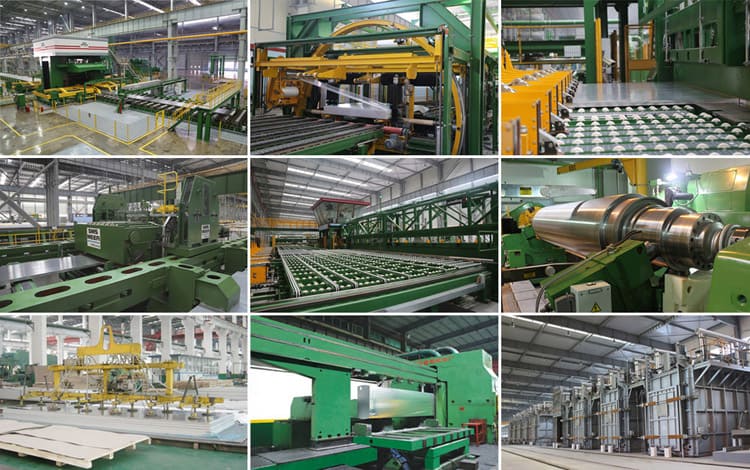
Proseso ng paghahagis at paggulong
Proseso ng paghahagis at paggulong: likidong metal, kahon sa harap (Kontrol sa antas ng likido), paghahagis at rolling machine (sistema ng pagpapadulas, paglamig ng tubig), paggupit ng makina, makina ng pag coiling.
Malamig na proseso ng produksyon ng pagulong
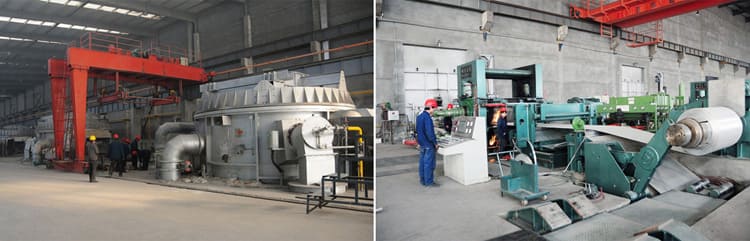
Panimula sa pagtatapos ng proseso ng produksyon
Aluminyo haluang metal ay may mga katangian ng mababang density, magandang mekanikal na katangian, magandang pagganap ng pagproseso, di nakakalason, madaling i recycle, mahusay na electrical kondaktibiti, paglipat ng init at paglaban sa kaagnasan, kaya ito ay may malawak na hanay ng mga application.
Aerospace: ginagamit upang gumawa ng mga balat ng sasakyang panghimpapawid, mga frame ng fuselage, mga girder, mga rotors, mga propeller, mga tangke ng gasolina, mga panel ng pader at mga struts ng landing gear, pati na rin ang rocket forging rings, mga panel ng pader ng spacecraft, atbp.
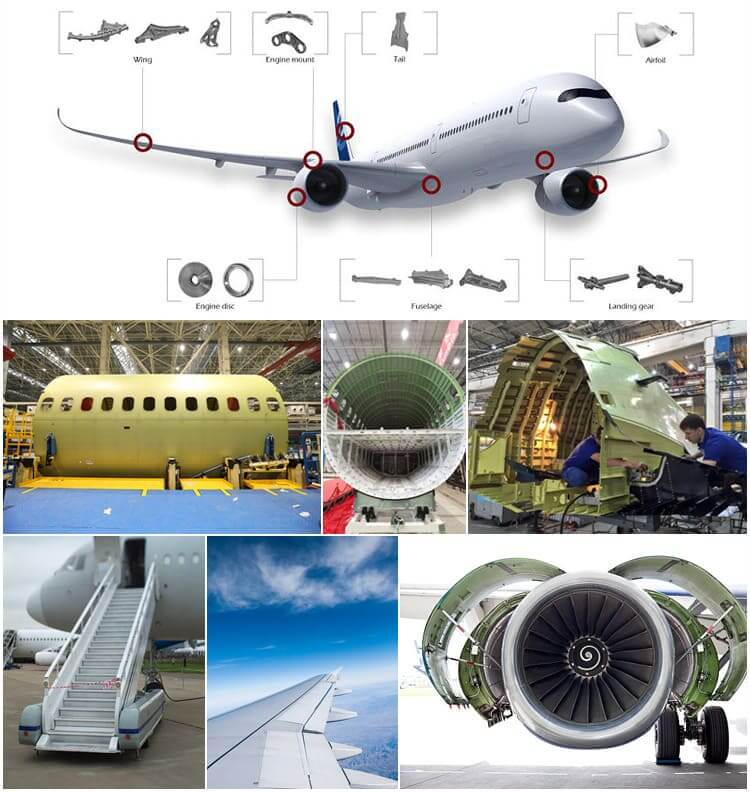
Aluminyo haluang metal na ginagamit para sa aerospace
Transportasyon: ginagamit para sa kotse katawan istraktura materyales ng mga sasakyan, Mga Sasakyan ng Subway, mga kotse ng pasahero ng tren, mabilis na mga kotse ng pasahero, mga pinto at bintana, mga istante, mga bahagi ng automotive engine, mga aircon, mga radiator, mga panel ng katawan, mga gulong at mga materyales ng barko.
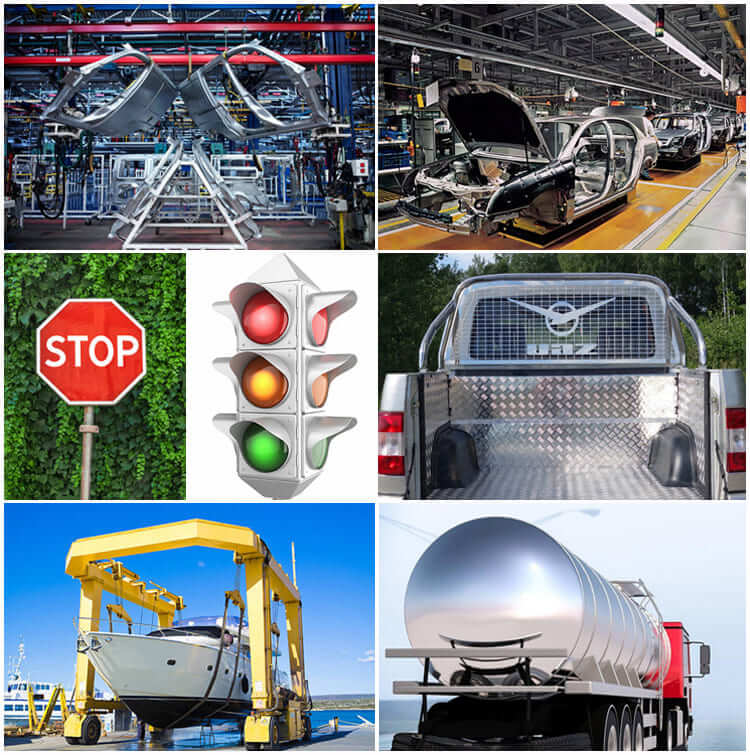
Application ng trapiko
Packaging: Ang lahat ng aluminyo pop lata ay pangunahing ginagamit bilang mga materyales sa packaging ng metal sa anyo ng mga manipis na plato at foils, at ginagawang lata, mga takip, mga bote, mga bariles, at packaging foils. Malawakang ginagamit sa packaging ng mga inumin, pagkain, mga pampaganda, mga gamot, mga sigarilyo, mga produktong pang industriya, mga gamot, atbp.
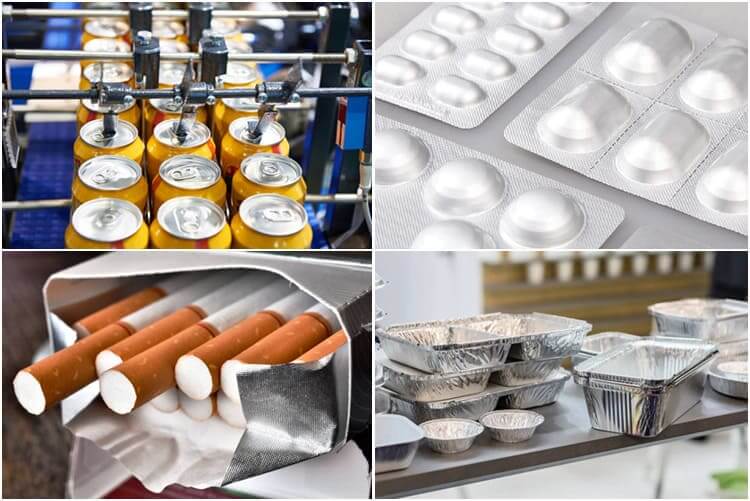
Application ng packaging
Pag-print: Pangunahing ginagamit upang gumawa ng PS plates, ang mga PS plate na nakabase sa aluminyo ay isang bagong uri ng materyal sa industriya ng pag print, ginagamit para sa awtomatikong paggawa ng plato at pag print.
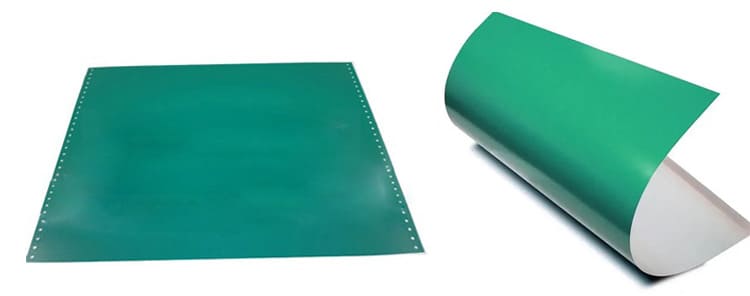
Pag print ng PS
Dekorasyon ng arkitektura: aluminyo haluang metal ay malawakang ginagamit sa mga istraktura ng gusali, mga pinto at bintana, suspendido ang mga kisame, pandekorasyon na ibabaw, atbp. dahil sa magandang kaagnasan nito paglaban, sapat na lakas, mahusay na pagganap ng proseso at pagganap ng hinang.
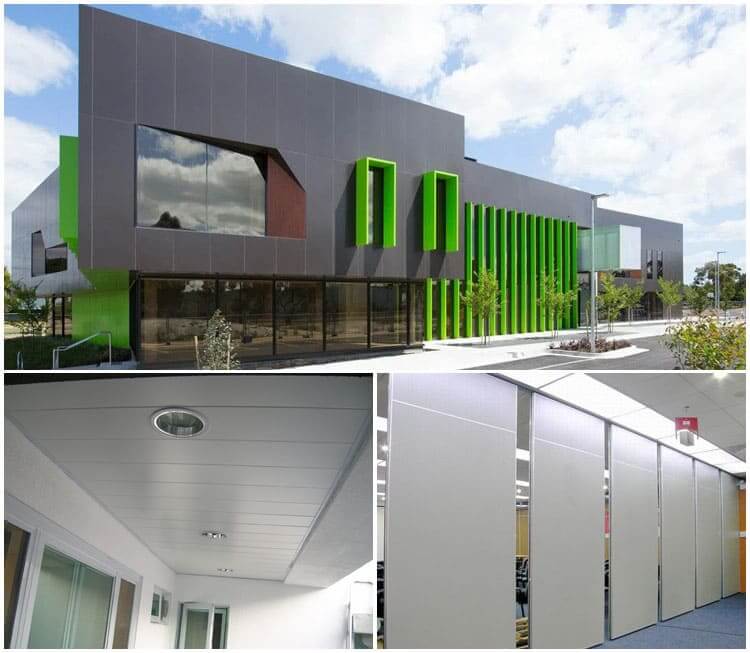
Application ng konstruksiyon ng haluang metal ng aluminyo
Mga produktong elektroniko: mga computer, mga mobile phone, mga shell ng refrigerator, mga radiator, atbp.
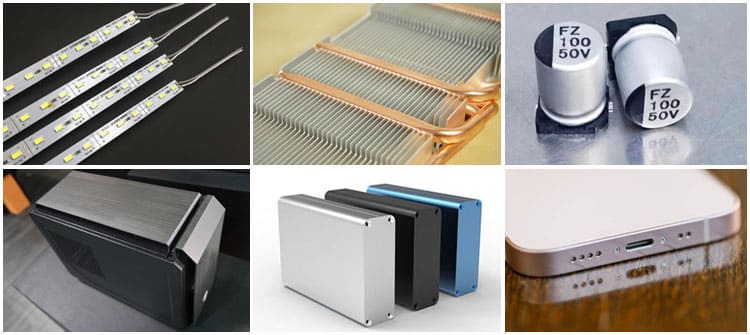
Electronic application ng produkto
Mga gamit sa kusina: mga kaldero ng aluminyo, aluminyo basins, mga liner ng rice cooker, sambahayan aluminyo foil, atbp.
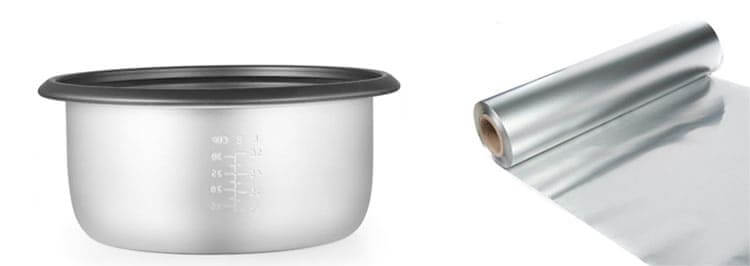
Application ng kusina
Packaging Ng Aluminum Sheet / Coil
Ang bawat detalye ng packaging ay kung saan namin ituloy ang perpektong serbisyo. Ang aming proseso ng packaging sa kabuuan ay ang mga sumusunod:
Paglalamina: malinaw na pelikula, asul na pelikula, mikro-mucosal, mataas na mucosal, laser pagputol ng pelikula (2 mga tatak, Novacell at Polyphem);
Proteksyon: mga tagapagtanggol ng sulok ng papel, mga pads laban sa presyon;
pagpapatayo ng mga: desiccant;
Tray: fumigated hindi nakakapinsala kahoy na tray, magagamit muli ang bakal na tray;
Pag-iimpake: Tik-tik-toe bakal sinturon, o PVC packing belt;
Kalidad ng Materyal: Ganap na libre mula sa mga depekto tulad ng puting kalawang, mga spot ng langis, mga rolling mark, pinsala sa gilid, mga baluktot, mga dent, mga butas, mga break lines, mga gasgas na, atbp., walang coil set.
Port: Qingdao o iba pang mga port sa China.
Lead oras: 15-45 mga araw.
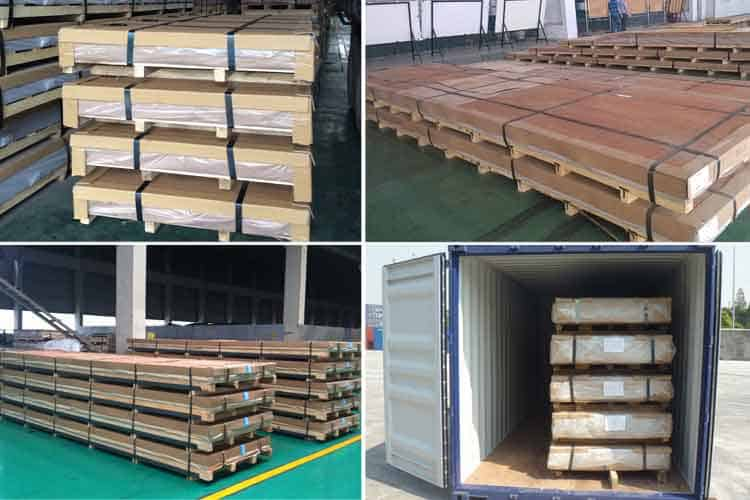
Aluminyo sheet / plate packaging proseso
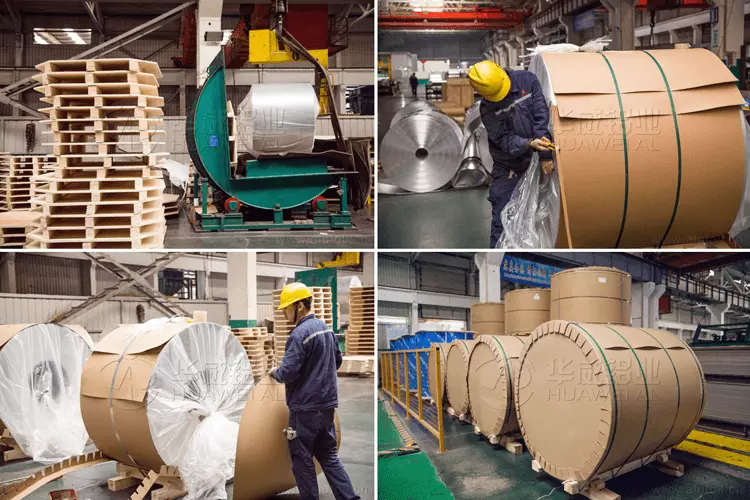
Aluminyo likawin packaging proseso
F: Ikaw ba ay isang tagagawa o isang mangangalakal?
Q: Kami ay isang tagagawa, ang factory namin ay sa No.3 Weier Road, Sonang Pang industriya, Gongyi, Henan, Tsina.
F: Ano ang MOQ para sa pag order ng produkto?
Q: Ang MOQ natin ay 5 tonelada, at ang ilang mga espesyal na produkto ay magkakaroon ng isang minimum na dami ng order ng 1 o 2 tonelada.
F: Gaano katagal ang iyong oras ng lead?
Q: Sa pangkalahatan ang aming lead time ay tungkol sa 30 mga araw.
F: Mayroon bang kalidad ng katiyakan ang iyong mga produkto?
Q: Oo nga, kung may problema sa quality sa products namin, kami ay mabayaran ang customer hanggang sa sila ay nasiyahan.
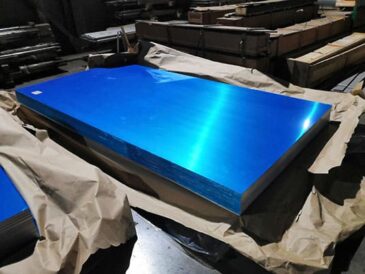
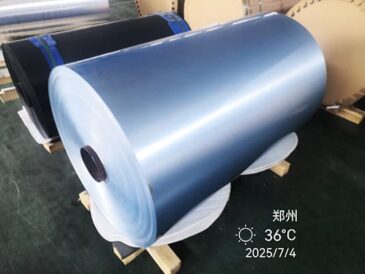
Mga Kaugnay na Produkto



Mga Pinakabagong Blog
Common Alloys of Reefer Truck Used PE Coated Aluminum Coil
Discover common alloys of reefer truck used PE coated aluminum coil, kasama na ang 3003, 3004, at 3105. Designed for excellent corrosion resistance, pagiging formable, and long-lasting outdoor performance.
Is Aluminum Conductive? Mga Katangian, Gumagamit ng mga & Benefits Explained
Is aluminum conductive? Discover aluminum's electrical conductivity, key advantages, and why it is widely used in power transmission and industrial applications.
Unlocking Sustainability: The Truth About Aluminum Foil Recycling
Is Aluminum Foil Recyclable? Learn how aluminum foil can be recycled, how to prepare it properly, and why recycling helps reduce waste and save resources.