Anodized Aluminum Cookware
15,489 Views 2025-11-06 07:29:00
1. What Is Anodized Aluminum Cookware?
Anodized Aluminum Cookware is aluminum cookware that has undergone controlled electrochemical oxidation. The process converts the outer microns of aluminum into dense Al₂O₃, creating a surface that is hard, inert, and corrosion-resistant. Compared with painted or PTFE-only nonstick, the anodic layer is integral to the substrate (not a film), so it won’t peel or flake under normal use.

Anodized Aluminum Cookware
2. Cookware Alloy Selection (Body & Handle)
| Component | Recommended Alloys | Why These Alloys | Notes for Anodizing |
|---|---|---|---|
| Pan/Pot body (deep-draw/spun) | 3003, 3004, 5052 aluminum circle | Good drawability; stable grain for spinning; balanced strength | 3xxx/5xxx anodize uniformly; popular for hard anodized cookware bodies |
| Forged/thick bases & premium pans | 6061, 6082 | Higher strength and stiffness for thicker sections | Hard-anodizes well; ideal for 2.5–5.0 mm premium skillets |
| Lids (ring/knob carriers) | 3003/5052 | Light, formable | Anodize or clear-coat |
| Handles / Rivets | 3003/5052 (cast/formed Al) or 304/430 SS | Thermally tuned grip | Stainless handles avoid hand heat; ferritic 430 aids induction discs |
Tip: High-silicon die-cast alloys anodize to darker/patchy tones; premium forged or wrought bodies yield the most uniform hard-anodized finish.
3. Typical Technical Parameters
| Parameter | Decorative Anodizing | Hard Anodizing | Units / Notes |
|---|---|---|---|
| Coating Thickness | 5 – 25 | 25 – 100 | µm |
| Surface Hardness | 150 – 300 | 350 – 700 | HV (Vickers) |
| Porosity (unsealed) | 5 – 15% | 1 – 6% | Lower porosity = higher corrosion resistance |
| Thermal Impact | < 3–5% | Minimal | Heat transfer reduction negligible |
| Wear Resistance | 2–4× vs. bare Al | 5–10× vs. bare Al | Taber abrasion test |
| Salt Spray Resistance | 24 – 96 h | 96 – 500 h | Depends on sealing quality |
| Sealing Method | Hot water / chemical | Chemical / cold sealing | Improves corrosion resistance |
| Food Safety | Compliant after sealing | Fully compliant | Migration & heavy metal tested |
Data based on standard lab test ranges and industrial results; specific values depend on processing method and testing protocol.

5052 Anodized Aluminum Circle
4. Performance Analysis & Data Insights
4.1 Wear & Scratch Resistance
The anodic oxide layer is ceramic-like, dramatically increasing hardness.
Hard-anodized coatings typically reach 350–700 HV, which reduces surface wear by 5–8 times compared to bare aluminum.
Taber abrasion and field tests confirm that hard-anodized cookware maintains appearance and non-stick performance even after extended use.
4.2 Thermal Conductivity
Base aluminum has a thermal conductivity of about 237 W/m·K, while the oxide layer has a much lower value.
However, since the anodic layer is extremely thin (usually <50 µm), its overall impact on heat transfer is less than 5%.
Thus, anodized cookware preserves aluminum’s hallmark fast and even heat distribution.
4.3 Corrosion Resistance & Sealing
Unsealed anodic pores may trap contaminants and reduce corrosion resistance.
Through hot water or chemical sealing, pore size and permeability decrease, increasing salt-spray performance from 24 hours to up to 500 hours.
A thin food-grade coating may be applied post-anodizing for enhanced acid, alkali, and cleaning resistance.
4.4 Food Contact Safety
Aluminum oxide (Al₂O₃) is chemically inert and non-reactive.
To ensure safety:
-
- Pores must be properly sealed;
- Electrolyte residues must be removed;
- Coloring or coating materials must meet migration limits.
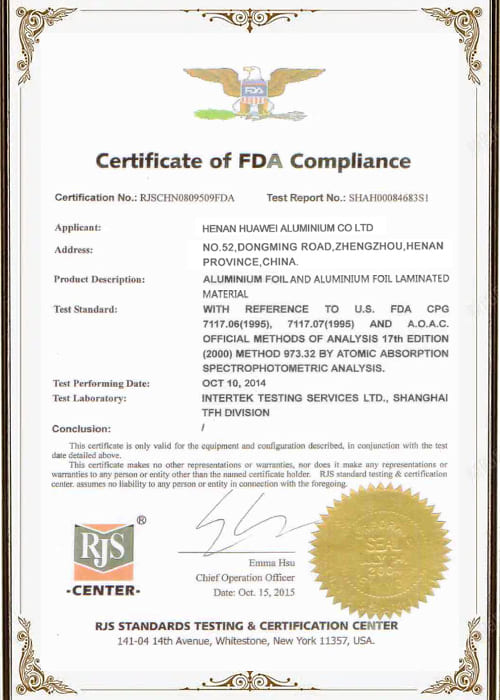
Certified cookware typically passes overall and specific migration tests as required by FDA / EU food-contact standards.

Packaged 1100 Aluminum Circle
5. Design & Manufacturing Considerations
5.1 Alloy Selection
The alloy composition affects anodizing uniformity and appearance.
Common choices: 3003, 5052, 6061 —
- 3003: excellent formability, ideal for deep-drawn pots and pans.
- 5052 / 6061: higher strength and post-forming stability.
Henan Huawei Aluminum Co., Ltd. can recommend alloy types based on forming and anodizing compatibility.
5.2 Film Thickness vs. Application
| Application | Type | Recommended Thickness |
|---|---|---|
| Daily cookware | Decorative anodizing | 5–20 µm |
| Professional / heavy-duty cookware | Hard anodizing | 30–80 µm |
Thicker coatings improve durability but slightly increase cost and internal stress; optimal design balances hardness, cost, and heat response.
5.3 Sealing & Post-treatment
To maximize corrosion resistance and hygiene:
- Chemical sealing is recommended over hot-water sealing;
- Optional nano-silica or food-grade fluorine coatings can improve cleanability and reduce staining.
5.4 Quality Control (QC / IQC)
Critical inspection points include:
- Film thickness uniformity (tolerance ±2–5 µm);
- Hardness testing (HV values);
- Pore sealing verification (bubble or dye tests);
- Salt-spray and abrasion cycle sampling;
- Migration and heavy metal testing (FDA / EU compliance).

Thickness Test of Aluminum Circle
6. Manufacturing Routes for Anodized Aluminum Cookware
- Deep drawing + spinning (most common): aluminum circles → deep-drawn cups → spun to profile → trim → hard anodize → seal.
- Forged heavy-gauge: plate/slug heated and forged → CNC trim → hard anodize → seal. Best for even heating and warp resistance.
- Impact-bonded base: Aluminum body + ferritic stainless disc impact-bonded for induction compatibility.
- Riveting/handles: Stainless handles/rivets minimize heat conduction to grip; anodized aluminum handles are lighter but need thermal breaks.
7. Huawei Quality Control & Test Plan
- Anodic thickness: Eddy-current mapping (≥12 points per pan).
- Hardness: HV test on rim/flat; acceptance ≥ 350 HV for premium lines.
- Seal quality: Dye stain or conductivity drop method.
- Corrosion: Neutral salt spray or acetic salt spray (customer-defined hours); kitchen simulants (tomato/lemon).
- Adhesion: Cross-hatch on dyed/anodized + top-coat systems.
- Thermal shock: 10× cycles (200 °C to water quench).
- Warp/flatness: Pre- and post-thermal cycles on glass-top fixtures.
- Induction base: Bond shear / peel after cycling.

Huawei Anodized Aluminum Circle
8. Anodized Aluminum Cookware Compare with Other Materials
| Attribute | Hard-Anodized Aluminum | Stainless (304/316) | Cast Iron | Copper (clad) |
|---|---|---|---|---|
| Heat conductivity | High (≈205) | Low (≈16) | Medium (≈50) | Very high (≈385) |
| Heat-up time | Fast | Slow | Medium | Fast |
| Weight (relative) | Lightest | Heavy | Heavy | Heaviest |
| Surface hardness | High (300–500 HV) | Medium | Medium (seasoned) | Soft (clad face is SS) |
| Induction-ready | Needs disc/clad | Yes | Yes | If ferritic clad |
| Maintenance | Low | Low | Seasoning needed | Moderate |
| Cost tier | $$ (value-premium) | $$–$$$ | $–$$ | $$$$ |
9. Conclusion
Anodizing transforms aluminum cookware into a durable, corrosion-resistant, and visually appealing product while maintaining its lightweight and thermal efficiency.
Success depends on selecting suitable alloys, coating thickness, and sealing processes, combined with strict quality and compliance control.
With full-process manufacturing and testing capabilities, Henan Huawei Aluminum Co., Ltd. offers cookware producers a complete material and surface engineering solution, ensuring consistent quality and global competitiveness.
10. FAQs — Anodized Aluminum Cookware
Is hard-anodized aluminum cookware nonstick?
Not inherently. It’s low-stick when preheated/seasoned; many brands add PTFE/ceramic for easy-release.
Will acids attack the surface?
Properly sealed Type III tolerates kitchen acids; avoid prolonged soaking in strong alkali detergents.
Metal utensils?
Occasional contact is fine; avoid sharp scraping to preserve finish aesthetics.
Dishwasher safe?
Some products are rated so, but hand-wash extends appearance and seal life.
Induction use?
Requires ferritic disc or clad construction.
Is aluminum exposure a risk?
The anodic layer is inert; it isolates base aluminum from food.
Why are premium pans heavier?
Thicker bases (≥3 mm) improve evenness and warp resistance.
Can the color fade?
Dyes can fade under UV/alkali; natural hard-anodized gray/black is most stable.