1100 Spinning Aluminium Circle for Cookware
1256 Views 2026-08-13 02:39:40
1. Executive Summary
1100 Spinning Aluminium Circle for Cookware is a high-purity aluminum circular blank specifically used as a starting material for cookware manufactured through metal spinning, forming, and related fabrication processes.
AA 1100 belongs to the 1xxx series of wrought aluminum alloys and contains a minimum of 99.00% aluminum.
Its combination of excellent ductility, formability, corrosion resistance, and thermal conductivity makes it a practical material for producing spun pots, frying pans, saucepans, lids, bowls, and other kitchenware.
Unlike cookware materials selected primarily for high mechanical strength, 1100 aluminum focuses on easy forming, efficient heat transfer, corrosion resistance, and lightweight construction.
These characteristics are particularly valuable in metal spinning, where a flat circular blank undergoes controlled plastic deformation while rotating against a mandrel.
The material must flow smoothly under the forming roller while maintaining sufficient integrity to avoid cracking, tearing, or excessive wrinkling.
2. What Is 1100 Spinning Aluminium Circle?
2.1 Definition of 1100 Aluminum Circle
A 1100 aluminum circle is a flat, round aluminum blank manufactured from AA 1100 aluminum sheet or coil.
Instead of supplying the material as a rectangular sheet, manufacturers cut it into a precise circular shape before it enters the forming process.
For cookware production, this circular blank becomes the starting workpiece for metal spinning. The blank is mounted onto a spinning machine and rotated at high speed.
A forming roller then applies controlled pressure while following the surface of a mandrel. As the roller progressively moves across the material, the flat circle deforms into the desired three-dimensional cookware shape.
Therefore, the term “1100 Spinning Aluminium Circle” describes three important characteristics:
- 1100 — the aluminum alloy designation.
- Spinning — the intended metal-forming process.
- Circle — the round blank geometry supplied to the manufacturer.
This combination makes the product particularly relevant to cookware manufacturers using rotary forming processes.
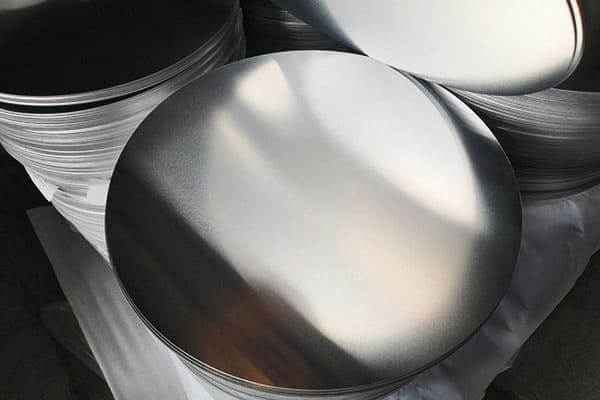
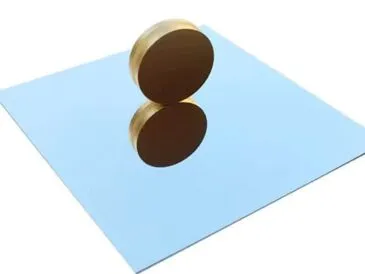
1100 Spinning Aluminium Circle Surface Display
2.2 What Is Aluminum Metal Spinning?
Metal spinning is a forming process that converts a flat metal blank into a symmetrical hollow component through controlled plastic deformation.
The basic process can be summarized as:
Aluminum Circle → Rotational Clamping → Roller Forming → Progressive Deformation → Trimming → Finished Cookware
During spinning, the aluminum circle rotates together with the mandrel. The forming roller gradually moves the material toward the mandrel surface instead of forcing the entire blank into its final shape in a single operation.
This controlled deformation allows manufacturers to produce cookware with different depths, diameters, wall profiles, and curved geometries while using relatively flexible tooling.
For aluminum cookware, the quality of the original circle directly affects the stability of this process. Variations in thickness, surface defects, edge condition, or material properties can become more obvious as the blank is progressively formed.
2.3 Why Is 1100 Aluminum Suitable for Spinning?
AA 1100 is a commercially pure wrought aluminum alloy with a minimum aluminum content of 99.00%.
As a member of the 1xxx series, it is characterized by excellent workability and corrosion resistance, together with high thermal and electrical conductivity.
These characteristics are particularly useful for metal spinning.
During spinning, the material needs to accommodate significant plastic deformation without developing premature cracks.
1100 aluminum has relatively high ductility and can therefore undergo substantial forming when the appropriate temper and processing conditions are selected.
Its forming behavior is one reason 1100 aluminum has long been associated with applications involving formed and spun hollowware.
For cookware manufacturers, this means the alloy can provide a good material foundation for products in which forming performance is more important than maximum mechanical strength.
3. Why Choose 1100 Aluminum Circle for Cookware?
3.1 Excellent Formability for Metal Spinning
The primary reason manufacturers choose 1100 aluminum for spun cookware is its excellent formability.
Metal spinning places considerable demands on the material because the flat circle must progressively transform into a three-dimensional component. If the material cannot accommodate the required plastic deformation, defects such as cracking, tearing, wrinkling, or localized thinning may occur.
1100 aluminum provides a favorable combination of softness and ductility, particularly when supplied in a suitable annealed or soft temper. This allows the material to flow under the forming roller and conform to the mandrel geometry with relatively low resistance.
For cookware with deep walls, curved profiles, or relatively complex shapes, this forming capability can improve process stability and reduce the risk of material failure.
3.2 High Thermal Conductivity
Thermal performance is one of the most important considerations in cookware.
Aluminum has significantly higher thermal conductivity than many common ferrous cookware materials. 1100, as a high-purity aluminum alloy, retains the excellent thermal conductivity characteristic of the 1xxx series.
However, the thermal performance of finished cookware depends on more than alloy selection. Wall thickness, base construction, cookware geometry, surface treatment, and whether the product uses a multilayer base can all influence actual heat distribution.
3.3 Excellent Corrosion Resistance
Cookware operates in a demanding environment involving water, steam, food ingredients, cleaning agents, and repeated heating cycles.
1100 aluminum offers excellent corrosion resistance because of its high aluminum content and the protective oxide film that naturally forms on its surface.
This characteristic makes it suitable for kitchenware applications where the material may be exposed to moisture and normal atmospheric conditions.
Nevertheless, corrosion resistance should always be evaluated together with the final cookware design. Coatings, anodizing, food-contact requirements, cleaning conditions, and the chemical characteristics of the food being prepared can influence the long-term performance of the finished product.
3.4 Lightweight Cookware Construction
Aluminum has a density of approximately 2.71 g/cm³, which is considerably lower than that of steel and many other cookware metals.
Using 1100 aluminum circles therefore allows manufacturers to produce cookware with relatively low weight without sacrificing the advantages associated with metal construction.
3.5 Good Surface Quality for Finishing
Surface appearance is important for both functional and decorative cookware.
A properly manufactured 1100 aluminum circle can provide a smooth and consistent starting surface for subsequent processes such as:
- Polishing
- Brushing
- Anodizing
- Coating
- Painting
- Other decorative or protective treatments
This is particularly important because spinning can expose or emphasize pre-existing defects. A minor scratch on a flat aluminum circle may become more visible after the material has been stretched and formed into the final cookware shape.
For this reason, surface inspection should be performed before the circles enter the spinning process.
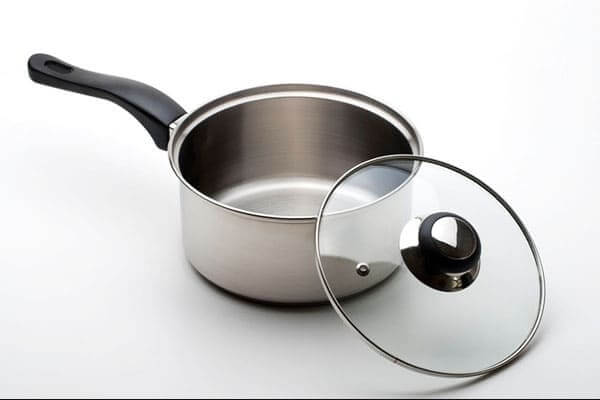
1100 Spinning Aluminium Circle for Cookware
4. Chemical Composition of 1100 Aluminum Alloy
AA 1100 is a commercially pure wrought aluminum alloy belonging to the 1xxx aluminum series.
Its defining characteristic is a very high aluminum content, with the balance consisting of controlled amounts of iron, silicon, copper, manganese, zinc, and other residual elements.
According to ASTM B209/B209M, alloy 1100 is identified as UNS A91100 for aluminum and aluminum-alloy sheet, coiled sheet, and plate products.
4.1 Typical Chemical Composition of AA 1100
| Element | Composition, wt.% | Main Influence |
|---|---|---|
| Aluminum (Al) | ≥ 99.00 | Base metal; contributes to ductility, corrosion resistance and conductivity |
| Copper (Cu) | 0.05–0.20 | Provides limited solid-solution strengthening |
| Iron (Fe) | ≤ 0.95 | Controlled impurity; can influence microstructure and formability |
| Silicon (Si) | ≤ 0.95 | Controlled impurity; affects microstructure and processing |
| Manganese (Mn) | ≤ 0.05 | Minor alloying/residual element |
| Zinc (Zn) | ≤ 0.10 | Controlled residual element |
| Other elements | Limited by standard | Maintains alloy consistency |
| Total Al + specified constituents | Balance | Determines final alloy chemistry |
The exact limits should always be verified against the specific standard and product specification being ordered because chemical-composition limits can differ slightly between standards and product forms.
4.2 Why High Aluminum Purity Matters for Spinning
The high aluminum content of AA 1100 is closely related to its excellent workability.
Unlike precipitation-hardenable aluminum alloys, 1100 does not rely on a complex alloying system to achieve high strength.
Instead, it retains a relatively soft and ductile metallurgical character.
This is particularly beneficial during spinning.
When a 1100 aluminum circle passes through a spinning operation, the material must undergo localized plastic deformation as the forming roller progressively moves across the blank.
A highly ductile material can accommodate this deformation more readily, reducing the risk of premature cracking under properly controlled processing conditions.
5. Mechanical Properties and Temper Selection
Mechanical properties are particularly important when 1100 aluminum circles are used for spinning because the forming process depends heavily on the material’s ability to undergo controlled plastic deformation.
Unlike applications where maximum tensile strength is the primary design criterion, cookware spinning often requires a careful balance between strength and ductility.
A material that is too hard may resist deformation and increase the possibility of cracking, while an appropriately soft material can flow more readily around the spinning mandrel.
5.1 Typical Mechanical Properties of 1100 Aluminum
Mechanical properties vary with temper and product thickness. Therefore, the following values should be regarded as representative rather than universal design values.
| Property | 1100-O | 1100-H12 | 1100-H14 |
|---|---|---|---|
| Temper Condition | Annealed | Strain hardened | Strain hardened |
| Relative Strength | Low | Moderate | Higher |
| Ductility | Very High | High | Moderate |
| Formability | Excellent | Very Good | Good |
| Spinning Suitability | Excellent for severe forming | Good for moderate forming | More suitable for less severe forming |
| Typical Use | Deep spinning and forming | General forming | Components requiring additional strength |
Actual tensile strength, yield strength, and elongation should be taken from the applicable material standard for the specified thickness and temper rather than using one value for every 1100 circle.
5.2 Why Temper Selection Matters for Spinning
Temper determines how much deformation the aluminum can accommodate before failure.
A simplified relationship is:
Softer temper → higher ductility → easier forming
Harder temper → higher strength → lower forming margin
This does not mean that O temper is always the best option. The correct choice depends on the final cookware design and production process.
For example:
- A deep cooking pot with substantial wall deformation may favor a softer temper.
- A shallow pan with limited deformation may tolerate a harder condition.
- A lid may require a balance between forming capability and final rigidity.
Therefore, temper selection should be made according to the forming ratio, wall geometry, thickness, tooling design, and required final properties.
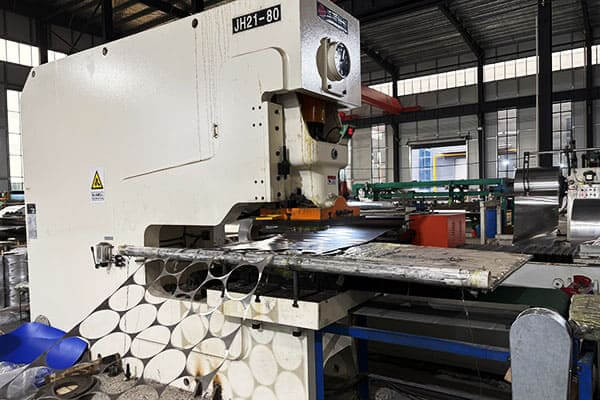
Production of 1100 Aluminium Circle
6. 1100 Spinning Aluminium Circle Manufacturing Process
The quality of a 1100 spinning aluminum circle begins long before the circle reaches the cookware factory.
Consistent performance depends on controlling the entire production chain, from aluminum alloy preparation and rolling to circle cutting, inspection, packaging, and storage.
A typical manufacturing route can be represented as:
Aluminum Alloy Preparation → Casting → Homogenization → Hot Rolling → Cold Rolling → Annealing → Precision Circle Cutting → Edge Processing → Inspection → Packaging
Each stage can influence the final spinning behavior.
6.1 Aluminum Alloy Preparation
The manufacturing process begins with aluminum alloy preparation according to the required AA 1100 chemistry.
High-purity aluminum is combined with controlled quantities of permitted alloying and residual elements. Chemical composition is checked before casting to ensure that the material meets the specified alloy limits.
6.2 Casting
The molten aluminum is cast into a suitable semi-finished form, commonly through an industrial direct-chill casting route for wrought aluminum production.
During casting, process control is important for minimizing undesirable metallurgical features and maintaining a suitable starting structure for subsequent rolling.
The cast structure is not the final microstructure of the aluminum circle. Subsequent homogenization and rolling processes substantially modify it.
6.3 Homogenization
Homogenization is a controlled heat-treatment step performed after casting and before extensive rolling.
Its purpose is to reduce chemical segregation and modify the distribution of alloying elements and intermetallic phases within the cast structure.
For 1100 aluminum, proper homogenization can contribute to more consistent downstream processing and help establish a stable metallurgical condition for rolling.
6.4 Hot Rolling
The homogenized aluminum is hot rolled to progressively reduce its thickness.
Hot rolling serves several purposes:
- Reduces the thickness of the cast material
- Breaks down the cast structure
- Improves structural uniformity
- Establishes the basis for subsequent cold rolling
- Controls the final product thickness range
For spinning circles, thickness uniformity is particularly important because the final blank must deform consistently during rotational forming.
6.5 Cold Rolling
Cold rolling further reduces the material thickness and improves dimensional control.
This stage has a major influence on:
- Thickness tolerance
- Surface quality
- Mechanical properties
- Grain structure
- Final temper
The amount of cold reduction and subsequent annealing schedule must be carefully controlled because these parameters influence the balance between strength and ductility.
6.6 Annealing and Temper Control
Annealing is one of the most important steps when producing soft, highly formable 1100 aluminum circles.
For 1100-O, controlled annealing reduces the effects of cold work and restores a softer, more ductile condition.
For H tempers, the final temper is established through controlled cold working to achieve the required strength and hardness.
The relationship can be simplified as:
Rolling → Cold Work → Increased Strength
Annealing → Reduced Cold-Work Effects → Increased Ductility
This makes temper control a critical part of manufacturing spinning-grade aluminum circles.
6.7 Precision Circle Cutting
After the aluminum sheet or coil reaches the required thickness and temper, it is converted into circular blanks using precision cutting equipment.
The cutting process must control:
- Circle diameter
- Roundness
- Edge quality
- Burr formation
- Dimensional consistency
Accurate circle dimensions are essential because the blank diameter directly influences material utilization and the forming behavior of the finished cookware.
6.8 Edge Processing
After blanking, the circle edges may undergo deburring or other edge-control processes depending on the customer’s requirements.
A properly controlled edge helps reduce:
- Sharp edges during handling
- Edge cracking during spinning
- Material tearing
- Surface damage to tooling
- Production interruptions
For automated cookware production, consistent edge quality can also improve feeding and positioning reliability.
6.9 Surface Inspection
Surface inspection is particularly important for spinning-grade material.
Typical defects that should be controlled include:
- Scratches
- Dents
- Roll marks
- Stains
- Oxide-related defects
- Edge cracks
- Foreign-material contamination
- Excessive surface roughness
The reason is simple: spinning can magnify defects that already exist in the blank.
A surface that appears acceptable before forming may become visibly defective after it has been stretched over a mandrel.
6.10 Packaging and Storage
Aluminum circles should be packaged to prevent scratching, deformation, contamination, and moisture-related problems during transportation.
Typical protective measures include:
- Protective paper or film where appropriate
- Wooden pallets
- Edge protection
- Moisture-resistant packaging
- Secure stacking
- Proper container loading
Storage conditions also matter. Aluminum products should preferably be kept in a dry environment and protected from condensation. Improper storage can result in surface staining or other appearance problems before the material reaches the cookware production line.
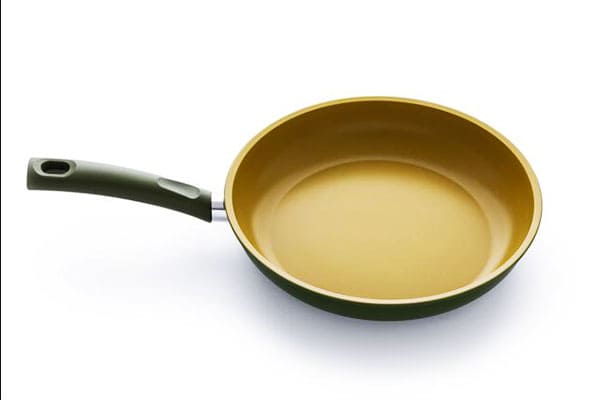
1100 Spinning Aluminium Circle for Frying Pans
7. Key Factors Affecting 1100 Aluminum Spinning Performance
The spinning performance of a 1100 aluminum circle depends on the interaction between material properties, blank dimensions, tooling, machine parameters, and forming conditions.
Even though AA 1100 has excellent ductility and is widely regarded as a highly formable aluminum alloy, an unsuitable temper, excessive deformation, poor blank quality, or incorrect spinning parameters can still cause cracking, wrinkling, uneven wall thickness, or surface defects.
For cookware manufacturers, evaluating these factors before production is essential for achieving consistent forming quality and minimizing scrap.
7.1 Aluminum Alloy and Temper
The alloy grade provides the basic material characteristics, while the temper determines the balance between strength and ductility.
For 1100 aluminum circles, softer conditions generally provide better forming capability.
1100-O is particularly suitable for applications involving significant deformation because the annealed condition offers high ductility.
H12 and H14 conditions provide progressively greater strength and hardness, but their forming capacity is lower than that of the fully annealed condition.
| Forming Requirement | Recommended Material Consideration |
|---|---|
| Deep or severe spinning | 1100-O generally preferred |
| Moderate forming | 1100-O or H12, depending on design |
| Shallow spinning | H12 or H14 may be considered |
| Higher final rigidity | Harder temper may be advantageous if forming permits |
The important principle is that higher strength does not automatically mean better cookware material.
For a deep-spinning application, excessive hardness can reduce the available forming margin.
7.2 Circle Thickness
Thickness has a direct influence on material flow, forming force, finished wall thickness, weight, and dimensional stability.
A thicker blank generally provides greater rigidity and may better resist local deformation, but it also requires greater forming force.
A thinner blank can reduce product weight and material consumption but may be more sensitive to localized thinning, wrinkling, or deformation.
Most importantly, thickness uniformity is often more important than simply achieving a nominal thickness. Significant variation across the circle can produce inconsistent material flow during spinning.
7.3 Circle Diameter
The initial circle diameter determines how much material is available to form the finished cookware.
If the blank is undersized, there may not be sufficient material to achieve the required wall height or final geometry. An oversized blank, on the other hand, can increase material consumption and create additional trimming waste.
The required blank diameter should be established based on:
- Finished cookware diameter
- Finished depth
- Wall profile
- Material thickness
- Forming method
- Trimming allowance
For high-volume manufacturing, maintaining tight diameter tolerances helps stabilize automated production and improve material utilization.
7.4 Grain Structure and Material Anisotropy
The metallurgical condition of the aluminum circle can affect how it deforms during spinning.
Rolling and annealing influence grain size, grain orientation, and the distribution of microstructural features. If the material exhibits significant directional differences in mechanical behavior, the deformation response may vary depending on the forming direction.
This can influence:
- Surface appearance
- Wall-thickness distribution
- Local deformation
- Edge behavior
- Dimensional consistency
For demanding cookware applications, consistent rolling and annealing practices are therefore important for obtaining predictable spinning behavior.
7.5 Surface Quality
Surface condition is another critical factor.
A flat aluminum circle may appear acceptable during incoming inspection, but defects can become much more visible after the material is stretched and formed.
Potential problems include:
- Scratches
- Roll marks
- Dents
- Oxide stains
- Surface contamination
- Edge cracks
- Embedded foreign particles
For cookware receiving polishing, anodizing, coating, or decorative finishing, surface quality becomes even more important because finishing processes can emphasize substrate imperfections.
7.6 Edge Quality
The edge of the aluminum circle is directly involved in material handling and can influence the early stages of forming.
Poorly cut circles may have:
- Excessive burrs
- Jagged edges
- Local cracks
- Distorted geometry
These defects can interfere with positioning and may become initiation points for cracking during deformation.
Precision blanking and appropriate deburring can therefore improve both production safety and spinning consistency.
7.7 Spinning Speed
Rotational speed affects the rate at which deformation takes place and interacts with roller feed, pressure, lubrication, and material properties.
An excessively aggressive combination of speed and feed may generate unstable deformation or localized defects. Conversely, inappropriate machine settings may reduce productivity without providing a meaningful quality benefit.
The optimum speed should be established through the actual machine, tooling, blank thickness, and cookware geometry rather than applying one universal value to every 1100 aluminum circle.
7.8 Lubrication and Friction
Friction between the aluminum blank, roller, and tooling can significantly influence forming behavior.
Appropriate lubrication can help:
- Reduce friction
- Lower tool wear
- Improve surface quality
- Stabilize material flow
- Reduce the risk of galling
The lubrication system should be compatible with the aluminum alloy, equipment, subsequent cleaning process, and final cookware requirements.
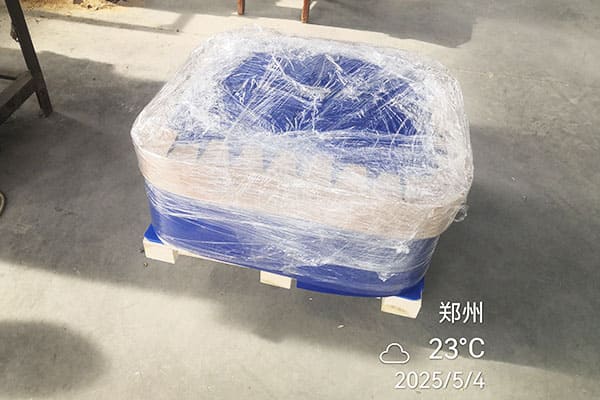
Huawei Packaged 1100 Spinning Aluminium Circle
8. Typical Specifications of 1100 Spinning Aluminium Circle
The specifications of a 1100 spinning aluminum circle should be determined according to the finished cookware design and manufacturing process. There is no single thickness or diameter that is suitable for every pot, pan, lid, or bowl.
A professional purchase specification should cover alloy, temper, dimensions, tolerances, surface condition, edge quality, standards, and packaging.
| Parameter | Typical Specification / Options |
|---|---|
| Aluminum Alloy | AA 1100 |
| UNS Designation | A91100 |
| Temper | O, H12, H14 and other agreed tempers |
| Product Form | Aluminum Circle / Disc / Round Blank |
| Thickness | Customized according to cookware design |
| Diameter | Customized according to finished product |
| Surface | Mill finish or customer-specified finish |
| Edge | Smooth, burr-controlled |
| Flatness | According to applicable standard/customer requirement |
| Application | Spun pots, pans, lids, bowls and kitchenware |
| Inspection | Chemical, dimensional, mechanical and surface inspection |
| Packaging | Export-grade protective packaging |
The applicable material standard should be agreed between the buyer and supplier.
ASTM B209/B209M is one recognized specification covering aluminum and aluminum-alloy sheet, coiled sheet, and plate products.
9. 1100 Aluminum Circle for Different Cookware Applications
The versatility of 1100 aluminum makes it suitable for various types of rotationally formed cookware.
However, each product imposes different requirements on the aluminum circle because cookware geometry directly determines the severity and distribution of deformation.
9.1 1100 Aluminum Circle for Frying Pans
Frying pans are one of the most recognizable applications for spun aluminum circles.
The blank must generally provide:
- Good radial material flow
- Excellent surface quality
- Stable wall thickness
- Reliable forming behavior
- Suitable dimensional accuracy
A frying pan may have a relatively shallow body compared with a deep cooking pot, but the transition between the base and sidewall can still impose significant localized deformation.
1100 aluminum is attractive because its high ductility allows the pan body to be formed without requiring the high strength of structural aluminum alloys.
For coated frying pans, surface condition becomes especially important because scratches or other substrate defects can affect the appearance and quality of the subsequent coating.
9.2 1100 Aluminum Circle for Cooking Pots
Cooking pots generally require a larger blank and greater forming depth than shallow pans.
The material must therefore accommodate more substantial deformation while maintaining:
- Consistent wall thickness
- Stable geometry
- Good surface quality
- Adequate dimensional accuracy
For deeper pots, a softer temper such as 1100-O can be advantageous because of its higher forming capability.
The final specification should nevertheless be determined through actual forming trials because pot depth, wall profile, thickness, and spinning equipment all influence material requirements.
9.3 1100 Aluminum Circle for Sauce Pans
Sauce pans typically combine a relatively deep sidewall with a smaller overall diameter.
This geometry makes controlled material flow particularly important. The aluminum circle must deform progressively without excessive thinning or cracking around the transition between the base and sidewall.
1100 aluminum provides a useful combination of:
- Ductility
- Corrosion resistance
- Thermal conductivity
- Lightweight construction
These characteristics make it a suitable candidate for this type of cookware when the required strength level is moderate.
9.4 1100 Aluminum Circle for Aluminum Lids
Cookware lids have different requirements from pots and pans.
The primary considerations often include:
- Dimensional accuracy
- Flatness
- Shape retention
- Surface appearance
- Formability
The spinning process can produce curved or domed lid profiles efficiently, while the relatively high ductility of 1100 aluminum allows the blank to be formed into these shapes.
For decorative lids, a clean surface is especially important because polished, anodized, or coated finishes can make surface defects more visible.
9.5 1100 Aluminum Circle for Bowls
Bowls are well suited to rotational forming because their geometry is generally symmetrical around a central axis.
1100 aluminum can provide:
- Good deep-forming capability
- Smooth curved profiles
- Low product weight
- Good corrosion resistance
- Good surface finishing potential
The required temper depends on the depth-to-diameter ratio and the severity of the forming operation.
9.6 1100 Aluminum Circle for Commercial Cookware
Commercial kitchens often use larger and heavi
1100 aluminum can still be considered when the product design emphasizes:
- Efficient heat transfer
- Lightweight construction
- Easy forming
- Corrosion resistance
However, if the cookware requires significantly higher mechanical strength or resistance to deformation during heavy-duty service, other aluminum alloys may provide a better balance.
This is an important material-selection principle: 1100 is highly formable, but it is not a high-strength aluminum alloy.
10. 1100 Spinning Aluminium Circle for Cookware vs. Other Alloys
Selecting an aluminum alloy for cookware requires more than comparing tensile strength or aluminum purity.
The forming process, cookware geometry, thermal requirements, surface treatment, corrosion environment, and final product strength all influence the appropriate alloy.
For spinning cookware, 1100 aluminum is particularly attractive because it combines excellent formability with good thermal conductivity and corrosion resistance.
However, other alloys such as 1050, 1060, and 3003 may provide different performance advantages.
10.1 Comparison of Common Aluminum Alloys for Cookware
| Property | 1100 | 1050 | 1060 | 3003 | 5052 |
|---|---|---|---|---|---|
| Aluminum Series | 1xxx | 1xxx | 1xxx | 3xxx | 5xxx |
| Aluminum Content | ≥99% | ≥99.5% | ≥99.6% | Balance with Mn/Cu | Balance with Mg |
| Formability | Excellent | Excellent | Excellent | Very Good | Good |
| Spinning Performance | Excellent | Excellent | Excellent | Very Good | Good–Very Good |
| Thermal Conductivity | High | Very High | Very High | High | Moderate |
| Corrosion Resistance | Excellent | Excellent | Excellent | Excellent | Excellent |
| Relative Strength | Low | Low | Low | Moderate | Higher |
| Typical Temper for Forming | O | O | O | O | O/H32 |
| Surface Finishing | Very Good | Very Good | Very Good | Very Good | Very Good |
| Typical Cookware Use | Spun pots, pans, bowls, lids | Highly formable kitchenware | Heat-transfer-focused cookware | Stronger cookware bodies | Higher-strength cookware |
| Main Advantage | Balanced formability and thermal performance | High purity and conductivity | Excellent conductivity | Better strength | Higher mechanical strength |
| Main Limitation | Relatively low strength | Relatively low strength | Relatively low strength | Less formable than 1xxx alloys | More difficult for severe spinning |
Exact chemical limits and mechanical properties depend on the applicable material standard and temper.
11. Huawei Quality Control for 1100 Spinning Aluminium Circle
Quality consistency is critical for spinning cookware because variations in thickness, temper, surface condition, or dimensions can directly affect forming performance.
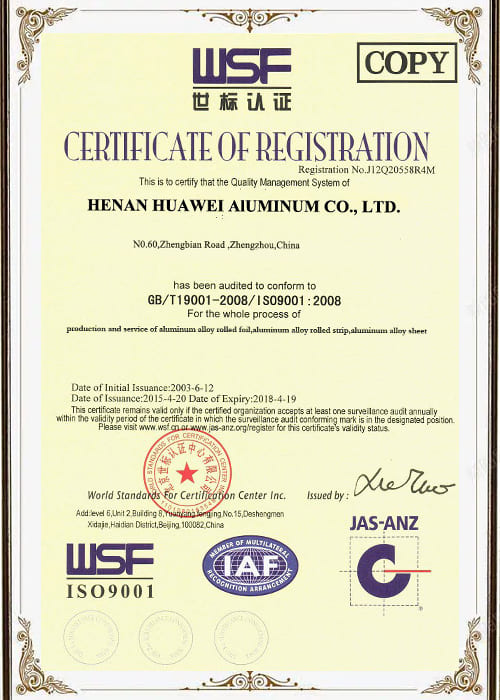
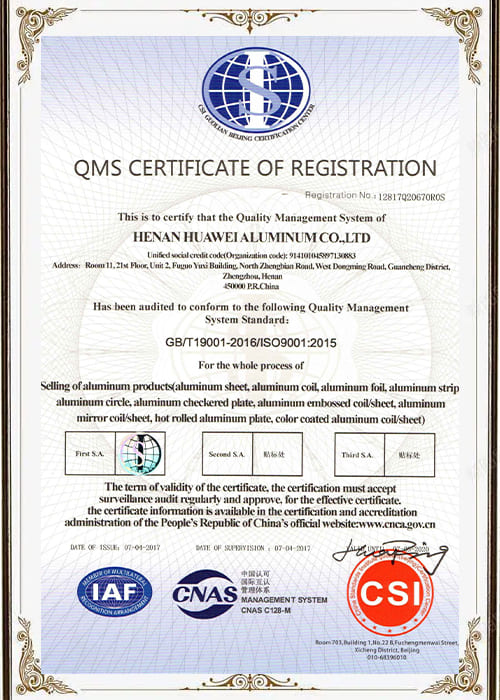
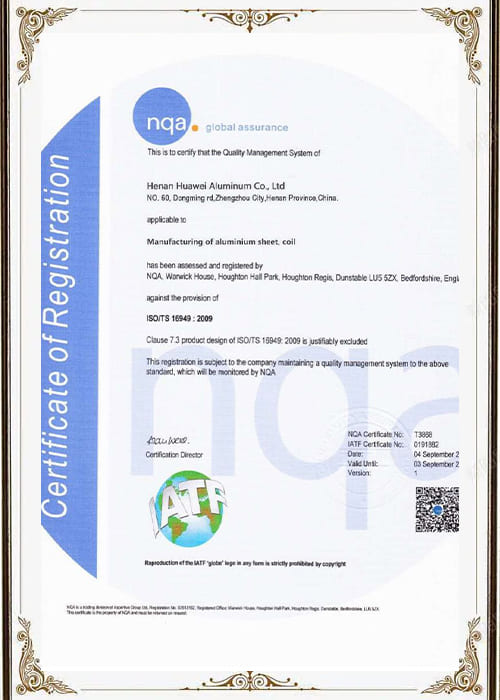
Huawei Aluminum focuses on key quality-control points throughout the production process to ensure that 1100 aluminum circles meet customer specifications.
11.1 Alloy and Temper Control
Each batch is checked to ensure the aluminum chemistry complies with the required AA 1100 specification. Temper conditions such as O, H12, and H14 are also controlled according to the customer’s forming requirements.
For spinning applications, proper temper selection is especially important because it determines the balance between strength and ductility.
11.2 Dimensional Accuracy
Huawei controls the key dimensions of each aluminum circle, including:
- Circle diameter
- Thickness
- Thickness tolerance
- Flatness
- Roundness
- Edge condition
Consistent dimensions help cookware manufacturers achieve stable material flow and more predictable spinning results.
11.3 Surface and Edge Inspection
Surface quality is carefully checked for defects such as scratches, dents, stains, cracks, and other imperfections that could become more visible during spinning or subsequent finishing.
Edges are also inspected to control burrs and cutting defects, helping reduce the risk of edge cracking during forming.
11.4 Mechanical Property Testing
Where required, mechanical properties such as tensile strength, yield strength, and elongation are tested according to the applicable standard.
These tests help verify that the material has the required combination of strength and ductility for the specified temper and cookware application.
11.5 Final Inspection and Packaging
Before shipment, the finished circles undergo final inspection to verify their alloy, temper, dimensions, surface condition, and quantity.
Protective export packaging is then used to minimize scratching, moisture exposure, and deformation during transportation.
11.6 Consistent Quality for Spinning Applications
For Huawei, quality control is not limited to the final aluminum circle. It covers the key stages from raw material and rolling to temper control, circle cutting, inspection, and packaging.
This process helps provide 1100 spinning aluminum circles with consistent dimensions, stable forming properties, clean surfaces, and reliable batch-to-batch quality, supporting efficient cookware production.
12. FAQs About 1100 Spinning Aluminium Circle for Cookware
1. What is a 1100 spinning aluminium circle?
A 1100 spinning aluminium circle is a round aluminum blank made from AA 1100 alloy and designed for metal spinning and forming. It is commonly used to manufacture cookware such as pots, pans, lids, and bowls.
2. Is 1100 aluminum suitable for cookware?
Yes. 1100 aluminum offers excellent formability, good thermal conductivity, corrosion resistance, and low density, making it suitable for many cookware applications. The final material selection should also consider the cookware design, surface treatment, and applicable food-contact requirements.
3. Is 1100 aluminum good for metal spinning?
Yes. 1100 aluminum has excellent ductility and is well suited to metal spinning. 1100-O is particularly suitable for deep or complex forming because of its high elongation and soft condition.
4. Which temper is best for spinning 1100 aluminum?
For severe spinning, 1100-O is generally preferred because it provides the highest formability. H12 or H14 may be considered when the forming requirements are less demanding and greater final strength is needed.
5. What is the difference between 1100-O and 1100-H14?
1100-O is an annealed, soft temper with higher ductility and better forming capability. H14 is strain hardened, providing higher strength and hardness but lower ductility.
6. Is 1100 better than 3003 for cookware?
It depends on the application. 1100 generally offers better formability and thermal conductivity, while 3003 provides higher strength with good formability. 1100 is often preferable for severe spinning, while 3003 may be better when additional rigidity is required.
7. How do I choose the thickness and diameter of a 1100 aluminum circle?
The thickness and diameter should be determined according to the finished cookware dimensions, forming depth, wall thickness, product weight, and spinning process. There is no universal size suitable for every cookware product.
8. Can 1100 aluminum circles be used for coated cookware?
Yes. 1100 aluminum can serve as a substrate for suitable surface treatments and coatings. However, the performance and food-contact compliance of the finished cookware depend on the complete coating system and applicable regulations.
13. Conclusion
1100 Spinning Aluminium Circle for Cookware is a practical material solution for manufacturers producing pots, frying pans, saucepans, lids, bowls, and other rotationally formed kitchenware.
Its main advantages come from the characteristics of AA 1100: high aluminum purity, excellent ductility, good formability, high thermal conductivity, excellent corrosion resistance, and low density.
Among these characteristics, formability is particularly important for spinning. The aluminum circle must undergo controlled plastic deformation while maintaining sufficient integrity to avoid cracking, excessive thinning, or other forming defects.
A suitable temper, accurate dimensions, consistent thickness, and clean surface can therefore be just as important as the alloy designation itself.
When selecting 1100 spinning aluminum circles, cookware manufacturers should evaluate the complete material specification:
Alloy → Temper → Thickness → Diameter → Surface → Edge → Tolerance → Spinning Conditions
1100 is particularly attractive when the cookware design prioritizes easy forming, efficient heat transfer, corrosion resistance, lightweight construction, and surface quality.
When substantially higher strength is required, alloys such as 3003 or 5052 may provide a more suitable balance.
Ultimately, successful cookware production depends on matching the aluminum circle to the actual forming process.
A professional supplier should be capable of providing not only the required alloy and dimensions but also consistent metallurgy, stable temper, controlled surface quality, reliable inspection, and export-ready packaging.