8011 Aluminum Foil for Flexible Duct
10 Views 2026-10-15 05:34:00
1. Introduction
8011 aluminum foil is an aluminum alloy material used in various industrial applications, including selected flexible duct and HVAC ventilation products.
Its suitability depends on the foil thickness, temper, surface quality, and the manufacturing process used to produce the finished duct.
In flexible duct systems, aluminum foil may serve as a barrier layer in a laminated structure or as the primary metal layer in a formed duct.
The foil can help limit moisture and vapor transmission, while its mechanical properties influence how well it withstands bending, corrugation, and other converting operations.
For duct manufacturers, choosing the right foil requires more than identifying the alloy number.
Thickness consistency, elongation, tensile strength, edge quality, and compatibility with adhesives or other materials can all affect production efficiency and finished-product performance.
2. What Is 8011 Aluminum Foil for Flexible Duct?
2.1 Definition of 8011 Aluminum Foil
8011 aluminum foil is an 8xxx-series wrought aluminum alloy containing iron and silicon as its principal alloying elements.
These additions influence the material’s strength, rolling behavior, and suitability for thin-foil production.
The alloy is used in several foil applications, although the appropriate specification depends on the final product.
For flexible duct production, 8011 foil must meet the requirements of the intended duct construction.
A foil intended for lamination may prioritize surface cleanliness, consistent thickness, and bonding compatibility, while a foil used in a formed semi-rigid duct may require a different balance of strength and ductility.

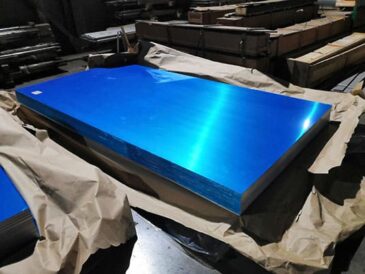
Huawei 8011 Aluminum Foil Display
2.2 The Role of Aluminum Foil in Flexible Duct Construction
The function of aluminum foil varies according to the duct’s design.
- Laminated flexible ducts: Aluminum foil forms one layer of a composite structure, often combined with polymer film, adhesive, reinforcement, or insulation.
- Semi-rigid aluminum ducts: A thicker foil or thin aluminum strip may form the duct wall through corrugation or spiral forming.
- Insulated ventilation ducts: Foil may serve as a facing or protective layer in an insulated assembly, depending on the product design.
These constructions should not be treated as interchangeable.
The foil thickness, temper, and acceptance criteria suitable for a laminate may not meet the requirements of a self-supporting formed duct.
2.3 Main Characteristics of 8011 Aluminum Foil
8011 foil offers a useful combination of material properties when the correct gauge and temper are selected.
- Formability: Supports bending and forming within the limits of the selected specification.
- Mechanical performance: Iron and silicon additions influence strength and deformation behavior.
- Corrosion resistance: Aluminum naturally forms a protective oxide film, although exposure conditions and contact with other materials still matter.
- Surface quality: A clean, consistent surface helps support downstream converting processes.
- Flexible supply formats: Manufacturers can supply master coils or slit coils according to production-line requirements.
The alloy designation alone does not guarantee finished-duct performance.
Actual results depend on the foil specification, processing conditions, and complete duct construction.
3. Why Choose 8011 Aluminum Foil for Flexible Duct?
3.1 A Practical Balance of Strength and Formability
8011 contains controlled amounts of iron and silicon, which influence its mechanical properties compared with commercially pure aluminum grades.
This makes it a potential option for applications requiring a balance between strength and forming performance.
For duct manufacturers, the appropriate balance depends on the process.
Foil that is too soft may lack the stiffness required for certain formed structures, while foil that is too hard may crack or perform poorly during tight bending.
Buyers should therefore evaluate tensile strength and elongation together rather than selecting material based on strength alone.
3.2 Suitable for Different Duct Manufacturing Processes
Depending on thickness and temper, 8011 aluminum foil may be evaluated for lamination, corrugation, bending, or spiral forming.
For laminated ducts, manufacturers should focus on surface cleanliness, dimensional consistency, and compatibility with the adhesive or polymer film.
For semi-rigid ducts, forming stability, seam integrity, and resistance to cracking become especially important.
Production trials using the actual equipment and duct design provide a more reliable assessment than alloy designation alone.
3.3 Barrier Performance for Ventilation Applications
An intact aluminum foil layer can help limit the transmission of moisture vapor and other substances through a duct wall.
This can be useful in duct constructions where the foil serves as a barrier or facing layer.
However, barrier performance depends on more than the alloy. Pinholes, cracks, seams, adhesive layers, and the integrity of the finished assembly all affect the result.
Buyers should specify pinhole and surface-quality requirements where these characteristics matter to the application.
3.4 Corrosion Resistance in Appropriate Environments
Aluminum naturally develops a thin oxide layer that helps protect its surface from corrosion in many ordinary environments.
This property makes aluminum foil useful in a range of ventilation and building-material applications.
Nevertheless, aluminum foil is not immune to corrosion. Persistent moisture, aggressive chemicals, unsuitable cleaning agents, and contact with dissimilar metals can affect durability.
The complete duct system should be evaluated for its intended operating environment.
3.5 Efficient Material Use and Converting Flexibility
Foil provides a thin, lightweight material layer, which can help reduce material usage in applications where a thin barrier or facing is sufficient.
Suppliers can also process foil into specified widths and coil formats, helping manufacturers match the material to slitting and converting equipment.
Correct width, winding quality, and edge control can reduce downtime and material waste during production.
3.6 Potential for Customized Specifications
Different flexible duct products require different material configurations. Buyers may need to customize:
- Foil thickness and temper
- Coil width and weight
- Inner diameter and outer diameter
- Surface finish and cleanliness
- Slit-edge quality and dimensional tolerances
- Requirements for lamination or downstream forming
Customization should follow the finished duct’s technical requirements rather than a generic specification.
The most suitable 8011 foil is the one that performs consistently within the intended manufacturing process and meets the finished product’s requirements.

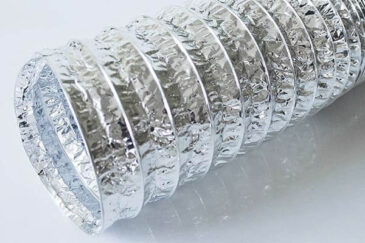
8011 Aluminum Foil for Flexible Duct
4. Key Specifications of 8011 Aluminum Foil for Flexible Duct
| Parameter | Typical Specification | Notes |
|---|---|---|
| Aluminum Alloy | 8011 | Al-Fe-Si alloy |
| Temper | O, H14, H22, H24 | Select according to forming and stiffness requirements |
| Thickness | 0.06–0.20 mm (60–200 μm) | Reference range for selected semi-rigid duct applications |
| Width | 50–1600 mm | Actual range depends on supplier and production line |
| Thickness Tolerance | ±5% as a reference | Confirm the agreed product specification |
| Width Tolerance | ±1.0 mm as a reference | Depends on slitting capability and order requirements |
| Tensile Strength | Approximately 45–110 MPa for one published 8011-O duct-foil offering | Supplier-specific; varies with thickness and temper |
| Elongation | Above 10% in one published 8011-HO specification | Not a universal value; confirm test conditions |
| Coil Inner Diameter | 75, 76, or 152 mm | Commonly listed options; other sizes may be available |
| Coil Outer Diameter | Up to approximately 1800 mm in one supplier listing | Depends on coil weight and equipment |
| Coil Weight | Customized; some suppliers list up to 800 kg | Confirm the actual supplier’s maximum |
| Surface Finish | Mill finish; bright or matte | Coating, embossing, or lamination may be available |
| Edge Type | Mill edge or slit edge | Specify edge quality and burr limits |
| Applicable Standard | GB/T 3198 or another agreed applicable standard | Confirm the standard’s scope and the exact product requirements |
| Packaging | Moisture-resistant export packaging | Protect against moisture, contamination, and edge damage |
Important technical note: The thickness range of 0.06–0.20 mm is more relevant to certain semi-rigid duct applications than to every laminated flexible duct.
For thinner laminated products, the foil gauge must be selected according to the laminate design and converting process.
Mechanical properties and tolerances should be confirmed against the supplier’s technical data sheet before ordering.

Aluminum Foil Thickness Measurement
5. Chemical Composition and Mechanical Properties of 8011 Aluminum Foil
The chemical composition and mechanical properties of 8011 aluminum foil determine its suitability for flexible duct manufacturing.
Buyers should evaluate both factors because the alloy composition influences material behavior, while temper and thickness affect how the foil performs during bending, corrugation, lamination, and forming.
5.1 Chemical Composition of 8011 Aluminum Foil
| Element | Composition (wt.%) | Main Influence |
|---|---|---|
| Silicon (Si) | 0.50–0.90 | Influences alloy structure, strength, and processing behavior |
| Iron (Fe) | 0.60–1.00 | Contributes to strength and influences forming characteristics |
| Copper (Cu) | ≤ 0.10 | Controlled to maintain the required alloy properties |
| Manganese (Mn) | ≤ 0.20 | Influences strength and microstructure |
| Magnesium (Mg) | ≤ 0.05 | Restricted alloying addition |
| Chromium (Cr) | ≤ 0.05 | Controlled minor element |
| Zinc (Zn) | ≤ 0.10 | Controlled impurity or minor addition |
| Titanium (Ti) | ≤ 0.08 | Helps control grain structure during processing |
| Other elements | Each ≤ 0.05; total ≤ 0.15 | Limits unwanted impurities |
| Aluminum (Al) | Remainder | Base metal |
Note: These are representative limits, not a substitute for the governing alloy standard or the certificate for a specific coil.
5.2 Mechanical Properties of 8011 Aluminum Foil
Mechanical properties vary with temper, thickness, and manufacturing conditions.
A soft O-temper foil may suit applications requiring substantial deformation, whereas a strain-hardened temper may provide greater stiffness for certain formed duct structures.
The table below illustrates the types of properties that buyers should specify.
It deliberately avoids assigning one universal strength range to every 8011 foil product.
| Property | Why It Matters for Flexible Duct | Specification Guidance |
|---|---|---|
| Tensile strength | Indicates resistance to tensile loading during processing | Obtain the minimum and maximum values for the specified temper and thickness |
| Yield strength | Indicates the stress at which permanent deformation begins | Relevant when the formed duct must retain its shape |
| Elongation | Indicates the foil’s ability to stretch before fracture | Important for corrugation, bending, and forming |
| Thickness consistency | Affects stiffness, material consumption, and process stability | Define nominal thickness and tolerance |
| Surface quality | Affects appearance and can influence bonding or coating | Set limits for stains, scratches, and other defects |
| Pinhole level | Can affect barrier performance in foil laminates | Define inspection criteria appropriate to the application |
| Edge quality | Helps reduce tearing and web breaks during converting | Specify burr limits and acceptable edge condition |
5.3 Selecting the Right Temper
The temper should match the required balance between flexibility and stiffness.
- O temper: Generally soft and ductile, making it a candidate for applications requiring substantial deformation.
- H14 or H16: Strain-hardened conditions that may suit applications requiring more stiffness, subject to the required forming geometry.
- H22 or H24: Strain-hardened and partially annealed conditions that may be considered for selected formed products.
These are general material-selection guidelines, not universal recommendations for every flexible duct.
Confirm the mechanical-property limits for the actual gauge and temper, and conduct forming trials where necessary.

8011 Aluminum Foil Flexible Duct Applications
6. Applications of 8011 Aluminum Foil in Flexible Duct Systems
8011 aluminum foil can serve as a material layer in different ventilation and HVAC duct constructions.
Its suitability depends on whether the foil functions as a laminate barrier, a protective facing, or a formed metal wall.
6.1 Laminated Flexible HVAC Ducts
In laminated flexible ducts, aluminum foil may be combined with polyester (PET) film, adhesives, reinforcing layers, or insulation materials.
The foil provides a metallic barrier layer, while the other layers contribute to strength, flexibility, or thermal performance.
Manufacturers should evaluate foil thickness, surface cleanliness, bonding compatibility, and resistance to cracking during repeated bending.
The complete laminate must also meet the requirements of its intended HVAC application.
6.2 Semi-Rigid Aluminum Flexible Ducts
Semi-rigid aluminum ducts typically use thicker aluminum material that can withstand corrugation or spiral forming.
In these products, the material must balance formability with sufficient stiffness to retain the required duct shape.
8011 may be considered when its specified mechanical properties meet the forming and service requirements.
Buyers should verify elongation, tensile strength, seam integrity, and resistance to cracking during production trials.
6.3 Insulated Flexible Duct Systems
Aluminum foil may function as a facing or protective layer in insulated duct assemblies.
Depending on the design, it can help limit moisture-vapor transmission and protect underlying insulation from exposure.
However, the foil layer alone does not determine the thermal insulation value of the complete duct.
Insulation type, thickness, joints, installation quality, and air leakage also affect system performance.
6.4 Commercial and Residential Ventilation
Foil-based flexible ducts are used in selected residential and commercial ventilation systems, including air distribution and exhaust applications where the finished duct is approved for the intended service.
Material selection should account for operating temperature, airflow conditions, installation geometry, moisture exposure, and applicable building requirements.
7. Manufacturing Process of 8011 Aluminum Foil for Flexible Duct
The manufacturing process of 8011 aluminum foil involves several stages to ensure consistent thickness, suitable mechanical properties, and reliable surface quality.
These factors directly affect the foil’s performance during flexible duct production.
7.1 Alloy Melting and Casting
Manufacturers melt aluminum and add controlled amounts of iron and silicon to meet the chemical composition requirements of 8011 alloy.
The molten metal is then cast into rolling stock for further processing.
7.2 Hot Rolling and Cold Rolling
The cast material undergoes hot and cold rolling to reduce its thickness.
During cold rolling, manufacturers control thickness, flatness, and surface quality to meet the requirements of the intended duct application.
7.3 Annealing and Temper Control
Appropriate annealing or other thermal treatments help achieve the required temper and mechanical properties.
The selected processing route depends on whether the foil needs greater flexibility or additional stiffness for forming.
7.4 Slitting and Edge Trimming
Manufacturers slit the foil into the required widths and inspect the edges for burrs, cracks, and other defects.
Good edge quality helps reduce material breaks and waste during lamination and duct forming.
7.5 Quality Inspection
Before shipment, manufacturers check key parameters, including:
- Thickness and width tolerances
- Tensile strength and elongation
- Surface cleanliness and visible defects
- Pinhole levels, where required
- Edge quality and coil-winding consistency
Inspection requirements should match the customer’s technical specifications and intended application.
7.6 Coil Winding and Packaging
The finished foil is wound into coils with specified inner diameters, outer diameters, and weights.
Protective packaging helps prevent moisture exposure, contamination, and edge damage during storage and transportation.
8. 8011 Aluminum Foil vs. Other Aluminum Foil Alloys
Different aluminum alloys offer different combinations of strength, ductility, and forming performance.
For flexible duct production, the best choice depends on whether the foil serves as a thin laminate layer or a thicker material formed into the duct wall.
| Comparison Factor | 8011 Aluminum Foil | 1100 Aluminum Foil | 1235 Aluminum Foil | 3003 Aluminum Foil |
|---|---|---|---|---|
| Alloy Series | 8xxx | 1xxx | 1xxx | 3xxx |
| Main Alloying Elements | Iron and silicon | Commercially pure aluminum with controlled impurities | High-purity aluminum with controlled impurities | Manganese |
| Relative Strength | Depends on temper and thickness | Generally low to moderate | Generally low in soft foil tempers | Generally higher than 1xxx alloys at comparable conditions |
| Formability | Good when the correct temper is selected | Excellent in soft tempers | Excellent in soft tempers | Good, depending on temper and forming geometry |
| Ductility | Depends on temper and thickness | Generally high in soft tempers | Generally high in soft tempers | Depends on temper and thickness |
| Corrosion Resistance | Good in suitable environments | Generally very good | Generally very good | Generally very good |
| Potential Flexible Duct Applications | Selected laminated or formed duct products | Selected flexible duct foil and coated duct products | Selected thin foil or laminate layers | Selected formed or semi-rigid duct products |
| Main Selection Consideration | Balance of strength, flexibility, and processability | Ductility and general-purpose performance | Thin-gauge flexibility and laminate compatibility | Strength and shape retention |
| Key Limitation | Must match the duct’s forming requirements | May provide insufficient stiffness for some formed structures | May not provide the required strength for certain duct walls | Forming performance must be verified for the selected gauge and temper |
The relative descriptions above are general comparisons, not guaranteed property rankings.
Actual performance depends on alloy specification, temper, thickness, and manufacturing conditions.
9. Cost Factors of 8011 Aluminum Foil for Flexible Duct
The cost of 8011 aluminum foil for flexible duct depends on more than the price of aluminum.
Alloy specifications, foil thickness, temper, surface treatment, order quantity, and processing requirements all influence the final quotation.
Understanding these factors helps HVAC duct manufacturers balance material costs with product performance.
9.1 Key Factors Affecting Price
| Cost Factor | Impact on Price |
|---|---|
| Aluminum ingot price | Changes in the aluminum market directly affect raw material costs. |
| Foil thickness | Thicker foil generally uses more aluminum per square meter, increasing material cost. |
| Alloy and temper | Different alloy and temper requirements may involve different processing and quality-control costs. |
| Roll width and dimensions | Special widths, core diameters, and roll weights may require additional slitting or winding arrangements. |
| Surface treatment | Coating, embossing, lamination, or other finishing processes add processing costs. |
| Quality requirements | Tighter tolerances, pinhole limits, surface standards, and additional testing may increase costs. |
| Order quantity | Larger orders may reduce unit costs, while small or trial orders can carry higher processing and packaging costs. |
| Packaging and shipping | Export packaging, transport distance, freight rates, and delivery terms affect the total landed cost. |
9.2 How to Reduce Procurement Costs
Buyers can control costs without compromising the performance of their flexible duct products by taking the following steps:
- Specify the required thickness accurately. Avoid excessive thickness, but do not reduce it below the level required for forming strength and barrier integrity.
- Choose the appropriate temper. Match the foil’s formability and mechanical properties to the duct manufacturing process.
- Optimize roll dimensions. Confirm the required width, core ID, outer diameter, and roll weight to reduce trimming waste and production interruptions.
- Confirm surface requirements. Request coating, lamination, or embossing only when the application needs these features.
- Compare total delivered costs. Consider material yield, defect rates, processing efficiency, packaging, and freight rather than comparing the unit price alone.
- Plan repeat orders. Forecasting demand can help suppliers arrange production and improve purchasing efficiency.
10. Reliable 8011 Aluminum Foil Supplier – Huawei Aluminum
Choosing a reliable aluminum foil supplier helps flexible duct manufacturers maintain consistent production quality, control material waste, and meet delivery schedules.
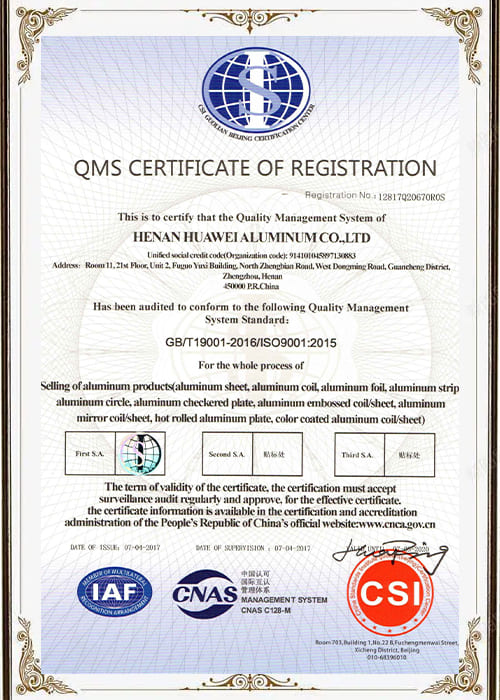
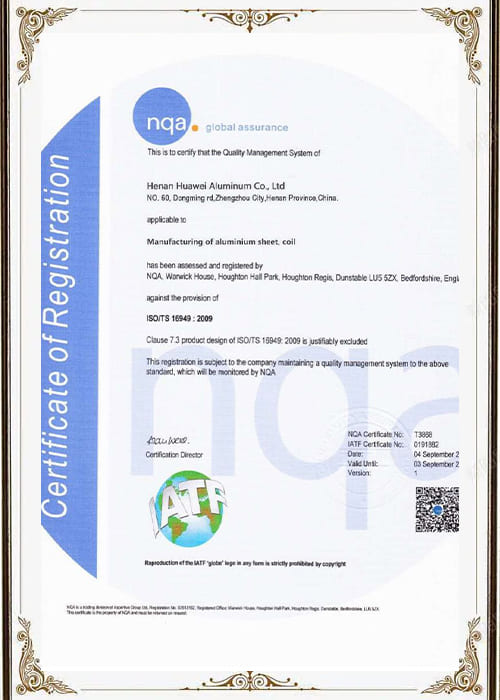
Henan Huawei Aluminum Co., Ltd. was established in 2001 and supplies aluminum sheet, coil, strip, and foil for industrial and commercial applications.
The company also provides aluminum foil products for air duct manufacturing.
10.2 Quality Control and Specification Confirmation
For flexible duct applications, stable foil quality is essential to downstream slitting, lamination, corrugation, and forming.
Before production, buyers should agree with the supplier on the inspection criteria relevant to their application.
Key checks may include:
- Thickness and width measurements
- Tensile strength and elongation, where specified
- Surface cleanliness and visible defects
- Edge quality and winding consistency
- Pinhole requirements for applications where they matter
- Coating or lamination compatibility, when applicable
- Packing condition and identification of each coil
The exact inspection plan should follow the agreed product specification and order requirements.
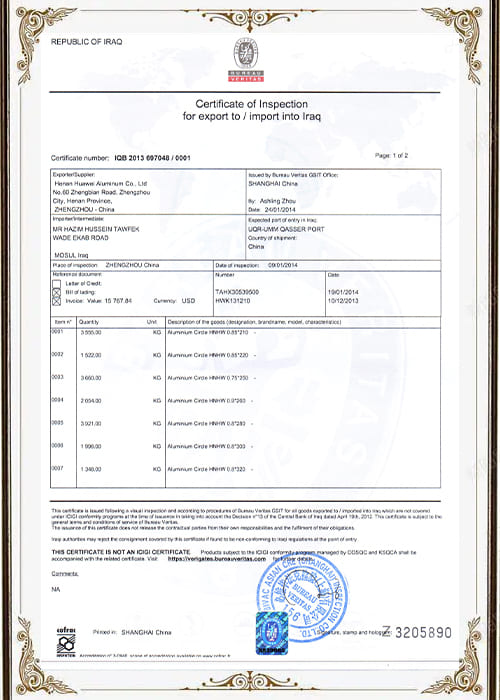
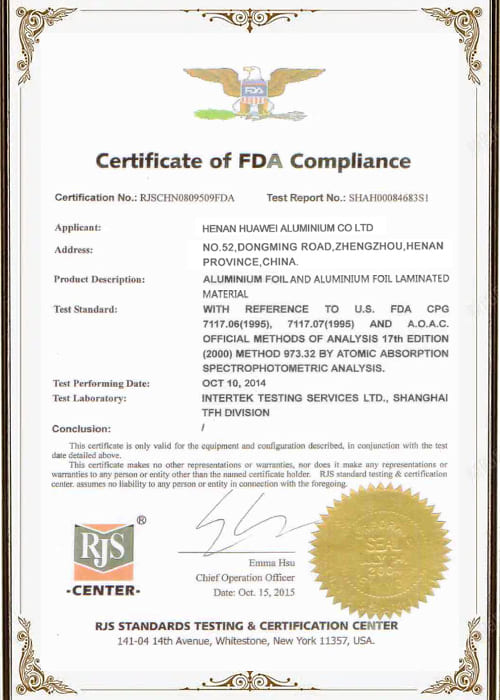
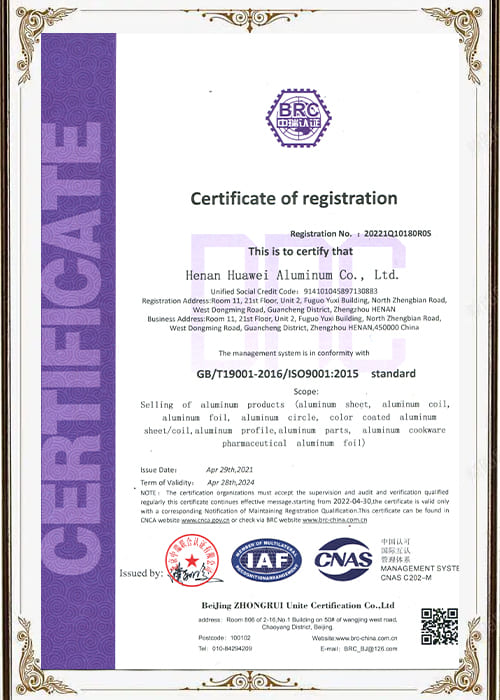
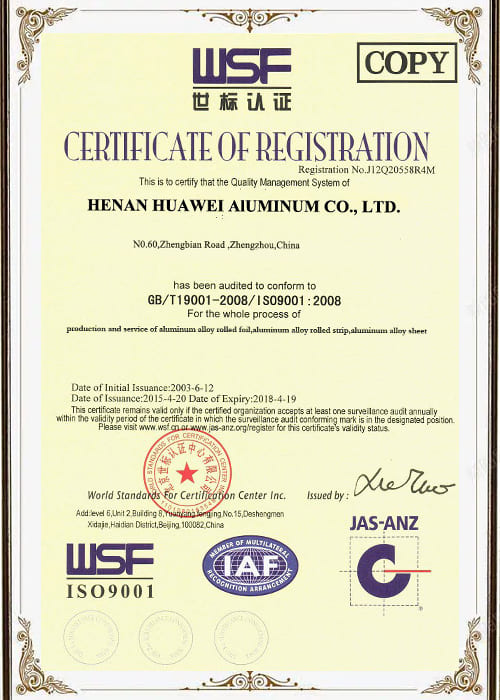
Buyers can also request relevant inspection records or certificates as part of the purchase agreement.
10.3 Manufacturing and Export Experience
With more than two decades of aluminum production and sales experience, Huawei Aluminum serves international customers and has exported to 72 countries, according to company information.
This experience supports communication on product specifications, packaging, documentation, and shipment arrangements for overseas buyers.
When requesting a quotation, provide the target thickness, width, temper, roll dimensions, application, quantity, and destination.
Clear requirements help the supplier assess feasibility and offer a more accurate proposal.
Contact Huawei Aluminum for a quotation based on your flexible duct design and production requirements.
11. Conclusion
8011 aluminum foil can be a suitable material for selected flexible duct and HVAC applications because it offers a useful balance of formability, strength, corrosion resistance, and compatibility with converting processes.
However, the right specification depends on whether the foil serves as a thin laminate layer, insulation facing, or a more substantial formed component.
Before purchasing, evaluate the foil thickness, temper, mechanical properties, surface condition, roll dimensions, and compatibility with adhesives or other laminate materials.
Compare suppliers based on consistent quality, specification control, delivery reliability, and total delivered cost—not price alone.
Henan Huawei Aluminum Co., Ltd. supplies aluminum foil and other aluminum products in a range of specifications for industrial applications.
By confirming the requirements with the supplier before production, flexible duct manufacturers can select a suitable 8011 foil specification for their products and equipment.
FAQs
What is 8011 aluminum foil used for in flexible ducts?
It is used in selected laminated flexible ducts, insulation facings, and formed duct products, depending on the design and required performance.
What thickness is suitable for flexible duct foil?
The suitable thickness depends on the duct construction. Thin laminate layers and thicker formed duct materials require different specifications.
Which temper is best for 8011 aluminum foil?
O temper offers good flexibility and formability, while strain-hardened tempers provide different strength levels. Choose according to your forming process.
Can 8011 aluminum foil be laminated?
Yes. It can be used in suitable laminated structures, provided the foil surface, adhesive, and polymer film are compatible.
How do you check 8011 aluminum foil quality?
Check thickness, width, mechanical properties, surface condition, edge quality, and pinhole requirements where applicable.
What affects the price of 8011 aluminum foil?
Key factors include thickness, temper, dimensions, surface treatment, order quantity, quality requirements, and shipping costs.
Can Huawei Aluminum provide customized 8011 aluminum foil?
Henan Huawei Aluminum Co., Ltd. can discuss customized specifications based on your application. Provide the required thickness, width, temper, roll dimensions, and order quantity for a quotation.