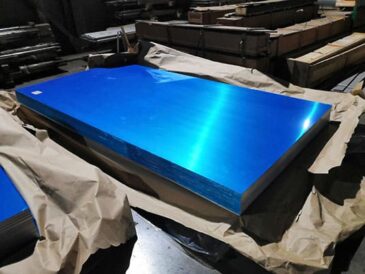
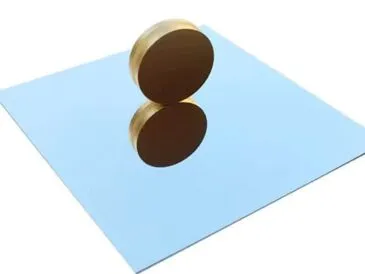
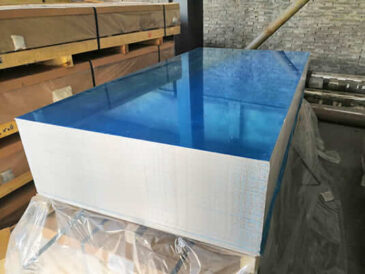
1050 H22 Aluminum Sheet for License Plates
10 Ansichten 2026-06-22 06:50:57
1. Einführung
1050 H22 aluminum sheet for license plates is one of the most widely used materials in vehicle registration plate manufacturing worldwide.
Thanks to its high aluminum purity (≥99,5 %), ausgezeichnete Korrosionsbeständigkeit, outstanding embossing performance, lightweight characteristics, und Wirtschaftlichkeit, 1050 H22 aluminum has become the preferred substrate for passenger vehicle, commercial vehicle, motorcycle, and specialty license plates.
The H22 temper provides an ideal balance between strength and formability, enabling manufacturers to produce clear embossed characters without cracking or deformation.
Combined with reflective films, Beschichtungen, and anti-counterfeiting technologies, 1050 H22 aluminum sheets deliver long-lasting durability and visibility under diverse environmental conditions.
Im Vergleich zu Stahl, Edelstahl, and plastic alternatives, 1050 H22 aluminum offers superior corrosion resistance, lower weight, easier processing, und hervorragende Recyclingfähigkeit.
These advantages make it the standard choice for modern license plate production.
2. Was ist 1050 H22 Aluminum Sheet for License Plates?
2.1 Was ist 1050 Aluminiumlegierung?
1050 Aluminiumlegierung gehört dazu 1xxx-Serie aus Aluminium, known for its hohe Reinheit (Minimum 99.5% Aluminium) und ausgezeichnete Korrosionsbeständigkeit.
It is a non-heat-treatable alloy that offers outstanding formability and is widely used in applications requiring superior surface finish and moderate strength.
2.2 Chemische Zusammensetzung von 1050 Aluminiumlegierung
| Element | Typischer Inhalt | Funktion / Auswirkungen |
|---|---|---|
| Aluminium | ≥99.50% | Provides corrosion resistance, Duktilität, Leicht, und Beschichtungskompatibilität |
| Eisen | ≤0.40% | Influences strength, grain behavior, and surface appearance |
| Silizium | ≤0,25 % | Affects formability and surface consistency |
| Kupfer | ≤0,05 % | Kept low to protect corrosion resistance |
| Magnesium | ≤0,05 % | Kontrollierte Verunreinigung |
| Mangan | ≤0,05 % | Kontrollierte Verunreinigung |
| Zink | ≤0,05 % | Kontrollierte Verunreinigung |
| Titan | ≤0,03 % | May support grain control |
| Vanadium | ≤0,05 % | Controlled trace element |
The high aluminum content gives 1050 its key advantage: clean formability and strong outdoor corrosion resistance.
2.3 What Does H22 Temper Mean?
The temper designation is the most critical factor for license plate manufacturing. “H22” represents a specific thermomechanical history:
- H2 (Strain-Hardened and Partially Annealed): The metal is cold-rolled to increase its strength (Kaltverfestigung) and is then passed through a thermal furnace to partially soften it back to a specific mechanical state.
- 2 (Viertelharte): The number ‘2’ signifies the degree of final hardness. It represents a “quarter-hard” state, positioning the metal perfectly between fully annealed (O-Temperament, completely soft) and half-hard (H24).
Das “quarter-hard sweet spot” means the metal retains enough yield strength to remain flat and rigid on a vehicle bumper, but is ductile enough to endure the deep, localized stretching required to emboss 3D letters and numbers without tearing or “orange-peeling” at the edges.
2.4 Why License Plates Use 1050 Aluminium
License plate manufacturers choose 1050 aluminum because it matches the actual working conditions of vehicle plates.
Main advantages include:
- Leicht: aluminum density is about 2.70 g/cm³, much lower than steel.
- No red rust: aluminum forms a natural oxide layer that helps resist corrosion.
- Good embossing formability: raised letters and numbers can be stamped cleanly.
- Surface compatibility: suitable for paint, Beschichtung, Eloxieren, and reflective film.
- Mass-production efficiency: easy to shear, punch, level, and blank.
- Recyclingfähigkeit: aluminum scrap from blanking and punching has recovery value.
3. Spezifikationen von 1050 H22 Aluminum Sheet for License Plates
| Parameter | Typische Anforderung |
|---|---|
| Produktname | 1050 H22 aluminum sheet for license plates |
| Legierung | 1050 |
| Temperament | H22 |
| Aluminiumgehalt | ≥99.50% |
| Dicke | Customized according to local plate standard |
| Breite / Länge | Spule, Blatt, or cut-to-size blank |
| Oberfläche | Sauber, Wohnung, ölgesteuert |
| Beenden | Mühlenfinish, beschichtet, bemalt, eloxiert, or film-ready |
| Ebenheit | High flatness for printing, Laminierung, and embossing |
| Kantenqualität | Smooth edge, geringer Grat |
| Verpackung | Moisture-proof packaging |
| Documents | Mill test certificate, dimension report, surface inspection report |
Common license plate sheets often fall around 0.6-1.2 mm Dicke, depending on country, plate type, embossing depth, and rigidity requirements.
Final thickness should follow the applicable local vehicle registration plate standard.
4. Mechanical and Physical Properties
| Eigentum | Typical Reference / Focus | Importance for License Plates |
|---|---|---|
| Dichte | Um 2.70 g/cm³ | Lightweight finished plate |
| Aluminiumreinheit | ≥99.50% | Corrosion resistance and surface quality |
| Temperament | H22 | Balance of strength and embossing formability |
| Zugfestigkeit | Mäßig, specification-controlled | Prevents easy bending during use |
| Streckgrenze | Controlled by H22 temper | Helps plate keep shape |
| Verlängerung | Adequate for embossing | Reduces cracking risk |
| Wärmeleitfähigkeit | High among common metals | Supports coating curing and heat transfer |
| Korrosionsbeständigkeit | Excellent in normal outdoor service | Long-term plate durability |
| Oberflächenqualität | Clean and uniform | Supports printing, Beschichtung, and reflective film |
Because mechanical properties vary by thickness and production route, buyers should rely on the supplier’s mill test certificate for final values.
5. Herstellungsprozess von 1050 H22 Aluminum Sheet for License Plates
Der Herstellungsprozess von 1050 H22 aluminum sheet for license plates must control both the aluminum substrate and the final surface condition.
License plate production requires clean surfaces, stable flatness, accurate thickness, and reliable embossing performance.
Deshalb, each production stage affects the final plate’s appearance, Haltbarkeit, and processing efficiency.
5.1 Raw Material Selection and Alloy Control
Production starts with high-purity aluminum raw material.
Seit 1050 Aluminium enthält ≥99.50% aluminum, the mill must control impurity elements such as iron, Silizium, Kupfer, Magnesium, Mangan, und Zink.
For license plates, chemical consistency matters because different batches must behave similarly during blanking, Stempeln, Beschichtung, and reflective film lamination.
5.2 Schmelzen und Gießen
The selected aluminum is melted and cast into slabs or coils. Während des Schmelzens, the producer controls temperature, Entgasung, Filtration, and impurity levels to reduce inclusions, oxide particles, and internal defects.
5.3 Homogenisierung und Warmwalzen
Nach dem Casting, homogenization improves the internal structure of the aluminum and reduces segregation.
Hot rolling then reduces the material thickness and prepares it for cold rolling.
Good hot rolling control helps produce a more uniform sheet, which later improves flatness and embossing consistency.
5.4 Cold Rolling to Target Gauge
Cold rolling further reduces the sheet to the required thickness.
For license plate materials, common thickness ranges may be around 0.6-1.2 mm, depending on local standards, plate type, and embossing depth.
Cold rolling improves dimensional accuracy and surface smoothness. It also increases strength through strain hardening, which is necessary before final H22 temper control.
5.5 H22 Temper Control
The H22 temper is achieved through strain hardening and partial annealing.
This step gives the material a quarter-hard condition, balancing strength and formability.
If the temper is too soft, the finished plate may bend too easily. If it is too hard, the embossed areas may crack or show surface damage.
5.6 Tension Leveling and Flatness Correction
Flatness is critical for license plates, especially when the sheet will receive printing, Beschichtung, or reflective film.
Tension leveling reduces waves, internal stress, and shape defects.
Poor flatness can cause film bubbles, printing misalignment, uneven embossing, or plate warping.
5.7 Surface Cleaning and Pretreatment
Before coating, Malerei, Eloxieren, or reflective film bonding, the aluminum surface must be clean and oil-controlled.
Beim Reinigen wird Walzöl entfernt, Metallstrafen, Staub, Fingerabdrücke, and oxidation residues.
This stage directly affects coating adhesion and reflective film bonding.
If oil or dust remains on the surface, the plate may suffer from coating peeling, film delamination, Flecken, or poor weather resistance.
5.8 Schneiden, Dunkeltastung, and Edge Control
The aluminum sheet may be supplied as coil, full sheet, Streifen, or cut-to-size blanks.
License plate manufacturers often require precise dimensions to match plate standards and stamping dies.
Low-burr edges improve safety and reduce problems during coating, Laminierung, und Installation.
5.9 Beschichtung, Malerei, or Reflective Film Preparation
Depending on the final license plate system, the sheet may be prepared for different surface processes.
Common surface routes include:
| Surface Route | Zweck |
|---|---|
| Mühlenfinish | For downstream coating or film lamination |
| Primer-coated sheet | Improves paint or film adhesion |
| Painted sheet | Provides background color |
| Anodized sheet | Improves surface durability and appearance |
| Reflective film-ready sheet | Supports traffic-grade reflective plate production |
For reflective license plates, Oberflächenreinheit, Ebenheit, and adhesion performance are especially important because the film must remain bonded under UV exposure, Regen, Hitze, cold, and washing chemicals.
6. Anwendungen von 1050 H22 Aluminum Sheet for License Plates
Aufgrund seiner hervorragenden Formbarkeit, Korrosionsbeständigkeit, lightweight characteristics, and compatibility with reflective coatings, 1050 H22 aluminum sheet has become the standard material for license plate manufacturing worldwide.
Its versatility enables it to meet the requirements of various vehicle registration systems and identification applications.
6.1 Passenger Vehicle License Plates
Passenger cars represent the largest market for license plate production.
Typical Requirements
- Clear embossed characters
- Hohes Reflexionsvermögen
- Witterungsbeständigkeit
- Long service life
Most passenger vehicle license plates use aluminum sheets with thicknesses ranging from: 0.8–1.0 mm to balance rigidity and lightweight performance.
6.2 Commercial Vehicle Registration Plates
Commercial vehicles operate under more demanding conditions than passenger vehicles.
Common Vehicles
- Trucks
- Buses
- Logistics vehicles
- Construction equipment
Typical Sheet Thickness
Commercial vehicle plates generally use: 1.0–1,2 mm dick 1050 H22 aluminum sheets.
The H22 temper provides sufficient strength while maintaining excellent embossing characteristics.
6.3 Motorcycle License Plates
Motorcycle license plates require lightweight materials due to size constraints and exposure to environmental conditions.
Typische Dicke
Motorcycle plates commonly use: 0.5–0.8 mm thick aluminum sheets.
Despite the reduced thickness, the material maintains adequate stiffness and durability.
6.4 Government and Official Vehicle Plates
Government agencies often require higher-quality registration plates with enhanced durability and security features.
- Police vehicles
- Military vehicles
- Government fleets
- Diplomatic vehicles
Additional Requirements
- Anti-counterfeiting elements
- Reflective coatings
- Special color systems
- Long service life
The smooth surface and excellent coating compatibility of 1050 H22 aluminum make it ideal for advanced security plate production.
6.5 Specialty and Customized License Plates
Many regions offer personalized or specialty license plates.
- Personalized vehicle plates
- Commemorative plates
- Collector vehicle registrations
- Promotional vehicle identification plates
7. 1050 H22 Aluminum Sheet vs Alternative Materials
Selecting the right material for license plates requires evaluating multiple factors, including durability, Korrosionsbeständigkeit, Gewicht, Herstellbarkeit, und Kosten.
The following comparison highlights the advantages of 1050 H22 aluminum sheet relative to other commonly used materials.
Comprehensive Material Comparison
| Eigentum | 1050 H22 Aluminum | Kohlenstoffstahl | Edelstahl 304 | Plastic Composite | 3003 Aluminium |
|---|---|---|---|---|---|
| Dichte (g/cm³) | 2.71 | 7.85 | 8.00 | 1.3–1,8 | 2.73 |
| Weight Advantage | ★★★★★ | ★★ | ★ | ★★★★★ | ★★★★★ |
| Korrosionsbeständigkeit | Exzellent | Mäßig | Exzellent | Gut | Sehr gut |
| Embossability | Exzellent | Gut | Mäßig | Arm | Gut |
| Reflective Film Adhesion | Exzellent | Gut | Gut | Mäßig | Gut |
| Outdoor Durability | Exzellent | Mäßig | Exzellent | Mäßig | Sehr gut |
| Oberflächenfinish -Qualität | Exzellent | Gut | Gut | Mäßig | Gut |
| Recyclingfähigkeit | 100% | 100% | 100% | Beschränkt | 100% |
| Processing Efficiency | Exzellent | Mäßig | Mäßig | Hoch | Exzellent |
| Materialkosten | Mäßig | Niedrig | Hoch | Mäßig | Mäßig |
| Maintenance Requirement | Sehr niedrig | Hoch | Niedrig | Mäßig | Niedrig |
| Typical Service Life | 10–20 Years | 5–10 Years | 15–20 Years | 3–8 Years | 10–15 Years |
| License Plate Suitability | ★★★★★ | ★★★ | ★★★★ | ★★ | ★★★★ |
8. Warum Huawei wählen? 1050 H22 Aluminum Sheet for License Plates
Henan Huawei Aluminium Co., GmbH. liefert Aluminiumblech, Spule, Streifen, und Folienprodukte für Verpackungen, Transport, Beschilderung, und industrielle Anwendungen.
For license plate producers, supplier consistency is critical because small changes in temper, Oberflächenreinheit, or thickness can affect embossing quality and film adhesion.
Huawei kann unterstützen 1050 H22 aluminum sheet for license plates mit:
- 1050 aluminum sheet supply with ≥99.50% aluminum content
- H22 temper control for embossing and plate rigidity
- Maßgeschneiderte Dicke, Breite, Länge, and cut-to-size blanks
- Mühlenfinish, beschichtet, or film-ready surface options
- Flatness and surface quality control
- Feuchtigkeitsbeständige Exportverpackung
- Werkstestzertifikate und Chargenrückverfolgbarkeit
- Sample support for embossing, Beschichtung, Drucken, or reflective film trials
Before ordering, buyers should provide plate size, Dicke, embossing depth, coating system, reflective film type, surface requirement, and packaging preference.
9. Abschluss
1050 H22 aluminum sheet for license plates is a reliable material for modern vehicle registration plates.
Its high aluminum purity, Korrosionsbeständigkeit, moderate H22 strength, good embossing formability, and surface treatment compatibility make it suitable for both embossed and reflective license plate systems.
Für Käufer, successful sourcing depends on more than alloy name. Dickentoleranz, Ebenheit, Oberflächenreinheit, Kantenqualität, temper consistency, Beschichtungskompatibilität, and supplier traceability all affect production performance.
A well-controlled 1050 H22 aluminum sheet helps manufacturers produce license plates that are durable, readable, attraktiv, und kostengünstig.
FAQs
1. Was ist 1050 H22 aluminum sheet used for?
It is used for license plates, vehicle number plates, motorcycle plates, trailer plates, reflective plates, traffic tags, Zeichen, und Namensschilder.
2. Warum ist 1050 aluminum suitable for license plates?
1050 aluminum offers high purity, ausgezeichnete Korrosionsbeständigkeit, good embossing formability, Leicht, and strong compatibility with coating and reflective film.
3. What does H22 temper mean?
H22 means the aluminum has been strain-hardened and partially annealed to a quarter-hard condition. It provides a balance of strength and formability.
4. Dose 1050 H22 aluminum sheet be embossed?
Ja. H22 temper is suitable for embossing raised letters, numbers, borders, and symbols when thickness and tooling are properly matched.
5. What thickness is used for license plates?
Many license plate sheets use thicknesses around 0.6-1.2 mm, but the exact value depends on local plate standards and production requirements.
6. Ist 1050 aluminum corrosion resistant?
Ja. 1050 aluminum has excellent corrosion resistance in normal outdoor conditions because of its high aluminum content and natural oxide layer.
7. Can reflective film bond to 1050 Aluminium?
Ja, if the surface is clean, Wohnung, ölgesteuert, and properly treated. Surface preparation strongly affects bonding strength.
8. How should 1050 H22 aluminum sheets be stored?
Store them in a dry, clean warehouse. Avoid moisture, corrosive chemicals, Staub, Kratzer, and condensation before coating or lamination.