1060 Aluminum Disc for Non-stick Cookware
1826 Mga Pananaw 2026-04-01 03:30:35
1. Panimula
1060 Aluminum Disc for Non-stick Cookware is a practical material solution for modern cookware manufacturing, where forming performance, thermal kondaktibiti, kalidad ng ibabaw, and coating compatibility all matter.
In non-stick cookware production, the base aluminum disc plays a decisive role in shaping the final product’s durability, appearance, and cooking performance.
Unlike structural alloys selected for maximum strength, 1060 aluminum disc is valued for its high purity, Mahusay na ductility, and stable processing behavior.
These characteristics make it especially suitable for deep drawing, umiikot na, pag stamp ng, and other forming methods commonly used in pans, mga kaldero, woks, and similar cookware bodies.
When properly selected and processed, 1060 aluminum disc provides a reliable substrate for non-stick coating systems, helping manufacturers produce cookware that heats evenly, resists corrosion, and delivers a smooth, consumer-friendly cooking experience.
2. Why use 1060 aluminum disc for non-stick cookware?
The unique properties of 1060 mga disc ng aluminyo make them exceptionally well-suited as the foundational material for non-stick cookware, delivering benefits that directly enhance cooking performance and product longevity.
2.1 Superior Thermal Conductivity: The Heart of Even Cooking
The paramount advantage of 1060 aluminum is its exceptionally high thermal conductivity (humigit-kumulang 220 W/(m·K)). This translates directly into:
- Uniform Heat Distribution: 1060 ensures heat spreads rapidly and evenly across the entire cooking surface, eliminating “hot spots” that can burn food or degrade non-stick coatings prematurely. Uniform heat also ensures food cooks consistently.
- Kahusayan ng Enerhiya: Cookware made from 1060 aluminum heats up quickly, reducing preheating times and overall energy consumption. This translates into tangible savings for consumers. A pan made from 1060 aluminum can reach cooking temperature up to 30% mas mabilis than a comparable stainless steel pan.
2.2 Excellent Deep Drawing and Formability: Design Freedom and Manufacturing Efficiency
As a commercially pure aluminum, 1060 offers unparalleled ductility, making it the ideal choice for demanding forming operations:
- Complex Geometries: Manufacturers can deep draw intricate shapes, subtle curves, and integrated features (like pouring spouts) into the cookware body without the risk of cracking, excessive material thinning, or the need for multiple intermediate annealing steps. The ‘O’ temper allows for elongation values often exceeding 30-40%.
- Seamless Construction: Deep drawing from a single disc results in a seamless pan body, eliminating weak points, reducing manufacturing complexity, and enhancing aesthetic appeal.
- Reduced Manufacturing Costs: High formability minimizes material waste and simplifies production processes, contributing to more cost-effective products.

1060 Aluminum Disc for Non-stick Cookware
2.3 Optimal Surface for Coating Adhesion: Longevity of Non-stick Layer
The success of non-stick cookware hinges on the durability of its coating.
1060’s high purity and consistent metallurgical structure provide an excellent substrate for non-stick coating adhesion after proper pre-treatment.
- Clean Canvas: The absence of significant alloying elements means a cleaner, more uniform surface.
- Effective Mechanical Bonding: When subjected to surface preparation techniques like sandblasting or chemical etching, 1060 forms a reliable microscopic profile that provides strong mechanical interlocking for the non-stick primer. This crucial initial bond is vital for preventing coating delamination, which is a major failure mechanism in non-stick cookware over time.
2.4 Food-Grade Safety and Purity
With a minimum aluminum content of 99.6%, 1060 alloy is highly pure and inherently food-safe.
It exhibits minimal reactivity with food products, thereby preserving their original taste and ensuring that no harmful elements leach into meals.
This purity consistently meets stringent international food contact regulations.
2.5 Cost-Effectiveness and Availability
As a high-volume, commercially pure aluminum alloy, 1060 ay readily available and generally more cost-effective as a raw material compared to specialty alloys or other metals.
Its ease of workability further contributes to efficient manufacturing processes, making high-quality non-stick cookware accessible to a broader consumer base.
2.6 Lightweight Nature: Enhancing User Experience
With a density of approximately 2.73 g/cm³, cookware made from 1060 aluminum is lightweight and easy to handle.
This improves the ergonomic experience for consumers, making cooking and cleaning less strenuous, while also reducing shipping and transportation costs for manufacturers and retailers.
3. Ano ang 1060 aluminyo disc?
1060 aluminyo disc is a round blank made from 1060 aluminum sheet or coil, designed for further forming into cookware, lighting parts, industrial components, and other products that require excellent formability and surface quality.
It belongs to the commercially pure aluminum family, with a very high aluminum content and only small amounts of alloying elements.
Para sa hindi malagkit na cookware, 1060 aluminum disc is especially valuable because it combines good thermal conductivity, low density, high ductility, and reliable processing behavior.
These properties make it well suited for deep drawing, umiikot na, pag stamp ng, and coating preparation.

Huawei 1060 Aluminum Disc Display
3.1 Komposisyon ng kemikal
1060 aluminum is a high-purity aluminum grade. Its chemistry is intentionally simple, because the main goal is not high structural strength but stable forming and efficient heat transfer.
| Elemento | Karaniwang Saklaw (wt.%) | Pag-andar |
|---|---|---|
| Al | 99.6% minimum na | Base metal; provides conductivity, paglaban sa kaagnasan, and ductility |
| Fe | ≤ 0.35 | Minor impurity; influences strength and surface behavior |
| Si Si | ≤ 0.25 | Minor impurity; affects processing and casting behavior |
| Cu | ≤ 0.05 | Kept very low to preserve corrosion resistance |
| Mn | ≤ 0.03 | Trace impurity |
| Mg | ≤ 0.03 | Trace impurity |
| Zn | ≤ 0.05 | Trace impurity |
| Ti + other elements | Trace | Controlled for product cleanliness and consistency |
3.2 Mga katangian ng makina
Ang mga mekanikal na katangian ng 1060 aluminum disc depend on temper, kapal naman, and processing history.
In cookware applications, the alloy is valued more for formability and stability than for high strength.
| Pag-aari | Typical Behavior | Relevance to Non-stick Cookware |
|---|---|---|
| Densidad ng katawan | ~2.70 g/cm³ | Lightweight cookware body |
| Lakas ng paghatak | Mababa hanggang katamtaman, temper-dependent | Enough for forming and daily use |
| Magbunga ng lakas | Mababa hanggang katamtaman | Helps the disc deform without excessive cracking |
| Pagpapahaba | Good in soft tempers | Important for deep drawing and spinning |
| Formability | Napakahusay | Critical for cookware shell production |
| Thermal kondaktibiti | Mataas na | Supports fast and even heating |
| Paglaban sa kaagnasan | Mabuti na lang | Suitable for kitchen environments |
| Surface response | Mabuti na lang | Supports polishing and coating adhesion |
Typical temper trend
| Temper | Lakas ng loob | Ductility | Formability | Karaniwang Paggamit |
|---|---|---|---|---|
| O | Mababa ang | Mataas na | Napakahusay | Best for deep drawing and complex cookware shapes |
| H12 | Low to medium | Mabuti na lang | Very good | Balanced forming and handling performance |
| H14 | Katamtaman | Katamtaman | Mabuti na lang | Used when slightly higher rigidity is needed |
| H16 | Medium-high | Mas mababa | Fair | Less common for severe forming |
| H18 | Mataas na | Lowest | Limitado | Rare in deep-drawn cookware parts |
3.3 Common specifications
The exact specification of 1060 aluminum disc depends on the cookware design, forming method, and coating process. Gayunpaman, the following are common industrial ranges.
| Specification Item | Karaniwang Saklaw / Halaga | Notes |
|---|---|---|
| Alloy na grado | 1060 | Commercially pure aluminum |
| Disc shape | Round blank | Suitable for cookware bodies |
| Ang kapal | ~0.4 mm – 6.0 mm | Depends on cookware size and product type |
| Diameter | Napapasadyang | Selected according to pan or pot design |
| Temper | O, H12, H14, H16, H18 | Chosen based on forming requirement |
| Surface finish | Tapos na ang gilingan, pinakintab na, or pre-treated | Depends on coating and appearance needs |
| Flatness | Controlled within industrial tolerance | Important for stamping and deep drawing |
| Edge quality | Smooth and burr-controlled | Helps avoid defects during processing |
| Product Type | Tipikal na kapal | Karaniwang Temper | Main Requirement |
|---|---|---|---|
| Frying pan body | Katamtaman | O / H12 / H14 | Deep drawing and coating performance |
| Saucepan body | Medium to thicker | O / H12 | Stability and heat distribution |
| Wok blank | Katamtaman | O / H12 | Large deformation capacity |
| Baking tray | Katamtaman | H14 / H16 | Flatness and rigidity |
| Small pot / milk pan | Thinner to medium | O / H12 | Easy forming and smooth finish |
4. Mga kalamangan ng 1060 Aluminum Disc for Non-stick Cookware
1060 aluminyo disc offers a strong combination of processing, thermal, and finishing advantages that make it especially suitable for non-stick cookware manufacturing.
Its value does not come from high structural strength, but from its ability to support efficient forming and reliable coating performance in a cost-effective way.

1060 Aluminum Disc for Baking trays
4.1 Napakahusay na formability
One of the most important advantages of 1060 aluminum disc is its napakahusay na formability.
Non-stick cookware is commonly produced by deep drawing, umiikot na, or stamping, all of which require the metal blank to deform smoothly without cracking or tearing.
4.2 Magandang thermal kondaktibiti
Cookware must transfer heat efficiently from the heat source to the food. 1060 aluminum has mataas na thermal kondaktibiti, which helps distribute heat more evenly across the pan body.
For non-stick cookware, even heat distribution is especially important because coating performance and cooking quality both depend on stable thermal behavior.
4.3 Strong compatibility with non-stick coatings
A non-stick coating performs best when applied to a stable and coating-friendly substrate. 1060 aluminum disc provides a clean and reliable base for coating systems such as:
- PTFE-based coatings
- ceramic coatings
- primer and topcoat systems
- anodized or pre-treated surfaces
Its surface can be prepared effectively for coating adhesion, helping improve:
- pagkakapareho ng patong
- long-term adhesion
- paglaban sa gasgas
- cooking performance consistency
4.4 Lightweight structure
Aluminum is naturally lightweight, at 1060 ay walang pagbubukod. The low density of the material makes finished cookware easier to handle, transportasyon, at gamitin.
4.5 Magandang paglaban sa kaagnasan
Kitchen cookware is exposed to heat, halamang singaw sa paa, langis, food residue, and repeated cleaning. 1060 aluminum offers magandang paglaban sa kaagnasan in these conditions, especially when protected by a non-stick coating.
4.6 High surface quality potential
A successful non-stick cookware product depends not only on the coating but also on the quality of the substrate surface. 1060 aluminum disc can be produced with:
- smooth surface finish
- good flatness
- low defect levels
- uniform thickness
These characteristics support high-quality finishing steps such as polishing, blasting, pretreatment, and coating. A better starting surface usually leads to better final product quality.
4.7 Stable processing and high production efficiency
Cookware manufacturing often runs at high volume. A material that behaves consistently during stamping and forming can reduce waste and improve yield. 1060 aluminum disc is valued for its stable processing behavior, which helps manufacturers maintain predictable production results.
This stability is important in mass production environments where efficiency directly affects cost and quality.
4.8 Cost-effective choice
1060 aluminum disc offers a strong balance between performance and cost. It is widely available, madaling iproseso, and suitable for many standard cookware designs without requiring more expensive alloys.
4.9 Suitable for a wide range of cookware designs
Because it combines formability, conductivity, and coating compatibility, 1060 aluminum disc can be used for many cookware styles and sizes.
5. Microstructure and performance behavior
Ang pagganap ng 1060 aluminum disc depends heavily on its microstructure and processing condition.

1060 Aluminum Disc Grain Size Test
Fine-grain, highly workable structure
High-purity aluminum has a relatively simple microstructure, which helps it deform uniformly during stamping and drawing operations.
Cold working and annealing response
1060 can be supplied in different tempers depending on how much softness or strength is needed. This allows manufacturers to choose a balance between:
- easy forming
- structural stability
- kalidad ng ibabaw
- coating readiness
Surface behavior
The base metal itself does not create the non-stick effect. Instead, it provides a surface that can be prepared for:
- paglilinis
- roughening or texture control
- primer application
- fluoropolymer or ceramic coating
- anodic treatment
The quality of the final cookware depends not only on the coating, but also on how well the aluminum substrate supports that coating.
6. Proseso ng Paggawa ng 1060 Aluminum Disc for Non-stick Cookware
6.1 Paghahanda ng Raw Material
The journey begins with the meticulous selection and melting of high-purity aluminum ingots. These ingots undergo strict quality control to ensure a minimum 99.6% aluminum content and precise adherence to the 1060 alloy specification, minimizing unwanted impurities.
The molten aluminum is then cast into large slabs or billets, typically using direct chill (D at T) casting to achieve a homogeneous metallurgical structure.

1060 Aluminum Disc Production
6.2 Rolling Process
- mainit na pagulong: The cast ingots are pre-heated to temperatures around 400-550°C and then passed through powerful hot rolling mills. This initial stage significantly reduces the ingot’s thickness (hal., from meters to tens of millimeters), refines the grain structure, and improves the material’s overall workability.
- malamig na paggulong: Following hot rolling, the material undergoes a series of cold rolling passes at room temperature. This process further reduces the thickness to the final desired gauge (hal., typically between 2.0 mm at 5.0 mm for cookware) with exceptional precision. Cold rolling also work-hardens the material, increasing its strength, but this induced strength will be subsequently removed if ‘O’ temper is required.
6.3 Annealing Treatment
Para sa 1060 aluminum discs destined for deep-drawn non-stick cookware, ang full annealing (to ‘O’ temper) is a critical step.
The cold-rolled coils are precisely heated in an annealing furnace to temperatures typically between 340-410°C for a controlled duration.
This heat treatment completely recrystallizes the grain structure, relieves internal stresses from rolling, and renders the aluminum to its softest, most ductile state.
This maximum ductility is paramount for enabling severe deformation during deep drawing without material failure.
6.4 Surface Preparation
Pagkatapos ng annealing, the aluminum sheet undergoes thorough cleaning to remove any residual rolling oils, oxides, or surface contaminants.
A pristine, uniform surface is crucial for subsequent non-stick coating adhesion.
Depending on the final product requirements, additional surface treatments might be applied to the rolled sheet to optimize it for specific coating systems.
6.5 Disc Blanking
The final stage of producing the 1060 aluminum disc involves precision blanking (pagsuntok sa). High-speed, high-precision hydraulic or mechanical presses, fitted with specialized dies, stamp out circular blanks of exact diameters from the annealed and cleaned aluminum sheet.
The blanking process demands exceptional accuracy to ensure consistent diameter, perfectly circular shapes, and critically, malinis na, Mga gilid na walang burr. Burrs or rough edges can initiate cracks during the subsequent deep drawing process, leading to product rejection.
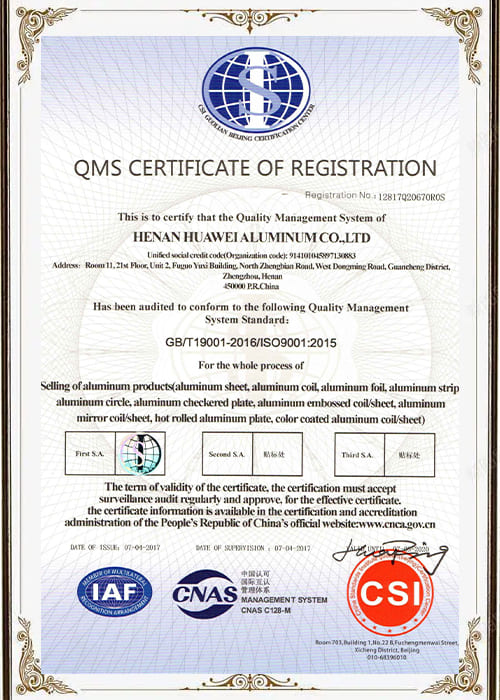
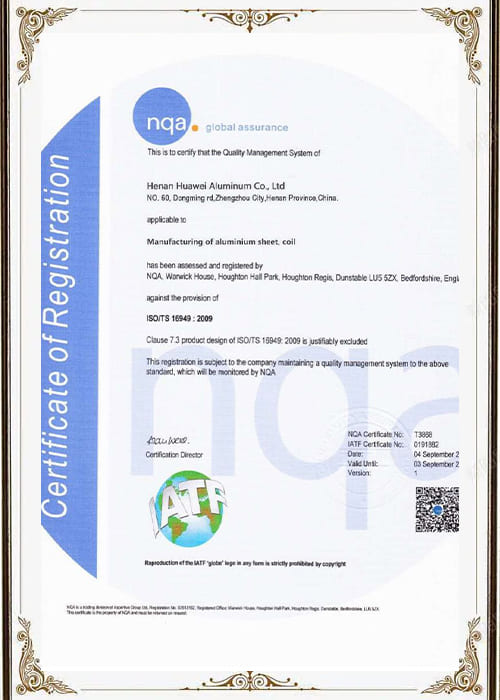
Henan Huawei Aluminyo Co., Ltd employs state-of-the-art rolling, annealing, and blanking technologies. Our rigorous quality control protocols at each stage, from melt composition verification to final disc dimensional and surface inspection, guarantee that our 1060 aluminum discs consistently surpass the stringent quality and performance requirements of the global non-stick cookware industry.
7. Challenges and Considerations in Using 1060 Aluminum for Non-stick Cookware
Habang 1060 aluminum offers numerous advantages, manufacturers must address certain inherent characteristics and design considerations to leverage its full potential.
7.1 Lower Inherent Strength
As a commercially pure aluminum, 1060 possesses lower tensile and yield strength compared to alloyed aluminum (hal., 3003, 3004) or stainless steel. For larger cookware pieces or those subjected to rough handling, this might necessitate:
- Thicker Gauges: Using slightly thicker discs to achieve adequate rigidity and warp resistance.
- Reinforced Bases: Incorporating multi-clad or encapsulated bases (hal., with stainless steel) to enhance structural integrity and prevent deformation over time, particularly under uneven heating or rapid temperature changes.
7.2 Scratch and Dent Susceptibility
The soft nature of 1060 aluminum makes its bare surface prone to scratching and denting.
Gayunpaman, this is largely a cosmetic concern for the consumer, as the entire interior and often the exterior of non-stick cookware are covered by durable non-stick or decorative coatings, which provide the necessary surface hardness and protection.
7.3 Compatibility with Induction Cooktops
Like all non-ferromagnetic aluminum alloys, hubad na hubad 1060 aluminum is not compatible with induction cooktops.
Induction cooking requires a magnetic material for heat generation. To overcome this, non-stick cookware made from 1060 aluminum typically features:
- Bonded or Encapsulated Induction Bases: A layer of ferromagnetic material (usually stainless steel) is bonded or encapsulated to the bottom of the aluminum pan. This adds a manufacturing step and increases the overall cost but expands market reach significantly.
7.4 Critical Importance of Surface Pre-treatment for Coating
Habang 1060 provides a clean foundation, the success and longevity of the non-stick coating are absolutely dependent on meticulous surface pre-treatment.
Without proper preparation (hal., pagputok ng buhangin, chemical etching, plasma treatment), the non-stick primer will not achieve sufficient mechanical or chemical adhesion, leading to premature coating delamination. This is a crucial quality control point in non-stick cookware manufacturing.
8. Mga Karaniwang Aplikasyon ng 1060 Aluminum Disc for Non-stick Cookware
8.1 Frying pans
One of the most common applications is the production of non-stick frying pans.
1060 aluminum disc is well suited to this type of cookware because it helps manufacturers produce lightweight pans with consistent cooking performance.
8.2 Saucepan bodies
Saucepans often require deeper forming and stable round geometry. 1060 aluminum disc is used to create saucepan shells that are easy to shape and suitable for non-stick coating or protective finishing.
8.3 Woks
Para sa woks, the material must tolerate strong forming and maintain a smooth, uniform surface.
1060 aluminum disc is a practical option for spun or stamped wok bodies, especially in non-stick designs where cooking convenience and easy cleaning are important.
8.4 Casseroles and stew pots
Casseroles at stew pots require deeper cookware shells with good thermal behavior and durable surface protection.
1060 aluminum disc supports these products by providing a stable substrate for non-stick coatings and a lightweight structure that remains easy to handle.
8.5 Milk pans and small sauce pots
Smaller cookware items such as milk pans, baby food pots, at small sauce pots benefit from 1060 aluminum disc because the material can be formed accurately and coated uniformly.
8.6 Baking trays and shallow cookware
Although baking trays are less complex than deep cookware, they still require a base material that is flat, stable, and easy to finish. 1060 aluminum disc or disc-derived blanks are used in some baking trays, shallow pans, and ovenware components where non-stick performance is desired.
8.7 Specialty non-stick kitchenware
1060 aluminum disc is also used in a variety of specialty cookware items.
8.8 Cookware bases for coated systems
In many non-stick cookware products, the aluminum disc is not the final product by itself.
It acts as the substrate for multi-layer coated systems, where the disc is first formed and then treated with primers, non-stick coatings, or decorative layers.
9. Comparison with similar products
1060 aluminum disc is often compared with other materials used in cookware manufacturing.
| Produkto / Materyal | Formability | Thermal kondaktibiti | Paglaban sa Kaagnasan | Coating Compatibility | Cost Efficiency | Main Advantage | Main Limitation | Karaniwang Paggamit |
|---|---|---|---|---|---|---|---|---|
| 1060 Aluminum Disc | Napakahusay | Napakahusay | Very good | Napakahusay | Mataas na | Best balance for non-stick cookware forming and coating | Lower strength than alloyed grades | Frying pans, saucepans, woks |
| 1050 Aluminum Disc | Napakahusay | Napakahusay | Very good | Napakahusay | Mataas na | Very high purity and good surface quality | Slightly different property balance by supplier | General cookware, reflective parts |
| 3003 Aluminum Disc | Very good | Mabuti na lang | Mabuti na lang | Very good | Mataas na | Better strength than pure aluminum | Less thermal conductivity than 1060 | Heavy-duty cookware, formed shells |
| 5052 Aluminum Disc | Mabuti na lang | Mabuti na lang | Napakahusay | Mabuti na lang | Katamtaman | Higher strength and corrosion resistance | Less ideal for deep forming than 1060 | Premium cookware bodies, mga bahagi ng istruktura |
| Stainless Steel Base | Katamtaman | Mas mababa | Napakahusay | Mabuti na lang | Mas mababa | Strong and durable | Poorer heat distribution | Multi-layer cookware |
| Aluminum Alloy with Clad Layers | Very good | Very good | Very good | Very good | Medium to high | Enhanced heat distribution and durability | More complex and costly | Premium cookware systems |
10. Pangwakas na Salita
1060 aluminum disc for non-stick cookware is a highly practical material choice because it combines napakahusay na formability, strong thermal conductivity, magandang paglaban sa kaagnasan, and reliable coating compatibility.
It is especially suitable for cookware bodies that must be stamped or deep drawn and then finished with a durable non-stick surface.
Its value lies in balance. It is not the hardest or strongest aluminum grade, but it is one of the most dependable for cookware production.
For manufacturers, that means fewer forming problems and more consistent coating results. For end users, it means cookware that heats evenly, performs reliably, and supports easy cooking and cleaning.
Sa madaling salita, 1060 aluminum disc is a proven base material for non-stick cookware where manufacturing efficiency and cooking performance must work together.
Mga FAQ
Bakit nga ba 1060 aluminum used for non-stick cookware?
Because it offers excellent formability, good thermal conductivity, and strong compatibility with coating systems.
Is 1060 aluminum disc suitable for deep drawing?
Oo nga. Its ductility and softness in suitable tempers make it very suitable for deep drawing and spinning.
Maaari bang 1060 aluminum be coated with non-stick layers?
Oo nga. It is commonly used as a substrate for PTFE-based and other non-stick coating systems.
Is 1060 better than 3003 for cookware?
For maximum formability and heat conductivity, 1060 is often preferred. For higher strength, 3003 may be considered.
Does 1060 aluminum rust?
Hindi. Aluminum does not rust like steel, at 1060 has good corrosion resistance in typical kitchen environments.
If needed, I can also turn this into a SEO blog version, a product page, or a comparison article with 3003 o 5052 aluminyo disc.