Pinholes on PTP Aluminum Foil | Causes, Pagsubok & Mga specs
17,681 Mga Pananaw 2025-10-23 03:03:44
Panimula
PTP (Press-Through Packaging) aluminyo foil protects tablets and capsules by blocking moisture, oxygen, and light while delivering clean push-through opening.
Pinholes—microscopic perforations formed during foil rolling or handling—undermine that protection. Even a few oversized pinholes can shorten shelf life, cause spotting or softening, and raise out-of-spec risks at stability.
This article explains what Pinholes on PTP aluminum foil are, why they develop, how to measure them, and—most importantly—how they affect barrier performance and patient safety.
You’ll also see mitigation options, realistic acceptance criteria, and comparisons with similar lidding materials so you can specify with confidence.

Pinholes on PTP Aluminum Foil
What Counts as Pinholes on PTP Aluminum Foil?
A pinhole is a through-thickness opening in the aluminum layer. In PTP lidding, the aluminum layer is typically 20–25 μm (tulad ng 8011, 8079, o 8021 aluminyo foil, malambot na temper).
Pinholes are defined by count per unit area at size class (approximate diameter).
- Micro pinholes: < 50 μm—often detectable only by light/electrolytic tests.
- Major pinholes: 50–150 μm—visible under bright backlight; high-risk for moisture ingress.
- Critical pinholes: > 150 μm—unacceptable in most pharma specs; potential visible defects in packs.
Because aluminum is a true barrier, intrinsic OTR/MVTR ≈ 0. Any nonzero transmission through a sealed blister almost always comes from discontinuities—pinholes, edge cracks, or seal voids.
How are pinholes on PTP aluminum foil produced?
Short version. Pinholes are through-thickness breaks in the metal layer. They appear when the foil is thinned, naunat na ang, scratched, or chemically attacked beyond what its microstructure can tolerate.
Risk rises sharply as thickness drops (hal., 20 µm vs 25 M), and whenever hard particles or sharp edges concentrate stress.
Below you’ll find the root causes grouped by stage, the physical mechanism behind each, and what to do about it.
1) Melt & Paghahagis (Sets the “pinhole propensity” before rolling)
Mechanism. Non-metallic inclusions (oxides, carbides), intermetallic stringers (Fe-Si-Al), and trapped gas porosity create local weak points. During heavy reductions, metal flows around these “hard islands,” leaving micro-thin spots that later break open.
Symptoms. Streak-aligned pinholes in machine direction; population varies coil-to-coil.
High-leverage controls. Clean melt practice (rotary degassing), ceramic foam filtration (30–50 ppi), tight Fe/Si control (choose 8079-O / 8021-O over generic 8011-O for better elongation and cleanliness), protected launders, and covered tundish.
2) Hot/Cold Rolling (Where most pinholes are born)
Mechanism. Extreme gauge reductions plus roll roughness, chatter, or abrasive debris cause shear bands and micro-cuts. Any hard speck on work rolls acts like a needle. Lubrication starvation or contaminated oil raises friction and micro-tearing.
Symptoms. Fine pinholes along chatter bands; scratch-aligned micro-holes; higher counts at low gauges (< 22–20 µm).
Controls. Super-finished rolls, strict filtration of rolling oil, frequent roll polishing, debris guards, optimized reduction schedules (avoid single heavy bites at thin gauges), at online light inspection to stop defects early.

PTP Aluminum Foil production process
3) Gauge Effect (Thin foil amplifies every imperfection)
Mechanism. As metal gets thinner, natural surface valleys and inclusions consume a larger share of thickness; the statistical chance of a through-hole rises non-linearly.
Implication. 25 µm PTP typically shows fewer pinholes than 20 M at the same process capability.
Control. Up-gauge high-risk SKUs; use 8079/8021 (higher ductility) when thin gauge is unavoidable.
Mechanism. Dull top/bottom knives, wrong overlap, or high nip pressure tear the edge and imprint “needle” defects a few millimeters inboard. Telescoping and tight cores generate edge crush and micro-buckles that later open in printing or sealing.
Symptoms. Edge-clustered pinholes within 5–20 mm from the slit; repeating with each pass.
Controls. Knife sharpness programs, calibrated overlap, lower web tension, crowned idlers, edge guards, and wider master slit with final trim after printing.
5) Pag-print, Lacquering & Pag-embossing (Over-impression = local thinning)
Mechanism. Excess nip pressure or hard blankets thin crest peaks of the foil’s surface topography. Embossing and mis-register score lines concentrate strain; solvent-rich systems can embrittle thin zones before curing.
Symptoms. Pinholes aligned with text/graphics or emboss pattern; “ink pin-spots” that later prove to be metal loss.
Controls. Set minimum effective impression, softer backing, controlled solvent balance, staged curing, and routine post-print light-table checks.
6) Imbakan & Environment (Pitting that turns into holes)
Mechanism. Condensation + acidic gases (SO₂/NOx) or chlorides cause micro-pitting on coil surfaces. During anneal or handling, pits coalesce into through-holes.
Symptoms. Random pinholes after long warehouse dwell; worse on outer wraps; sometimes brownish spots.
Controls. Store at 15–30 °C, < 60–65% RH, wrap with VCI paper or barrier film, avoid palletizing near chemicals, and rotate stock. Keep coil ends sealed; acclimate before opening to avoid “sweating.”
How We Measure and Classify Pinholes
| Paraan | What it detects | Typical sensitivity | Best use |
|---|---|---|---|
| Light table / camera (transmission) | Through-holes by light leakage | ~30–50 μm | Fast 100% or sampling inspection |
| Electrolytic test | Electrical continuity through holes | ~10–20 μm | High sensitivity on lab samples |
| Dye penetration (post-laminate) | Through-holes & seal path defects | ~50+ μm | Validates finished lidding stacks |
| Helium/mass spectrometry | Gross leaks (system level) | Sub-μm equivalent, but costly | Validation / root cause analysis |
Tip: Pair a fast optical check for routine QC with a more sensitive lab method to set action limits and trend pinhole propensity.

Huawei Aluminum foil pinhole test
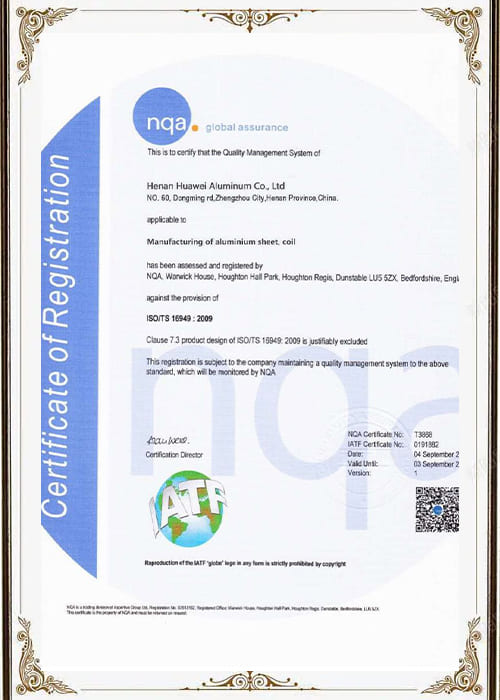
Huawei’s control of PTP aluminum foil pinholes
Adjust to your risk profile and forming film; values below reflect common industry practice for pharma PTP lidding.
| Foil Type | Ang kapal | Pinhole Count ≥ 0.3 mm | Pinhole Count 0.1–0.3 mm | Max single pinhole | Notes |
|---|---|---|---|---|---|
| 8079-O or 8021-O PTP | 25 M | 0 per m² | ≤ 3 per m² | < 0.5 mm | 8079/8021 chosen for better pinhole resistance |
| 8011-O PTP | 20–25 μm | 0 per m² | ≤ 5 per m² | < 0.5 mm | Stricter handling controls required |
| Printed/primered PTP | 20–25 μm | 0 per m² | ≤ 3 per m² | < 0.4 mm | Printing adds stress—tighten limits |
Practical rule: Zero tolerance for “critical” pinholes; tight limits for “major” pinholes; monitor trends for “micro” pinholes.
How Pinholes Impact PTP Aluminum Foil Performance
PTP foil’s value lies in three key performance traits: barrier protection, integridad ng selyo, and mechanical strength.
Pinholes on PTP Aluminum Foil erode all three, with consequences that range from product spoilage to safety risks.
1. Barrier Protection Failure
The biggest risk of pinholes is broken barrier protection. PTP aluminum foil is meant to block oxygen and moisture—two factors that degrade most medications.
A single pinhole, even 30 micrometers wide, lets ambient air and humidity seep into the blister pack.
Halimbawa na lang, a vitamin C tablet stored in a pinhole-affected blister may oxidize within weeks, turning yellow and losing potency.
Katulad din nito, moisture can cause aspirin to break down into acetic acid, leading to a vinegar-like smell and reduced effectiveness.
Sa paglipas ng panahon, this not only wastes inventory but also puts patients at risk of using ineffective drugs.

PTP Aluminum Foil for pharmaceutical packaging
2. Seal Integrity Issues
PTP foil relies on a tight seal with the blister’s plastic (usually PVC or PET) to trap the medication inside.
Pinholes near the seal line create “leak paths” that break this seal. During transport, if packs are jostled, the seal around a pinhole may peel open slightly, allowing dust or contaminants to enter.
In extreme cases, the entire blister may pop open, leading to lost or damaged pills.
For pharmaceutical companies, this means costly recalls—even a small batch with pinhole-related seal issues can trigger regulatory action, as it violates Good Manufacturing Practices (GMP).
3. Reduced Mechanical Strength
While PTP foil is thin, it needs enough strength to resist tearing during opening (when users peel the foil off the blister).
Pinholes act as stress points: when force is applied to open the pack, the foil is more likely to tear along the pinhole, creating larger gaps.
This not only makes the pack harder to use (users may struggle to remove pills cleanly) but also increases the chance of pill damage—for example, a soft gel capsule could burst if the foil tears unevenly.
Material Choices That Reduce Pinhole Risk — Focused, Data-Backed Guidance
Start with the metal. Most pinhole issues are “baked in” by alloy chemistry and gauge before your line ever sees the roll.
Converters can lower counts with careful handling, pero haluang metal + kapal naman decides your baseline risk.

Effect of Pinholes on PTP Aluminum Foil
1) Alloy selection (8079/8021 sa paglipas ng 8011 for critical packs)
- 8079-O at 8021-O are the pharma workhorses because they pair high ductility with a clean inclusion profile, so the foil survives heavy reductions without micro-tearing.
- 8011-O is widely available and fine for many OTC products, but its intermetallic population tends to raise pinhole propensity at thin gauges.
Comparative snapshot (indicative):
| haluang metal (O kahinahunan) | Relative pinhole resistance* | Typical gauge for PTP | Notes you can use |
|---|---|---|---|
| 8079-O | Mababa ang (best) | 25 M (20-25 μm) | Mataas na paghaba; tight inclusion control; premium choice for moisture-sensitive drugs |
| 8021-O | Low–Medium | 25 M (20-25 μm) | Magandang ductility; robust in converting; widely specified in pharma |
| 8011-O | Katamtaman | 20-25 μm | Epektibo ang gastos; acceptable with stricter handling and QC |
*Relative ranking derived from multi-plant QA datasets where “major pinholes (≥0.1 mm)” at 25 µm show ~30–50% lower counts for 8079/8021 mga bes. 8011 under comparable rolling capability.
2) Gauge choice (the single biggest lever)
Pinhole probability increases non-linearly as gauge drops, because surface valleys and inclusions consume more of the remaining thickness.
What users actually see (typical capable mills):
| Sukatan ng sukat | Expected “major” pinholes (≥0.1–0.3 mm) | Acceptance target you can write |
|---|---|---|
| 25 M | ≤ 1–3 per m² (8079/8021), ≤ 3–5 per m² (8011) | ≤ 3 per m², zero ≥0.3 mm |
| 20 M | 2–6 per m² (8079/8021), 5–8 per m² (8011) | ≤ 5 per m², zero ≥0.3 mm |
Rule of thumb: Moving from 20 µm → 25 M cuts major pinholes by ~40–70% and materially improves converting yield.
3) Temper and surface (press-through friendly, low stress)
- Use O temper only for PTP lidding. Hard tempers (H-, T-) carry more residual stress and are pin-prone under print/emboss pressure.
- Prefer foils with uniform surface topography (controlled Ra) and consistent matte/bright asymmetry. A smoother, defect-free roll face lowers crest thinning under nip; specify cosmetic grade without roll scratches.
4) Laminate architecture (mechanical robustness without hiding defects)
- Lacquered PTP (papel de liha + heat-seal lacquer) ay ang pamantayan. It relies entirely on the metal for barrier—any pinhole is a leak path.
- PET/foil/PE peel laminates add mechanical toughness and cut handling-induced damage by ~15–25% in typical lines, but they don’t heal true pinholes in the metal layer.
- Cold-form Alu-Alu (forming web): if you pair PTP lidding with an aluminum pocket, a rare lidding pinhole has less barrier impact (the cavity is still metal-barrier), though it will still fail cosmetic/leak tests.
PTP Foil vs Similar Lidding Options
| Lidding Type | Barrier to Moisture/O₂ | Pinhole Behavior | Opening Method | Pag-print | Karaniwang Paggamit |
|---|---|---|---|---|---|
| PTP Al (20–25 μm) + HS lacquer | Napakahusay (foil is true barrier) | Pinhole-limited; must control counts | Press-through | Napakahusay | Standard tablets/capsules |
| Paper/foil/PE laminate | Very good; edge-wicking risk | Paper layer can mask small holes but edges become critical | Peel | Mabuti na lang | OTC cards, large formats |
| PET/foil/PE laminate | Napakahusay | Better mechanical robustness; pinhole risk mainly from foil layer | Peel | Napakahusay | Child-resistant, higher abuse |
| Cold-form Alu-Alu | Outstanding (3-side Al barrier) | Lidding pinholes less catastrophic; pocket is still Al | Peel | Mabuti na lang | Very moisture-sensitive drugs |
Key takeaway: If your forming web is PVC or PVC/PVDC, lidding pinholes directly define pack barrier. With Alu-Alu, a rare lidding pinhole has less impact but still fails appearance and leak tests.
Mga FAQ
Do primers and lacquers “cover” pinholes?
Hindi. Coatings improve sealing and print adhesion, but they do not restore true metal barrier where a through-hole exists.
Will a desiccant in the carton compensate?
Desiccants help secondary headspace, but a pinhole can still let moisture into a specific cavity. Do not rely on desiccants to offset critical pinholes.
Bakit nga ba 25 μm preferred for sensitive products?
Thicker foil reduces pinhole propensity and tolerates converting stresses better, improving process yield and shelf-life margin.
Does cold-form Alu-Alu eliminate the problem?
It reduces the epekto of a rare lidding pinhole, because the pocket is aluminum, but you still must meet visual and leak requirements.
Pangwakas na Salita
Pinholes on PTP Aluminum Foil turn a perfect metal barrier into a local leak path. In PTP aluminum foil, that means moisture and oxygen ingress rise exactly where you least want it—at tablet level—driving physical changes and stability risk.
The fix is straightforward: specify the right alloy and thickness, enforce zero-critical limits, at control converting stress. Pair fast optical inspection with a sensitive lab method, then trend results so you catch drift before stability does.
If your product is highly moisture sensitive, standardize on 25 μm 8079-O/8021-O, keep major pinholes ≤ 3 per m² (or tighter), and validate your forming film choice.
This approach delivers consistent patient experience, fewer deviations, and a comfortable shelf-life margin—exactly what a good PTP system should do.