I. Introducción
Grado marino 5086 La placa de aluminio H116 ocupa una posición excepcionalmente valiosa en el espectro de materiales de construcción naval de aluminio, una posición que con frecuencia se subestima precisamente porque se encuentra entre dos aleaciones especificadas más prominentemente..
Más resistente a la corrosión y conformable que el 6061 serie, Aún más viable y soldable que el de alta resistencia. 5083, 5086 H116 ofrece una combinación de propiedades que lo hacen irreemplazable en una amplia gama de aplicaciones marinas.: Barcos de pesca de recreo con formas de casco complejas., cascos de veleros que requieren cubiertas acampanadas, estructura secundaria para barco de trabajo comercial, pasarelas de plataformas marinas, y superestructuras de buques militares.
Este artículo ofrece una visión completa, examen autorizado de grado marino 5086 Placa de aluminio H116 en dieciocho dimensiones analíticas: metalurgia, ciencia del temperamento, fabricación, propiedades, rendimiento contra la corrosión, la comparación crítica 5086 versus 5083, diseño estructural, aplicaciones de embarcaciones, fabricación, protección contra la corrosión, estándares de calidad, marcos regulatorios, economía de la cadena de suministro, sostenibilidad, e innovación.
II. Fundación metalúrgica: El 5086 Aleación de aluminio
2.1 La serie 5xxx: Química marina del magnesio
Las aleaciones de aluminio de la serie 5xxx logran su resistencia y resistencia a la corrosión a través del magnesio disuelto en una solución sólida dentro de la matriz de aluminio..
Átomos de magnesio, ligeramente más grande que los átomos de aluminio, distorsionar la red cristalina, impedir el movimiento de dislocación y, por lo tanto, aumentar la fuerza: un mecanismo llamado fortalecimiento de solución sólida que no requiere tratamiento térmico para activarse y nunca disminuye debido a la exposición térmica. (por debajo del rango de sensibilización).
Este carácter de no tratable térmicamente define la lógica de rendimiento marino de las aleaciones 5xxx.: sus propiedades permanecen estables durante toda la vida útil del recipiente, a diferencia de las aleaciones tratadas térmicamente cuyo endurecimiento por precipitación puede revertirse parcialmente mediante los ciclos térmicos de soldadura y fuego..
El segundo don marino del magnesio es electroquímico: Cambia el potencial de corrosión natural de la aleación en el agua de mar hacia un nivel más negativo. (anódico) valores, mejorar la resistencia a la corrosión por picaduras haciendo que la película pasiva sea más estable y reduciendo el diferencial entre la matriz de aleación y las partículas intermetálicas catódicas que sirven como sitios de iniciación de picaduras.
Un mayor contenido de magnesio generalmente significa una mejor resistencia a la corrosión del agua de mar, razón por la cual 5083 (4.0–4,9% magnesio) supera 5052 (2.2–2,8% magnesio) en servicio marítimo a largo plazo.
5086 se sienta entre estos dos: su rango de magnesio de 3,5 a 4,5 % ofrece una resistencia a la corrosión del agua de mar claramente superior a 5052 y acercándose 5083, manteniendo al mismo tiempo el contenido de magnesio lo suficientemente bajo como para reducir el riesgo de sensibilización que se convierte en una preocupación principal de ingeniería en aleaciones con alto contenido de Mg..
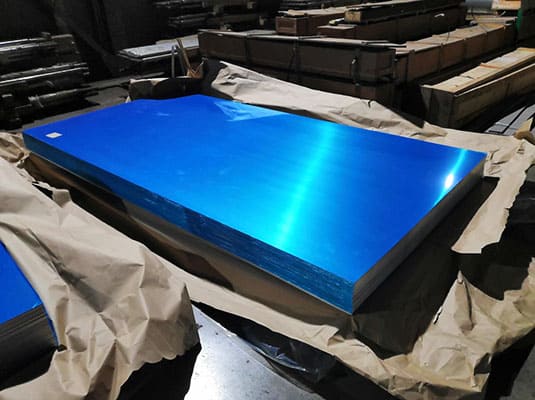
Grado marino 5086 Placa de aluminio H116
2.2 Composición química: Cada elemento diseñado para el mar
la composición de 5086 aluminio, definido por ASTM B209, EN 573-3, GB/T 3880, y JIS H4000, refleja ingeniería marina deliberada en cada elemento:
| Elemento | Rango de composición (%) | Función de ingeniería marina |
|---|---|---|
| Aluminio (Alabama) | Resto (~94,2–95,7) | matriz primaria; Formación y reparación pasiva de películas de óxido. |
| Magnesio (magnesio) | 3.5 – 4.5 | Fortalecimiento de la solución sólida; resistencia a la corrosión del agua de mar |
| Manganeso (Minnesota) | 0.20 – 0.70 | Control de la estructura del grano; Formación de dispersoide Al₆Mn |
| Cromo (cr) | 0.05 – 0.25 | Inhibe la recristalización; estabiliza los límites del grano |
| Hierro (Fe) | ≤ 0.50 | Impureza; forma partículas catódicas de Al₃Fe, controladas estrictamente |
| Silicio (Y) | ≤ 0.40 | Impureza; interactúa con Mg en la formación de Mg₂Si |
| Cobre (cobre) | ≤ 0.10 | Estrictamente minimizado — eleva el riesgo de picaduras y corrosión galvánica |
| Zinc (zinc) | ≤ 0.25 | Techo de impureza; el exceso degrada la resistencia del SCC |
| Titanio (De) | ≤ 0.15 | Refinador de grano de fundición; controlado para la consistencia de la propiedad |
| Otros (cada uno/total) | ≤0,05/≤0,15 | Límite de impureza agregada |
2.3 Análisis comparativo de aleaciones para aplicaciones marinas
Seleccionar la aleación de aluminio marino adecuada requiere comprender dónde se ubica cada una en el espectro de rendimiento, formabilidad y sensibilización.:
| Aleación | magnesio (%) | UTS mínimo (H116, MPa) | Sí mínimo (H116, MPa) | Riesgo de sensibilización | Formabilidad | Mejor aplicación marina |
|---|---|---|---|---|---|---|
| 5052-H32 | 2.2–2,8 | 228 | 193 | muy bajo | Excelente | Estructura ligera; sin casco |
| 5086-H116 | 3.5–4,5 | 270 | 193 | Bajo-moderado | Muy bien | Parte superior del casco; formas complejas; estructura secundaria |
| 5083-H116 | 4.0–4,9 | 303 | 214 | Moderado | Bien | Estructura primaria del casco; revestimiento inferior |
| 5456-H116 | 4.7–5,5 | 317 | 228 | Moderado-alto | Justo | Casco de alta resistencia; seguimiento cuidadoso |
| 5059-H116 | 5.0–6.0 | 330 | 240 | Bajo (optimizado) | Justo | naval premium; marina de mayor resistencia |
| 6061-T6 | 0.8–1,2 mg | 310 | 276 | N / A | Moderado | Estructural no marino; evitar la inmersión en agua de mar |
5086 Ocupa el óptimo de formabilidad de la familia de aleaciones marinas.. Se dobla más fácilmente que 5083, soldaduras con una reducción ligeramente menor de la resistencia HAZ, y lleva protección de sensibilización equivalente en temperamento H116, lo que la convierte en la opción lógica siempre que la geometría sea compleja., formas de casco curvadas, o una trabajabilidad superior en frío importa más que la prima de resistencia del 10 al 12% que 5083 proporciona.
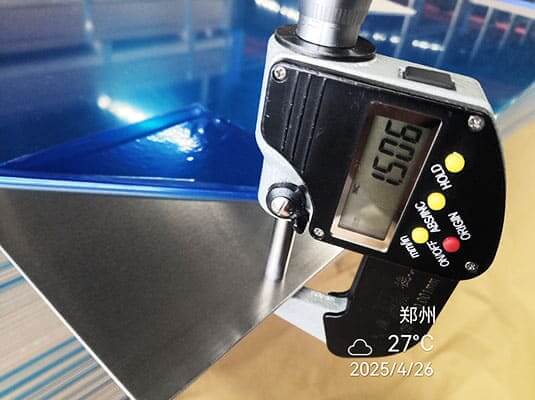
5086 Medición del espesor de la placa de aluminio H116
III. El temperamento H116: Ingeniería Marina Específica de 5086
3.1 Un temperamento nacido de la experiencia operativa
La especificación de temple H116 para aleaciones de aluminio marino no surgió de la ciencia de los materiales teóricos: surgió de una historia documentada de fallas prematuras por corrosión en embarcaciones construidas con aleaciones 5xxx en temples que superaban las especificaciones de propiedades mecánicas pero carecían del control microestructural necesario para resistir los mecanismos de corrosión específicos del agua de mar..
Exfoliación del revestimiento del casco., Fisuración por corrosión bajo tensión en uniones soldadas., y el ataque intergranular en placas que habían sido ligeramente sensibilizadas durante la fabricación contribuyeron al reconocimiento de la industria de que el aluminio marino necesitaba una designación de temple diseñada específicamente para resistir la corrosión., no sólo alrededor de la fuerza.
El resultado, codificado en ASTM B928 (publicado por primera vez 2004, revisado periódicamente) — define H116 como una condición endurecida por deformación para aleaciones de la serie 5xxx con ≥3 % de magnesio diseñada específicamente para proporcionar resistencia a la corrosión por exfoliación y al agrietamiento por corrosión bajo tensión..
La norma exige pruebas de sensibilización en cada lote de producción., haciendo del H116 el único templado de aluminio en la producción comercial de rutina donde la prueba de corrosión es un requisito obligatorio de aceptación del lote en lugar de una prueba complementaria opcional..
3.2 Ruta de producción H116: Trabajo en frío controlado
Productor 5086 H116 requiere un control preciso sobre la reducción en frío aplicada después del laminado en caliente, un porcentaje que logra simultáneamente tres objetivos que normalmente estarían en tensión.: resistencia a la tracción adecuada (UTS ≥270 MPa), ductilidad adecuada (alargamiento ≥10%), y la estructura de dislocación específica que interrumpe la cobertura continua de los límites del grano en fase beta.
La disciplina térmica crítica durante el laminado en frío H116 es mantener la temperatura de la placa por debajo de 65 °C durante todas las pasadas de reducción en frío..
La laminación en frío genera calor mediante la deformación plástica, y sin aplicación adecuada de refrigerante y enfriamiento entre pasadas, El calor de laminación por sí solo puede llevar la placa al rango de sensibilización, una excursión del proceso que produciría propiedades mecánicas templadas por el H116 en un material que ya ha comenzado la precipitación en el límite del grano que el H116 está diseñado para evitar..
3.3 Comparando 5086 temperamentos: Las distinciones marinas críticas
| Temperamento | Definición | NAMLT requerido | Resistencia a la exfoliación | Resistencia al CCS | Uso marino |
|---|---|---|---|---|---|
| O | Completamente recocido | No | Pobre | Pobre | Sólo conformado profundo; no para inmersión en agua de mar |
| H32 | endurecido por deformación + recocido parcial | No | Moderado | Moderado | No de calidad marina - estructural general solamente |
| H34 | endurecido por deformación + recocido parcial (más alto) | No | Moderado | Moderado | No de calidad marina |
| H116 | endurecido por deformación; controlado por mar | Sí (≤15 mg/cm²) | Excelente | Excelente | Especificación estructural marina primaria |
| H321 | endurecido por deformación + estabilizado | Sí (≤15 mg/cm²) | Excelente | Excelente | Alternativa al H116; lámina >38 milímetro |
| H112 | Tal como está fabricado; propiedades controladas | No | No probado | No probado | Aplicaciones estructurales no marinas |
3.4 Propiedad mecánica de grado marino 5086 Placa de aluminio H116
| Propiedad | Valor | Estándar de prueba | Aplicación de diseño |
|---|---|---|---|
| UTS (mínimo) | 270 MPa (39 ksi) | ASTM E8 | Resistencia del panel del casco; diseño de miembros estructurales |
| Límite elástico (0.2%) (min) | 193 MPa (28 ksi) | ASTM E8 | Límite de diseño elástico; evaluación de pandeo |
| Alargamiento (min) | 10% | ASTM E8 | Reserva de ductilidad para conformado y tolerancia al impacto. |
| Resistencia a la cizalladura (típico) | ~165MPa | - | Diseño de remaches y cizallas para soldar. |
| Dureza Brinell (típico) | 60–75 HB | ASTM E10 | verificación de temperamento; inspección entrante |
| Resistencia a la fatiga (sin soldar, 5×10⁸) | ~117MPa | ASTM E466 | Evaluación de fatiga del metal principal |
| Resistencia a la fatiga (junta soldada) | ~45–62 MPa | Eurocódigo 9/DNV | Criterio rector de diseño para cascos marinos |
| impacto charpy (−40°C) | >15 j | ASTM E23 | Calificación del servicio de clima frío |
| Módulo de elasticidad | 70.3 GPa | - | Cálculos de deflexión y rigidez. |
IV. Proceso de fabricación de grado marino. 5086 Placa de aluminio H116
4.1 De la certificación fundida a la marina: La secuencia de producción
Certificado 5086 La placa marina H116 requiere un control de proceso disciplinado en seis etapas de fabricación, porque la función principal del templado H116 (resistencia a la corrosión a través de una microestructura controlada) puede destruirse por una sola excursión térmica o una reducción de frío inadecuada en cualquier punto de la secuencia..
A continuación se rastrea el proceso de producción desde la preparación de la aleación hasta la certificación..
4.2 Preparación de aleaciones y fundición DC
El 5086 La masa fundida se prepara combinando aluminio primario. (≥99,7% Al) con adiciones de magnesio metálico pesadas con precisión (alcanzar el objetivo de 3,5 a 4,5 % de Mg) y aleación maestra de manganeso (0.20–0,70% objetivo Mn).
Adición de cromo (0.05–0,25% Cr) Requiere un control cuidadoso: muy poco sacrifica la función de estabilización del límite de grano.; Demasiado riesgo de formación de precipitados con cromo que pueden fragilizar la aleación.. Espectrometría de emisión óptica (OES) verifica la química del fundido a partir de muestras de cuchara antes de cada lanzamiento.
Enfriamiento directo (corriente continua) La fundición semicontinua produce losas rodantes normalmente de 400 a 550 mm de espesor y de 1000 a 2000 mm de ancho..
La tasa de solidificación controlada del proceso DC produce una fina, microestructura relativamente uniforme con gradientes de composición manejables, superior al más grueso, Estructura más segregada producida por métodos de colada continua..
Para la producción de placas marinas, La fundición DC es la ruta de producción requerida; productores que intentan el casting continuo de 5086 para aplicaciones marinas no puede lograr la uniformidad microestructural requerida para un rendimiento constante contra la corrosión del H116.
4.3 Homogeneización: Construyendo la base microestructural
La homogeneización a 460–510°C durante 8–18 horas cumple tres funciones simultáneamente para 5086 losas:
Eliminación de la segregación: La solidificación produce gradientes de composición a través de espacios de dendritas. (normalmente entre 50 y 200 μm). Mantener a temperatura elevada permite la difusión para redistribuir el magnesio., manganeso, y cromo en una distribución más uniforme, asegurando propiedades consistentes en todo el espesor de la placa.
Precipitación dispersoide: Durante el enfriamiento lento desde la temperatura de homogeneización, Partículas dispersoides de Al₆Mn y Al₁₂Mg₂Cr (0.05–0,5 µm) Nuclear y crecer.. Estas partículas son los agentes microestructurales responsables de inhibir la recristalización durante la laminación en caliente y el crecimiento del grano durante el recocido, controlando directamente la estructura final del grano de la placa H116..
Disolución de fase de no equilibrio: As-cast 5086 Contiene fases intermetálicas metaestables ricas en magnesio en los límites de las dendritas.. La homogeneización los disuelve en una solución sólida., preparar una microestructura inicial uniforme para el laminado en caliente.
4.4 laminación en caliente: Reducción del espesor del edificio con control microestructural
Después de la homogeneización, losas arrancadas (Superficie mecanizada para eliminar el exterior segregado de 10 a 20 mm.) se precalientan a 430-500°C y se laminan en caliente.
El programa de pasadas de laminación en caliente reduce la losa de ~400 a 550 mm al calibre de la banda en caliente de normalmente 3 a 20 mm mediante una secuencia de pasadas de ruptura. (gran reducción por pasada, alta temperatura) y rematar pases (reducción menor, temperatura de salida controlada).
La temperatura de salida de la laminación en caliente (la temperatura a la que la banda sale del tren de laminación final) es particularmente importante para 5086 producción de H116.
Si la temperatura de salida es demasiado alta (por encima de aproximadamente 320°C), la tira recristaliza ampliamente hasta formar una estructura de grano grueso que produce un acabado superficial inferior en el producto final.
Si la temperatura de salida es demasiado baja (por debajo de aproximadamente 220°C), La recristalización incompleta deja una estructura parcialmente trabajada que provoca propiedades variables después del recocido posterior..
Para consistente 5086 Propiedades H116, la mayoría de los productores apuntan a temperaturas de salida de 250 a 310 °C con un control de ±20 °C en todo el ancho de la tira.
4.5 Laminación en frío a condición H116
Después de enfriar la banda caliente por debajo de 100°C (Asegurar que no haya sensibilización durante la transición.), La laminación en frío aplica la reducción controlada que define al H116..
La disciplina de producción durante la laminación en frío abarca tres requisitos simultáneos:
- Control de reducción: Lograr la reducción porcentual específica (propiedad de cada productor, normalmente entre el 5% y el 20% para 5086 H116) que produce UTS ≥270 MPa, YS ≥193 MPa, alargamiento ≥10%, y densidad de dislocación suficiente para NAMLT ≤15 mg/cm²
- control de temperatura: Mantenga la temperatura de la placa por debajo de 65 °C en todo momento; verificado mediante termómetros de contacto en el lado de salida de cada pasada de laminación en frío.
- Gestión de lubricantes: Aplique aceite de rodamiento uniformemente para controlar la fricción., generación de calor, y limpieza de la superficie: el exceso de lubricante contribuye a la contaminación por hidrocarburos de la superficie que compromete la adhesión posterior del recubrimiento.
4.6 Integración del control de calidad: Pruebas de sensibilización en la etapa de producción
ASTM B928 requiere que cada lote de producción de 5086 H116 se somete a pruebas NAMLT antes de su lanzamiento. Un “lote” se define como todas las placas de la misma aleación., temperamento, y espesor producido a partir del mismo molde (calor) en la misma secuencia rodante.
La implicación práctica para los grandes laminadores que producen múltiples lotes simultáneamente es que las pruebas NAMLT pueden representar un tiempo de ciclo de certificación significativo, que generalmente agrega de 2 a 3 días hábiles a los cronogramas de entrega..
Los equipos de adquisiciones deben incorporar este cronograma en los cronogramas de entrega de materiales de los astilleros en lugar de presionar a los proveedores para que liberen la certificación previa..
La secuencia de pruebas de control de calidad de producción antes del lanzamiento de la plancha.:
- Composición química (por OES): Cada calor → aceptar/rechazar versus ASTM B209 / EN 573-3 límites
- Pruebas de tracción (ASTM E8): Cada lote → UTS, YS, Alargamiento versus mínimos H116
- NOMBRE (ASTM G67): cada lote → pérdida de masa ≤15 mg/cm²
- Dureza (Brinell): cada lote (control al azar) → Confirmación de rango 60–75 HB
- Inspección dimensional: Cada placa → espesor, ancho, longitud, llanura, comba
- Pruebas ultrasónicas (ASTM B594): Según lo especificado → laminación interna y detección de inclusiones
V. Propiedades físicas y mecánicas: El perfil completo
5.1 Comparación de propiedades estructurales: 5086 H116 frente a. Alternativas clave
Comprender el grado marino 5086 La placa de aluminio H116 de forma aislada es menos útil que entenderla en contexto.
Las siguientes posiciones de comparación 5086 H116 frente a sus alternativas marinas más comunes en todas las propiedades que rigen las decisiones de diseño estructural:
| Propiedad | 5086-H116 | 5083-H116 | 5052-H32 | 6061-T6 |
|---|---|---|---|---|
| UTS mín. (MPa) | 270 | 303 | 228 | 310 |
| YS mín. (MPa) | 193 | 214 | 193 | 276 |
| Alargamiento mínimo (%) | 10 | 10 | 12 | 8 |
| Densidad (g/cm³) | 2.66 | 2.66 | 2.68 | 2.70 |
| mi (GPa) | 70.3 | 70.3 | 70.3 | 68.9 |
| HAZ YS (tipo, MPa) | ~105 | ~115 | ~90 | ~ 160 (equivalente a T4.) |
| Radio de curvatura mínimo (3placa mm) | ~1,5 toneladas | ~2t | ~1t | ~2,5 toneladas |
| Corrosión del agua de mar | Excelente | Excelente | Muy bien | Moderado |
| Riesgo de sensibilización | Bajo-moderado | Moderado | muy bajo | N / A |
| Se requiere ASTM B928 | Sí | Sí | No | No |
La fila del límite elástico de la HAZ revela una de las ventajas subestimadas del 5086: sus propiedades HAZ de juntas soldadas, mientras está más bajo que la placa principal, compararse favorablemente con los valores de HAZ de 5083 porque el límite elástico inicial más bajo se traduce en una relación de eficiencia de la junta HAZ más favorable..
Para un panel estructural donde la eficiencia de las juntas soldadas (HAZ YS / padre YS) gobierna el diseño, 5086 logra aproximadamente 54% eficiencia conjunta versus aproximadamente 54% para 5083 - esencialmente equivalente.
Sin embargo, el nivel absoluto de estrés en el 5086 Cría (~105 MPa) es mas bajo, lo que significa que para una carga estructural dada, 5086 Las conexiones HAZ requieren una placa ligeramente más gruesa o un espaciamiento más estrecho entre los refuerzos que el equivalente. 5083 conexiones.
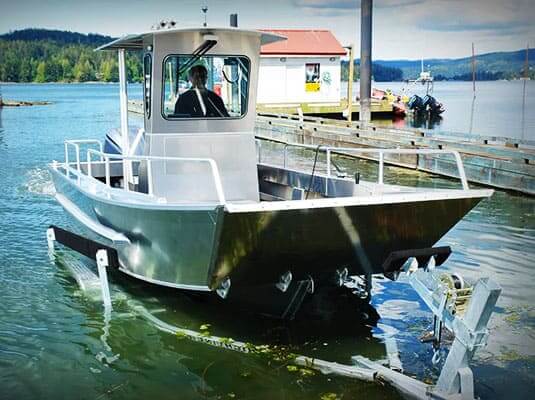
5086 Placa de Aluminio H116 para Cascos de Veleros
5.2 Propiedades físicas para el diseño marino
| Propiedad | Valor | Unidad | Implicaciones del diseño marino |
|---|---|---|---|
| Densidad | 2.66 | g/cm³ | 34% de acero; permite la construcción de casco ligero |
| Módulo de elasticidad | 70.3 | GPa | Más bajo que el acero; gobierna la deflexión en paneles grandes |
| Módulo de corte | 26.4 | GPa | Rigidez torsional; diseño de pandeo por cortante del panel |
| Coeficiente de expansión termal | 23.8 | µm/m·°C | Requisito de diseño de juntas térmicas del trópico al ártico |
| Conductividad térmica | 127 | W/m·K | Distribución de calor; análisis de ingeniería de incendios |
| Conductividad eléctrica | 31 | % SIGC | Diseño de distribución de corriente de protección catódica. |
| rango de fusión | 585–641 | ºC | seguridad contra incendios: más bajo que el acero; Se necesita protección pasiva. |
| Capacidad calorífica específica | 900 | J/kg · k | Masa térmica para cálculos de duración del incendio. |
La densidad de 2.66 g/cm³ es el número que, en última instancia, impulsa el argumento comercial a favor del aluminio frente al acero en la mayoría de las aplicaciones marinas..
Traduciendo esto a una comparación del peso estructural del casco.: a 5086 El panel de casco H116 con rigidez a la flexión equivalente a un panel de acero marino pesa aproximadamente entre el 45% y el 55% del peso del panel de acero..
En una embarcación de recreo de 15 metros, Este ahorro de peso de 600 a 900 kg en la estructura del casco reduce directamente el consumo de combustible aproximadamente entre un 15 y un 22 % a velocidad de crucero: una economía operativa sustancial durante una vida útil del buque de 20 a 30 años..
5.3 Formabilidad: 5086El diferenciador competitivo de
5086 La ventaja de formabilidad del H116 sobre 5083 H116 no es sutil: es la principal razón de ingeniería para especificar 5086 cuando se requiere una geometría de casco compleja.
El mecanismo detrás de la ventaja es sencillo.: 5086El menor contenido de magnesio. (3.5–4,5% frente a. 4.0–4,9% para 5083) produce un límite elástico más bajo, y un límite elástico más bajo se traduce directamente en una mejor conformabilidad en frío porque la tensión requerida para deformar plásticamente el material es menor en relación con su tensión de fractura..
Comparación del radio de curvatura mínimo (espesor del material 4 milímetro):
| Dirección de curvatura | 5086-H116 | 5083-H116 | Ventaja |
|---|---|---|---|
| Transversal a la dirección de rodadura | 1.5t (6 milímetro) | 2t (8 milímetro) | 5086: 25% radio más estrecho |
| Paralelo a la dirección de rodadura | 2t (8 milímetro) | 2.5t (10 milímetro) | 5086: 20% radio más estrecho |
Para la construcción de cascos que implican ángulos pronunciados de elevación, partes superiores acampanadas, secciones de arco curvadas compuestas, y giros de sentina de radio cerrado, Esta ventaja de conformabilidad es operativamente decisiva..
Fabricantes que trabajan con 5086 H116 informa entre un 30% y un 40% menos de incidentes de agrietamiento durante el doblado en frío de las cuadernas y los paneles del casco en comparación con su equivalente 5083 Operaciones H116: una mejora de calidad y productividad que compensa con creces la modesta diferencia de costo de material entre las dos aleaciones..
5.4 Propiedades de diseño por fatiga para estructuras marinas
Las propiedades de fatiga de las uniones soldadas de 5086 H116 sigue el mismo Eurocódigo 9 / Marco de curva DNV S-N como 5083 H116, Dado que ambas son aleaciones de aluminio soldadas y el rendimiento a la fatiga de las uniones soldadas depende principalmente de la geometría y la calidad de la soldadura más que de la aleación específica.:
| Detalle estructural | Categoría de detalle Δσ_C (MPa) | Ubicación representativa del casco |
|---|---|---|
| Placa de padres, alejado de las soldaduras | 70 | Panel medio, lejos de los refuerzos |
| Soldadura a tope de penetración total (calidad A) | 40–50 | Juntas longitudinales de las tracas del casco |
| Soldadura a tope de penetración total (calidad B) | 35–45 | Uniones de marco y transversales. |
| Terminación de refuerzo: con soporte | 28–35 | Conexiones finales del marco |
| Terminación de refuerzo: sin soporte | 20–28 | Terminaciones de refuerzo cortas |
| soldadura de filete, articulación cruciforme | 25–32 | Accesorio de hardware de cubierta |
Crucialmente, 5086 y 5083 Las uniones soldadas en la misma categoría de detalle ofrecen una vida de fatiga equivalente en rangos de tensión equivalentes..
La elección entre las dos aleaciones no afecta significativamente el resultado del diseño por fatiga., siempre que la calidad de la soldadura y la geometría detallada sean equivalentes.
Esta equivalencia significa que los diseñadores pueden sustituir libremente 5086 para 5083 en aplicaciones estructurales gobernadas por fatiga sin rediseñar los detalles de la soldadura: una simplificación práctica importante.
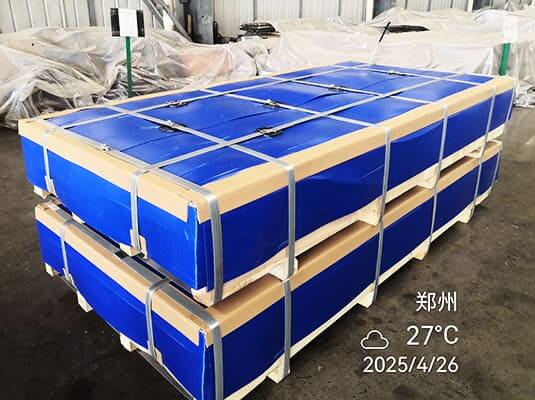
Embalaje de exportación de grado marino 5086 Placa de aluminio H116
VI. Rendimiento contra la corrosión marina: Análisis científico
6.1 5086Posición electroquímica en agua de mar
Grado marino 5086 La placa de aluminio H116 en agua de mar desarrolla un potencial de circuito abierto natural (OCP) de aproximadamente −0,85 V frente al electrodo de calomelanos saturado (SCE) - marginalmente más noble (positivo) que 5083 (aproximadamente −0,87 V), lo que refleja el contenido de magnesio ligeramente inferior.
Esta pequeña diferencia es prácticamente insignificante para la mayoría de los propósitos de diseño marino., ya que ambas aleaciones ocupan la misma posición general en la serie galvánica y responden de manera similar a los mismos sistemas de protección catódica.
La película pasiva en 5086 en agua de mar es una fina (2–8 millas náuticas), Capa amorfa de óxido de aluminio que se forma espontáneamente al exponerse a ambientes que contienen oxígeno y se mantiene a través de un equilibrio dinámico de disolución y repasivación..
La métrica clave de rendimiento es la potencial de picaduras — el potencial electroquímico por encima del cual se nuclean las picaduras — y el potencial de picaduras del 5086 en agua de mar a 25 °C cae aproximadamente entre −0,65 y −0,75 V frente al SCE.
Desde el OCP natural (−0,85 V) es significativamente más negativo que el potencial de picaduras, 5086 en servicio normal de agua de mar opera con aproximadamente 100 a 200 mV de protección catódica de su propio potencial masivo: un amortiguador autoprotector que proporciona una resistencia básica a la nucleación de las picaduras..
6.2 Los tres modos críticos de corrosión y los mecanismos de defensa del 5086
Corrosión por exfoliación: La defensa primaria H116
La exfoliación ataca las aleaciones 5xxx a través del cuerpo alargado., Límites de grano en forma de panqueque producidos por rodadura: la penetración intergranular del agua de mar levanta progresivamente capas de placas sucesivas a lo largo de planos de rodadura., creando la característica ampolla, Aspecto deslaminado que da nombre a la exfoliación..
El mecanismo requiere tres condiciones simultáneamente.: una red de límites de grano sensibilizada (cobertura continua de fase beta); un electrolito (Agua de mar) capaz de penetrar el límite de grano; y la restricción geométrica de los granos alargados que obliga a que la expansión del producto de corrosión se exprese como delaminación entre capas en lugar de ataque general disperso..
5086 H116 ataca este mecanismo en su primer requisito previo. Controlando la reducción en frío para producir un ciclo interrumpido, distribución de fase beta de límite de grano discontinuo, El templado H116 elimina la vía intergranular continua que el agua de mar requiere para una exfoliación progresiva..
Además, 5086El menor contenido de magnesio. (versus 5083) significa que incluso sin el control de temperamento H116, La fase beta del límite de grano tiende a formarse más lentamente y en un patrón más discontinuo, lo que proporciona un margen adicional de seguridad que explica por qué. 5086 en el temple H32 muestra una mejor resistencia a la exfoliación que 5083 en temperamento H32, a pesar de que ninguno cumple con el requisito de certificación ASTM B928.
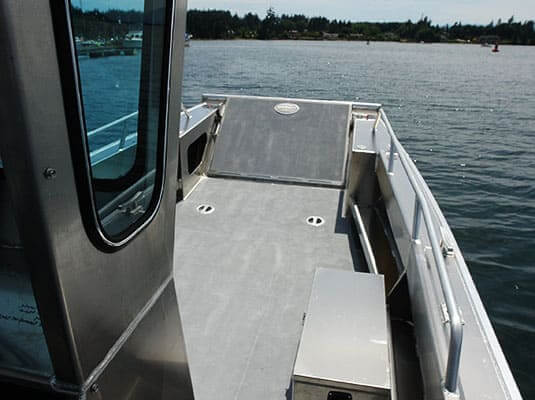
Cubierta de barco usada 5086 Placa de aluminio H116
Agrietamiento de la corrosión del estrés (CCS): Dónde 5086 Supera 5083
El SCC combina una tensión de tracción sostenida con un entorno corrosivo activo para propagar grietas con intensidades de tensión muy por debajo de la tenacidad a la fractura del material no estresado..
En aleaciones sensibilizadas 5xxx, La película de fase beta con límite de grano continuo permite la propagación de grietas de disolución anódica.. 5086 La resistencia al SCC del H116 se beneficia de dos mecanismos de refuerzo: la interrupción del templado H116 de la fase beta continua del límite de grano (Lo mismo que para la exfoliación.), y la cinética de sensibilización inherentemente más lenta del menor contenido de magnesio.
Datos publicados de pruebas de SCC a largo plazo de 5086 H116 demuestra resistencia al agrietamiento en niveles de tensión sostenidos hasta 60% del límite elástico en pruebas de inmersión alternativas (ASTM G44) — superior a 5083 H116 (típicamente resistente a aproximadamente 50% del límite elástico) y dramáticamente superior al material H32 sensibilizado (que puede agrietarse al 20-25% del límite elástico).
Para estructuras de casco que soportan tensiones de soldadura residuales de 30 a 50 MPa, Este margen de resistencia al SCC es adecuado para el servicio marítimo normal, pero no ilimitado.. Cualquier tensión de tracción sostenida combinada con un ambiente térmico que promueva la sensibilización merece atención de ingeniería..
Corrosión de picadura: El ataque básico al agua de mar
Las picaduras se inician en los sitios donde la película pasiva es más débil.: interfaces intermetálicas partícula-matriz, puntos de emergencia del límite de grano, y rayones en la superficie que exponen el aluminio fresco..
Para grado marino 5086 Placa de aluminio H116, Los sitios de iniciación de picaduras dominantes son partículas intermetálicas de Al₃Fe y Al₆Mn., que son catódicos a la matriz de aluminio y crean células galvánicas locales que disuelven el aluminio circundante..
El límite de impureza de hierro de ≤0,50% para 5086 (versus ≤0,40% para 5083) significa que 5086 En principio, puede contener más partículas de Al₃Fe, una desventaja menor en la resistencia a la corrosión en comparación con 5083. En la práctica, la mayoría de grado marino 5086 Los productores mantienen el hierro por debajo. 0.30%, haciendo que esta diferencia teórica sea insignificante.
Datos de pruebas de inmersión a largo plazo para 5086 en agua de mar sintética (Norma ASTM D1141) demuestra profundidades promedio de picadura de 0,10 a 0,25 mm después 5 años: una tasa de corrosión de 0,02 a 0,05 mm/año que se adapta cómodamente a la reserva de espesor de placa disponible en el revestimiento de cascos marinos.
VII. Aplicaciones marinas y tipos de embarcaciones
7.1 Embarcaciones de Recreo y Deportivas: El dominio de aplicación dominante
El mercado de la navegación de recreo representa la mayor proporción de 5086 Consumo de H116 a nivel mundial, Impulsado por la excepcional combinación de formabilidad de la aleación., resistencia a la corrosión del agua de mar, y eficiencia de peso para los tipos y tamaños de embarcaciones que dominan la construcción recreativa (6–18 m de eslora).
Barcos de pesca de altura de aluminio en el rango de 6 a 12 m representan el arquetipo 5086 Aplicación H116. Estos buques necesitan cascos de curvatura compuesta con un pronunciado desnivel. (normalmente entre 18 y 24°) y proas acampanadas para el mantenimiento del mar en alta mar, Resistencia a la corrosión del agua de mar para superficies superiores que pueden no pintarse durante años entre reparaciones., y resistencia estructural adecuada para servicio en alta mar sin peso excesivo que comprometería el rendimiento con motores fuera de borda o de popa más pequeños. Grado marino 5086 La placa de aluminio H116 en calibre de 3,0 a 5,0 mm satisface los tres requisitos simultáneamente.
Cascos de veleros presentan algunos de los desafíos geométricamente más complejos en la construcción de embarcaciones de aluminio: quillas barridas, secciones curvas del espejo de popa, partes superiores acampanadas, y pronunciada caída, todos requieren una curvatura de radio cerrado que 5086 maneja de manera más confiable que 5083. Además, Las cargas estructurales de los veleros son generalmente menores que las cargas de los barcos de motor de eslora equivalente. (sin portazos; velocidad más baja), haciendo el 10% diferencia de límite elástico entre 5086 y 5083 estructuralmente irrelevante para la mayoría de las aplicaciones de veleros. Los constructores experimentados de veleros de aluminio, incluidos especialistas en Europa y Nueva Zelanda, especifican constantemente 5086 H116 para superficies superiores y estructuras por encima de la línea de flotación, reservando 5083 H116 para áreas de unión a quilla y revestimiento de fondo/línea de flotación donde las demandas estructurales justifican la resistencia adicional.
Barcos con consola central y de paseo (7–10 metros) Benefíciese de la formabilidad del 5086 al producir estructuras de consola de lados profundos., caja de pescado rodea, y secciones de francobordo que definen estos tipos de casco. Los constructores reportan significativamente menos reparaciones de soldadura por grietas durante la formación de estos perfiles complejos cuando usan 5086 H116 versus 5083 H116: un ahorro directo en los costos de producción que compensa con creces cualquier prima menor en el costo del material..
7.2 Barcos de trabajo comerciales: Combinando rendimiento estructural con conformabilidad
Barcos de trabajo comerciales: lo práctico, Buques utilitarios que dan servicio a plataformas marinas., tripulación de transferencia, realizar encuestas, y apoyar las operaciones portuarias: representan el segundo dominio de consumo más importante para 5086 H116.
Buques de transferencia de tripulación (CTVS) para el mantenimiento de parques eólicos marinos demuestran más claramente la estrategia de optimización de la selección de aleaciones. un tipico 24 m El diseño del casco de CTV a menudo emplea 5083 H116 (6–8mm) para el revestimiento del fondo, donde las cargas de golpe provenientes del acceso repetido a la turbina en estados de baja mar imponen altas tensiones cíclicas, y 5086 H116 (5–6mm) para cubiertas y paneles de superestructura, donde la menor demanda estructural permite una aleación más moldeable y donde la compleja geometría de alojamiento de la tripulación se beneficia de la capacidad de radio de curvatura más estrecho del 5086.
Embarcaciones para prácticos y embarcaciones de servicio portuario. (12–22 metros) presentan condiciones particularmente favorables para 5086 H116: cargas estructurales moderadas (operación de desplazamiento en lugar de planificación en la mayoría de los casos), formas complejas de casco típicas del diseño de desplazamiento de sentina redonda, y el lavado regular con manguera de agua dulce de la parte superior que caracteriza el mantenimiento de los buques portuarios.. El menor riesgo de sensibilización de 5086 H116 versus 5083 es una ventaja secundaria en los buques portuarios que experimentan limpieza con vapor en la cubierta: una exposición potencial a la temperatura de sensibilización que está completamente ausente en las especificaciones de las aleaciones de construcción del casco en la mayoría de los astilleros..
7.3 Estructuras marinas y aplicaciones costa afuera
Más allá de los cascos de los barcos, 5086 La placa H116 sirve ampliamente en aplicaciones estructurales marinas donde se valoran la resistencia a la corrosión y el peso ligero del aluminio, pero el rendimiento estructural máximo es secundario.:
Muelles y pontones flotantes para marina usar 5086 H116 por su excepcional resistencia a la corrosión en el ambiente agresivo de las aguas marinas. (Niveles elevados de contaminantes por derrames de combustible., escurrimiento de pintura antiincrustante, y contaminación orgánica de buques atracados). Las menores exigencias estructurales de la construcción de muelles flotantes hacen innecesaria la resistencia adicional del 5083, mientras que la formabilidad del 5086 simplifica la fabricación de las formas de pontones y soportes de conexión que caracterizan los sistemas de muelles deportivos..
Pasarelas de plataformas marinas, pasamanos, y rejas — cuando la función principal sea la resistencia a la corrosión y la seguridad del personal en lugar de soportar cargas estructurales, utilice 5086 H116 por su combinación de resistencia adecuada (suficiente para la carga de la pasarela según los códigos aplicables), excelente resistencia a la corrosión sin pintura (Reducir el mantenimiento en ubicaciones remotas en alta mar.), y peso ligero (Reducir el peso muerto impuesto a la estructura superior de la plataforma.).
Pasarelas y rampas de acceso para la transferencia de buque a plataforma y de buque a costa presentan demandas de formabilidad que favorecen 5086: las secciones articuladas, rieles de guía curvos, y las plataformas de aterrizaje en ángulo de los sistemas de pasarelas modernos requieren operaciones de curvatura donde el radio de curvatura mínimo más ajustado del 5086 permite diseños que requerirían un recocido previo de 5083.
Mientras 5083 El H116 domina las aplicaciones estructurales primarias de cascos en la construcción de buques de guerra., 5086 El H116 encuentra un uso sustancial en la estructura secundaria y superestructura de buques de guerra.:
Paneles y cerramientos de superestructura. en patrulleras rápidas y embarcaciones de apoyo se benefician de la formabilidad del 5086 al producir el no plano, Superficies curvas compuestas que caracterizan la estética de las superestructuras de los buques de guerra modernos. (Diseñado para una sección transversal de radar reducida.). Los arquitectos navales que diseñan con criterios de sigilo especifican curvas, paneles de superestructura en ángulo que desafían a los fabricantes que trabajan con 5083; la transición a 5086 para estos elementos mejora significativamente las tasas de éxito de la fabricación en la primera pasada.
Buque de contramedidas mineras (MCMV) estructura auxiliar — paneles no estructurales, divisores internos de alojamiento, carcasas de maquinaria de cubierta: usos frecuentes 5086 H116 donde la reducción de peso y la resistencia a la corrosión son importantes, pero el máximo rendimiento estructural no.. El requisito no magnético que impulsa la selección del material del casco del MCMV hacia el aluminio (o PRFV) También se aplica a la estructura secundaria., haciendo 5086 un ajuste natural.
Construcción combinada de embarcaciones anfibias. estrategias emplean cada vez más 5086 H116 para superficies superiores, paneles laterales de rampa, y estructura del compartimento de la tripulación, reservando 5083 H116 para la carcasa inferior y los marcos estructurales que soportan las cargas concentradas de carga de vehículos durante las operaciones de desembarco en la playa..
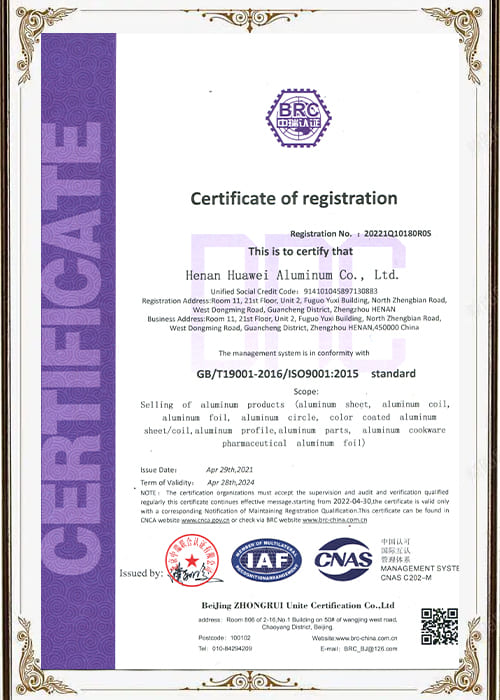
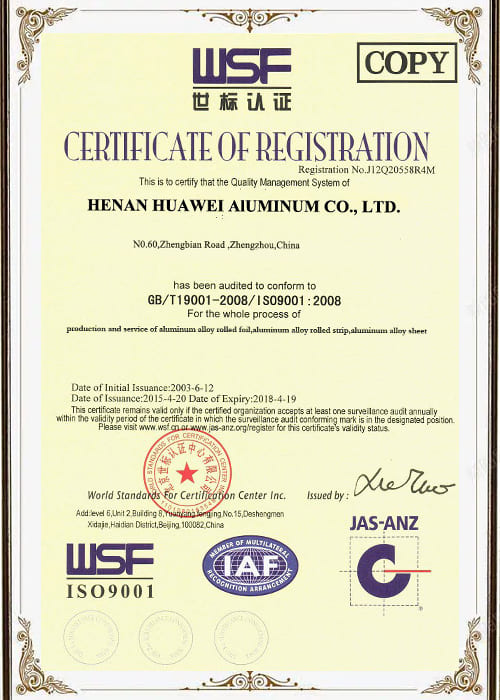
XIII. Estándares de calidad, Pruebas, y Certificación
Grado marino certificado 5086 La placa de aluminio H116 se encuentra dentro de un marco de estándares complementarios que abordan la composición., propiedades, sensibilización, y documentación:
| Estándar | Organismo emisor | Alcance | Requisito crítico para 5086 |
|---|---|---|---|
| ASTM B928 | ASTM Internacional | 5aleaciones xxx para servicio marino | NAMLT ≤15 mg/cm² en cada lote |
| ASTM B209 | ASTM Internacional | Al hoja y placa: dimensiones y propiedades | Composición química; propiedades mecánicas |
| ASTM G67 | ASTM Internacional | Prueba de sensibilización NAMLT | Procedimiento de prueba para el cumplimiento de B928 |
| ASTM G66 | ASTM Internacional | Prueba de exfoliación ASSET | Clasificación visual de la resistencia a la exfoliación. |
| EN 485 | cen | Hoja/placa europea: dimensiones y tolerancias | Marco de tolerancia dimensional |
| EN 573-3 | cen | Normas europeas de composición de aleaciones. | 5086 límites de composición |
| MIL-DTL-24093 | Departamento de Defensa de EE. UU. | Aluminio marino militar | Cualificación del material de los buques de guerra. |
| EN 10204 | cen | Tipos de certificados de materiales | 3.1 / 3.2 documentación de certificación |
IX. Conclusión
La conclusión más importante de este examen exhaustivo es una reformulación de cómo Marine Grade 5086 Se percibe placa de aluminio H116.. Descrito con demasiada frecuencia como “la alternativa menos fuerte a 5083 para aplicaciones donde la resistencia reducida es aceptable,” Grado marino 5086 La placa de aluminio H116 se entiende con mayor precisión como la elección del material de precisión para aplicaciones en las que se requiere una formabilidad superior., Resistencia equivalente a la corrosión marina a largo plazo en temple certificado H116., y una robustez de sensibilización marginalmente mejor se combinan para ofrecer mejores resultados de ingeniería que 5083 H116 lograría.
Las aplicaciones que se benefician específicamente de 5086 H116 son numerosos y comercialmente importantes.: Embarcaciones de recreo de aluminio con formas de casco complejas. (el sector de mayor volumen en consumo de aluminio marino), cascos y cubiertas de veleros, estructura secundaria para barco de trabajo comercial, estructuras de aluminio para plataformas marinas, Estrategias de construcción de cascos de aleaciones mixtas., y el mercado de embarcaciones eléctricas de batería en rápida expansión. En todas estas aplicaciones, 5086 H116 no es un recurso alternativo: es la respuesta de ingeniería correcta.
Proceso de producción de fundición y su introducción.
El propósito de la fusión y colada es producir aleaciones con una composición satisfactoria y alta pureza de fusión., a fin de crear condiciones favorables para la fundición de aleaciones de diversas formas.
Pasos del proceso de fundición y fundición.: procesamiento por lotes --- alimentación --- derritiendo --- revolviendo después de derretir, eliminación de escoria --- muestreo previo al análisis --- Adición de aleación para ajustar la composición., emocionante --- refinación --- Ajuste estático——Guía de fundición en horno.
Proceso de producción de laminación en caliente y su introducción.
- 1. Laminación en caliente generalmente se refiere a laminación por encima de la temperatura de recristalización del metal.;
- 2. Durante el proceso de laminación en caliente, el metal tiene procesos de endurecimiento y ablandamiento. Debido a la influencia de la velocidad de deformación., siempre que el proceso de recuperación y recristalización sea demasiado tarde, habrá un cierto endurecimiento del trabajo;
- 3. La recristalización del metal después del laminado en caliente es incompleta., eso es, la coexistencia de estructura recristalizada y estructura deformada;
- 4. El laminado en caliente puede mejorar el rendimiento del procesamiento de metales y aleaciones, reducir o eliminar los defectos de fundición.
- 1. La temperatura de colada y laminación está generalmente entre 680°C y 700°C. Cuanto más bajo mejor, la línea estable de fundición y laminación generalmente se detiene una vez al mes o más para volver a colocarse. Durante el proceso de producción, es necesario controlar estrictamente el nivel de líquido del tanque delantero para evitar un nivel bajo de líquido;
- 2. La lubricación utiliza polvo C con combustión incompleta de gas para la lubricación, que es también una de las razones de la superficie sucia de los materiales de fundición y laminación;
- 3. La velocidad de producción es generalmente entre 1,5 m/min-2,5 m/min;
- 4. La calidad de la superficie de los productos producidos por fundición y laminación es generalmente relativamente baja., y generalmente no puede cumplir con los productos con requisitos especiales de rendimiento físico y químico.
- 1. Laminación en frío se refiere al método de producción de laminación por debajo de la temperatura de recristalización;
- 2. No habrá recristalización dinámica durante el proceso de laminación., y la temperatura subirá a la temperatura de recuperación como máximo, y el laminado en frío aparecerá en un estado de endurecimiento por trabajo, y la tasa de endurecimiento por trabajo será grande;
- 3. La hoja y la tira laminadas en frío tienen una alta precisión dimensional, buena calidad superficial, estructura y rendimiento uniformes, y los productos en varios estados se pueden obtener con tratamiento térmico;
- 4. El laminado en frío puede producir tiras finas, pero al mismo tiempo, tiene las desventajas de un alto consumo de energía para la deformación y muchas pasadas de procesamiento.
- 1. El acabado es un método de procesamiento para hacer que la lámina laminada en frío cumpla con los requisitos del cliente., o para facilitar el procesamiento posterior del producto;
- 2. El equipo de acabado puede corregir los defectos producidos en el proceso de producción de laminación en caliente y laminación en frío, como borde agrietado, aceitoso, mala forma de la placa, estrés residual, etc.. Debe asegurarse de que no se introduzcan otros defectos en el proceso de producción.;
- 3. Hay varios equipos de acabado., incluyendo principalmente transversales, corte longitudinal, estiramiento y alisado, horno de recocido, deslizarse, etc..
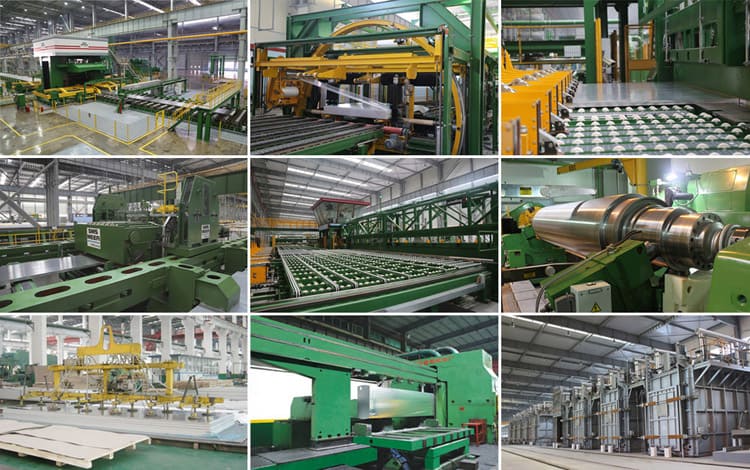
Proceso de fundición y laminación.
Proceso de fundición y laminación.: metal liquido, caja frontal (control de nivel de líquido), máquina de fundición y laminación (sistema de lubricación, agua de enfriamiento), máquina de esquilar, máquina de bobinado.
Proceso de producción de laminación en frío.
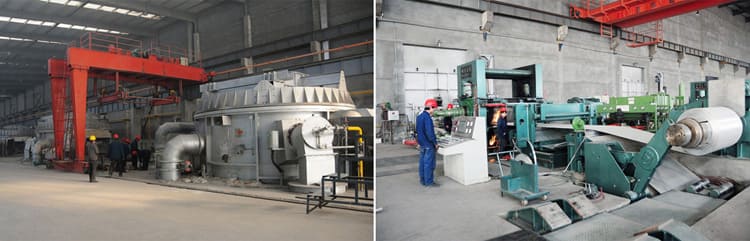
Introducción al proceso de producción de acabado.
La aleación de aluminio tiene las características de baja densidad., buenas propiedades mecanicas, buen rendimiento de procesamiento, no tóxico, fácil de reciclar, excelente conductividad eléctrica, transferencia de calor y resistencia a la corrosión, por lo que tiene una amplia gama de aplicaciones.
Aeroespacial: se utiliza para hacer pieles de aviones, marcos de fuselaje, vigas, rotores, hélices, tanques de combustible, paneles de pared y puntales del tren de aterrizaje, así como anillos de forja de cohetes, paneles de pared de naves espaciales, etc..

Aleación de aluminio utilizada para la industria aeroespacial
Transporte: utilizado para materiales de estructura de carrocería de automóviles, vehículos del metro, coches de pasajeros de ferrocarril, turismos de alta velocidad, puertas y ventanas, estantes, partes del motor automotriz, acondicionadores de aire, radiadores, paneles de carrocería, ruedas y materiales de barco.
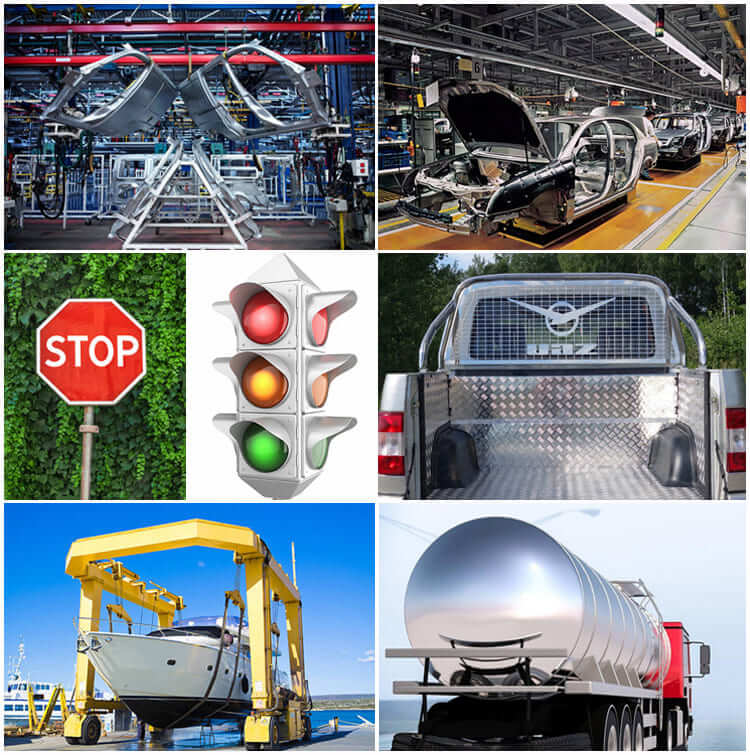
aplicación de tráfico
embalaje: Las latas de refrescos totalmente de aluminio se utilizan principalmente como materiales de embalaje de metal en forma de láminas y placas finas., y se convierten en latas, tapas, botellas, barriles, y láminas de embalaje. Ampliamente utilizado en el envasado de bebidas., alimento, productos cosméticos, medicamentos, cigarrillos, productos industriales, medicamentos, etc..
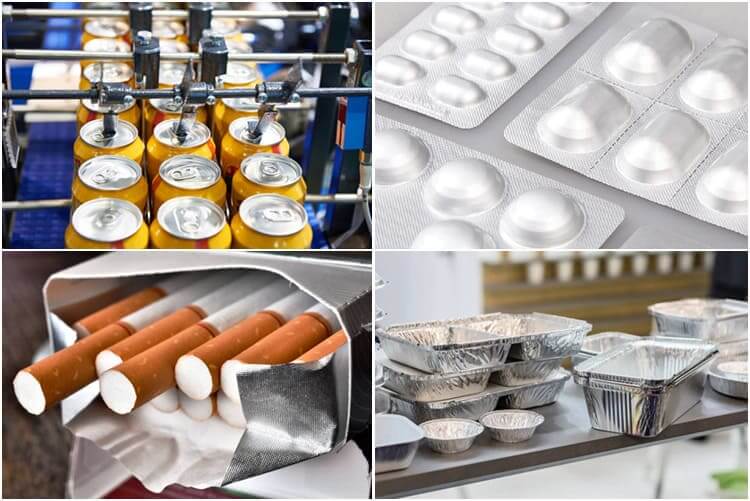
aplicación de embalaje
Impresión: Se utiliza principalmente para hacer placas PS., Las planchas PS a base de aluminio son un nuevo tipo de material en la industria de la impresión, utilizado para la fabricación e impresión automática de planchas.
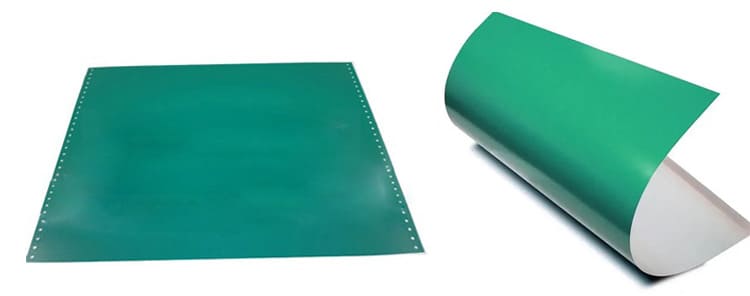
impresión de PS
Decoración arquitectónica: la aleación de aluminio es ampliamente utilizada en estructuras de construcción, puertas y ventanas, falsos techos, superficies decorativas, etc.. debido a su buena resistencia a la corrosión, fuerza suficiente, excelente rendimiento de proceso y rendimiento de soldadura.
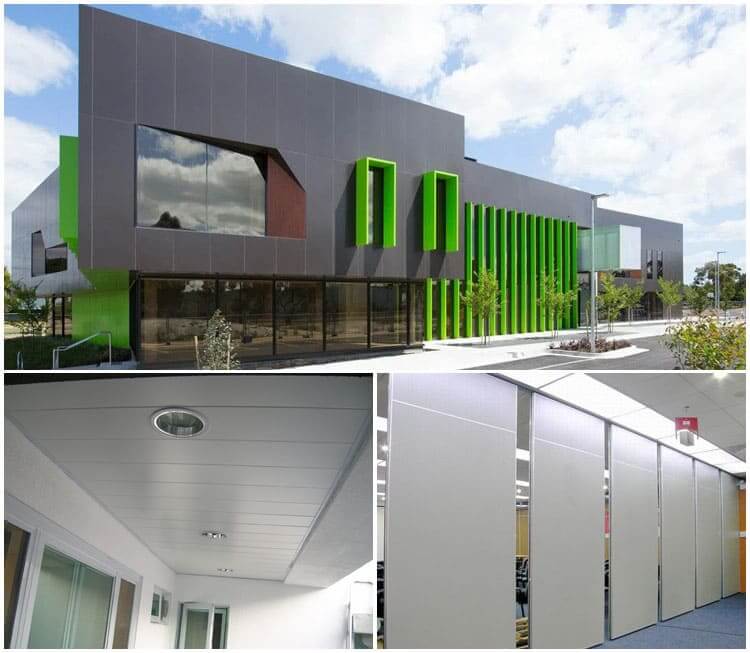
Aplicación de construcción de aleación de aluminio.
Productos electrónicos: ordenadores, teléfonos móviles, conchas de refrigerador, radiadores, etc..
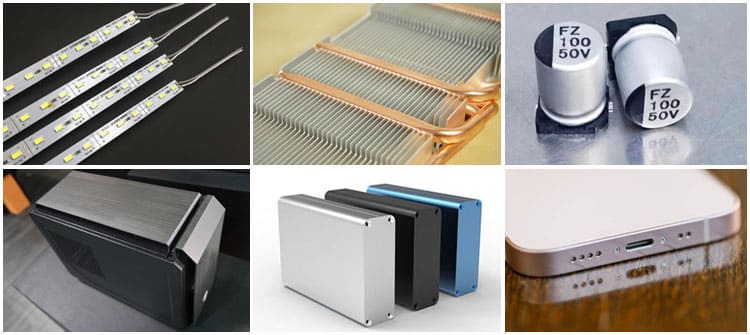
aplicación de producto electrónico
Utensilios de cocina: ollas de aluminio, lavabos de aluminio, revestimientos de olla arrocera, papel de aluminio doméstico, etc..
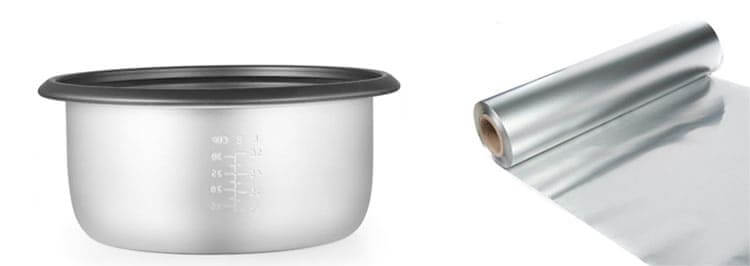
aplicación de cocina
Embalaje de láminas/bobinas de aluminio
Cada detalle del embalaje es donde buscamos un servicio perfecto.. Nuestro proceso de envasado en su conjunto es el siguiente:
Laminación: película clara, película azul, micro-mucosa, mucosa alta, película de corte por láser (2 marcas, Novacell y Polyphem);
Proteccion: protectores de esquinas de papel, almohadillas anti-presión;
el secado: desecante;
Bandeja: bandeja de madera inofensiva fumigada, bandeja de hierro reutilizable;
Embalaje: cinturón de acero tres en raya, o cinta de embalaje de PVC;
Calidad de materiales: Completamente libre de defectos como óxido blanco., manchas de aceite, marcas rodantes, daños en los bordes, enfermedad de buzo, abolladuras, agujeros, romper lineas, arañazos, etc., sin juego de bobinas.
Puerto: Qingdao u otros puertos en China.
Tiempo de espera: 15-45 días.
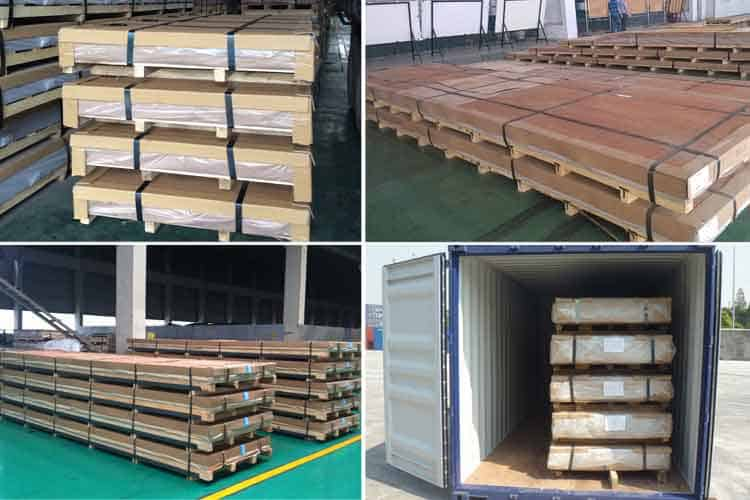
Proceso de envasado de láminas/placas de aluminio
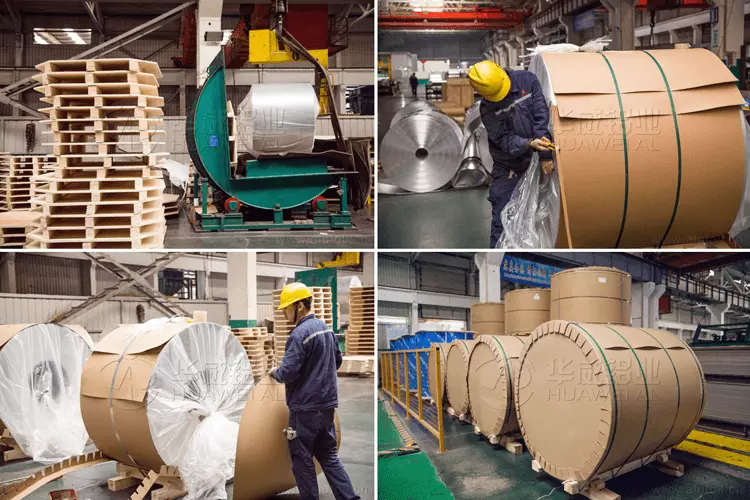
Proceso de envasado de bobinas de aluminio
F: ¿Es usted un fabricante o un comerciante??
q: somos un fabricante, nuestra fábrica está en No.3 Weier Road, Zona industrial, Gongyi, Henán, Porcelana.
F: ¿Cuál es el MOQ para pedir el producto??
q: Nuestro MOQ es 5 montones, y algunos productos especiales tendrán una cantidad mínima de pedido de 1 o 2 montones.
F: ¿Cuánto tiempo es su tiempo de entrega??
q: En general, nuestro tiempo de entrega es de aproximadamente 30 días.
F: ¿Sus productos tienen garantía de calidad??
q: Sí, si hay un problema de calidad con nuestros productos, compensaremos al cliente hasta que esté satisfecho.
Productos relacionados


Últimos blogs
5052 contra 6061 Aluminio: Diferencias clave & Mejores usos
Comparar 5052 contra 6061 aluminio para mayor resistencia, resistencia a la corrosión, formabilidad, y mecanizado. Descubre qué aleación se adapta mejor a tu proyecto.
Aleaciones comunes de bobinas de aluminio recubiertas de PE usadas para camiones frigoríficos
Descubra las aleaciones comunes de bobinas de aluminio recubiertas de PE usadas en camiones frigoríficos, incluido 3003, 3004, y 3105. Diseñado para una excelente resistencia a la corrosión, formabilidad, y rendimiento duradero en exteriores.
¿Es el aluminio conductor?? Propiedades, Usos & Beneficios explicados
¿El aluminio es conductor?? Descubra la conductividad eléctrica del aluminio, ventajas clave, y por qué se utiliza ampliamente en aplicaciones industriales y de transmisión de energía.
Liberando la sostenibilidad: La verdad sobre el reciclaje de papel de aluminio
¿Es el papel de aluminio reciclable?? Descubra cómo se puede reciclar el papel de aluminio, cómo prepararlo correctamente, y por qué el reciclaje ayuda a reducir los residuos y ahorrar recursos.