Aluminum foil for aluminum foil labels
110,557 Views 2025-02-07 02:21:42
Aluminum foil for aluminum foil labels
Metal foil was first used as a sealing decoration and anti-counterfeiting display for special beer bottles about 100 years ago. Today, the material called foil in beer label packaging is actually pure aluminum with a high content. Traditionally, the foiling metal used to be lead or tin-plated lead, which is why aluminum labels are still called tin foil labels in China. The advantages of aluminum foil are easy processing, good printing suitability and laminating performance, and compared with paper labels, it will not be affected by silk flow in printing and labeling.
The surface of the processed aluminum foil has been glazed, flat, clean and bright, suitable for roll gravure or flexographic printing, not limited by color, pattern and design, and can also print temperature-sensitive special inks to warn consumers of the best drinking temperature; or add a function to indicate the tampering of the unscrewed cap, and a pinhole line is pierced along the bottom of the bottle mouth. When labeling, the label glue cannot be attached to the part below the pinhole line. If the top label is accurately torn along the pinhole, it means that the bottle cap has been opened.

Aluminum foil labels
The aluminum foil top label of beer, also known as the cap label, has a natural metallic texture and brightness, and is more eye-catching than any other substrate. It is like an exquisite ornament on the crown, which is integrated with the belly label and the back label to create the perfection of the brand beer. Many high-end beers in Europe and the United States all use aluminum cap labels. Domestic 640m1, 630m1, and 500ml bottled aluminum labels now account for 60%. With the total national beer consumption and high-end beer growing at 15% and 10% respectively, it is expected that the aluminum foil label will increase by about 20% in the next few years.
Aluminum foil application performance
The original aluminum foil used in the printing factory is made by the aluminum foil factory through four processes of melting, hot casting, rough pressing, and fine pressing of standard aluminum ingots with a purity of 99.5%. The thickness of the domestic beer sealing label is about 0.011mm, and the German beer label is as thin as double zero, that is, 0.009mm. After aluminum forming, the surface lubricant is removed from the aluminum foil by evaporation. Grease is applied to prevent the roll from sticking during rolling. No oil residue should remain on the surface of the finished foil, otherwise it will affect the adhesion of the printing ink. The new gravure printing machine is generally equipped with a corona treatment device (corona treatment) to increase the dyne value of the printed surface and increase the ink/glazing fastness. The printed roll aluminum foil will be embossed/perforated, cross-cut, flattened, die-cut or punched in the following processes of the packaging factory to make the label shape required by the customer. These mechanical processes affect the mechanical properties and processing properties of the aluminum foil material to varying degrees. The connection optimization operation can reduce the damage to the tensile strength (Mpa) and elongation (%) of the aluminum foil label, and ultimately ensure the labeling adaptability of the winery.
The domestic post-process equipment used in the label factory is basically based on single-machine operation, consisting of embossing and perforating machines, cross-cutting machines, flattening machines, die-cutting machines (right-angle labels) and punching machines (special-shaped labels). German and Italian equipment only need two production lines, and the embossing/perforating/cross-cutting/flattening, die-cutting machine (right-angle label) and oblique punching (special-shaped label) operate on the same machine. On the one hand, embossing plays an aesthetic function of the label, and the flower shapes are worm-shaped, cup-shaped, diagonal rod-shaped, etc.; on the other hand, it helps the tightness of aluminum stacking. Reasonable embossing depth and the process sequence of first embossing and then perforating can make the aluminum foil adhere tightly like “butter” after cross-cutting. There is no gap formed by space between single aluminum foils, making the die/punching blade stand straight, thick and straight. The size, density and uniformity of the pinholes affect the tensile strength and distribution of the labeling glue, but mainly affect the drying time of the label glue. The brewery requires that the quick drying period for the water to be released from the label through the pinholes is 2 to 4 days after labeling.
If the brewery uses recycled bottles for filling, it must consider the efficiency of the bottle washing machine. The chemical properties of the aluminum label are reflected here. Commonly used bottle washing detergents are 1% sodium hydroxide solution supplemented with various additives, which can completely dissolve aluminum, metal salts, copper, zinc and other metals from glass bottle decoration. The pinhole should be able to ensure that the alkali solution quickly penetrates into the inner layer of the label within a few minutes to separate it from the bottle and dissolve within a few minutes. The use of high-quality ink and water-based varnish can reduce the pollution of the cleaning alkali solution, ensure that there is no scaling in the alkali tank, no toxic wastewater is generated, and the amount of chemical additives is minimized. In addition to regular slag removal, the bottle washing machine does not need to frequently replace the alkali solution. Breweries generally replace the solution 1 to 2 times a year.
Aluminum foil labeling properties
Burst pressure is the main strength index of aluminum foil cap label. High-quality labels can adapt to the labeling speed of 100,000 bottles per hour. The burst pressure of imported Pechiney pinhole-free aluminum is greater than 55kPa, and the domestic high-quality aluminum foil such as Huawei and Northwest Aluminum is not less than 42kPa; the arch height of imported aluminum is greater than 4mm, and the domestic aluminum foil is slightly lower than 4mm; the aperture of high-density micro-pinholes is 7umx8um, which is convenient for the rapid solidification of glue and better positioning of aluminum on the bottle; the embossed structure uses paper rollers or steel rollers, and the embossing depth is moderate, which must not affect the strength of aluminum. There are 15 conventional shapes of finished aluminum foil, which basically vary in size from three styles: square, T-shaped and waist-shaped. The mouth of the glass bottle is an irregular shaped part with uneven shapes. After sealing, the skirt of the crown cap forms an irregular angular circle. The special-shaped bottle mouth and cap ring increase the difficulty of cap label fitting.
The labeling effect of bottled beer is determined by many factors, including labeling technology (labeling machine), operators, bottles, adhesives and label quality. The labeling process is that the rubber roller and the scraper cooperate to form a certain thickness of rubber film on the rubber roller. When the label plate passes through the rubber roller, the label is glued and a label is taken out in a rolling form when it passes the front end of the label box. The label plate with the label continues to move, and the label is removed by the label peeling tube opening and closing the label peeling finger clamping the side edge of the label. When the label receiving tube turns to the side of the bottle turntable, the aluminum foil label is attached to the bottle mouth through the label pressing sponge (the body label is attached at the same time); the bottle with the label moves forward with the bottle turntable and rotates 90 degrees with the tray. When passing through the label brushing group, the label is brushed flat; finally, it moves to the label pressing star wheel to flatten the top part of the cap. The aluminum label contacts the label box, label plate, label peeling tube, rubber plate, label brush and label pressure on the labeling machine, and is sealed on the bottle mouth after multiple movements and pressures. Aluminum labels require that the labeling be straight, flat, aligned with the body label, without scratches, wrinkles or damage, and without glue marks.

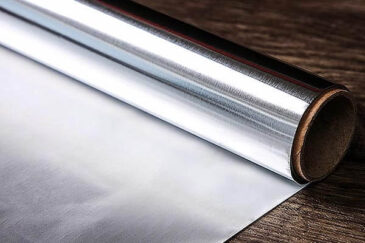
Huawei aluminum foil jumbo roll
Domestic breweries are increasingly using high-speed labeling machines, and aluminum labels should be able to meet a labeling speed of at least 40,000 bottles per hour. Because the surface of the label plate will wear out under high-speed and heavy use, defects such as misaligned labeling or uneven gluing will occur; uneven thickness of the cross-section of the label plate will cause poor fit between the label and the bottle, causing wrinkles or bubbles. The beer packaging workshop needs to regularly maintain and replace the label plate accordingly. Solid lumps on the surface of the gluing brush will also make the gluing surface uneven, and the gluing brush needs to be cleaned every day and checked or replaced regularly.
The efficiency of aluminum foil labeling is closely related to the label’s external dimensions, punching quality and embossing depth. When the external dimensions are too large, mechanized labeling cannot be achieved at all. The label will either get stuck in the label box or fall out from the front of the label box. Poor punching quality will cause the label stack to stick together, making it difficult or impossible to remove the label. Visual inspection shows that the surface of a good label is smooth and neat. Improper embossing will reduce the strength of aluminum foil. Generally, breweries are not equipped with embossing depth detectors. The theoretical formula is: depth = (Mx10000)/(Fx2.7), M represents the weight of aluminum, and F represents the area of the sample in square centimeters.
The market prospects for aluminum foil for packaging are broad
With the rapid development of my country’s national economy and aluminum processing industry, aluminum for packaging has become one of the most important consumption growth points in the aluminum foil market. At present, China consumes 161,300 tons of aluminum each year, making it the world’s second largest aluminum consumer after the United States, but the per capita share is still far behind that of developed countries, especially the limited use of aluminum for packaging, which has broad development space. Air-conditioning foil is the product with the largest consumption in China’s aluminum foil market; the second is cigarettes. As the world’s largest cigarette producer and consumer, China consumes 35,000 tons of cigarette packaging cigarettes annually, accounting for about 60% of the total consumption of double-zero foil; the third is decoration, which is mainly used for heat insulation, moisture-proof and decorative materials. At present, the application of decoration in China’s construction and home appliance industries is becoming more and more extensive; the fourth is cable foil, which mainly uses the airtightness and shielding properties of aluminum foil as a protective layer for cables. The consumption of the above four major aluminum foils accounts for more than 70% of China’s total aluminum consumption. In addition to cigarette packaging, the application of aluminum foil in the packaging industry mainly includes: aluminum cap labels for high-end wines, aluminum-plastic composite bags, pharmaceutical aluminum foil blister packaging and chocolate packaging, etc.
According to statistics, there are currently 83 aluminum foil production enterprises in China with an annual production capacity of about 235,000 tons. Although some enterprises have some modern production equipment, most aluminum production enterprises are small in scale, and there is still a big gap in equipment and process levels compared with developed countries. There are more low-end and medium-end products and fewer high-end products. Therefore, from the perspective of development prospects, the Chinese aluminum market has great room for development in terms of both consumption and product quality.