Aluminum Circle for Cookware Bottom
12,264 Views 2026-01-14 07:00:12
1. Introduction
Aluminum Circle for Cookware Bottom is a deceptively small component with outsized influence on cooking performance, durability and cost.
Material choice, thickness, temper, surface finish and the method used to integrate the disc with the cookware body determine heat distribution, resistance to warping, compatibility with induction cooktops, and long-term food safety.
An “aluminum circle” (also called a disc, coin or bottom plate) is the circular metal insert that forms the base of a pan, skillet, saucepan or pressure cooker.
Depending on construction it may be the full contact base that cooks food (in aluminum cookware), a bonded core layer in multi-ply cookware, or a sandwich core under a stainless cooking surface.
The bottom disc is critical to thermal performance (how evenly and quickly a pan heats), mechanical stability (flatness and resistance to warping), and functional features such as induction compatibility and sealing to the cookware wall.
Selecting and manufacturing the aluminum circle requires balancing thermal efficiency, manufacturability and cost while ensuring food-contact safety.
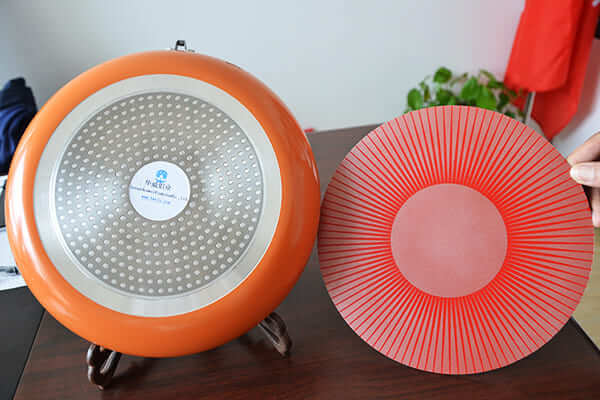
Aluminum Circle for Cookware Bottom
2. Types of Aluminum Circle for Cookware Bottom
Aluminum circle for cookware bottom are classified into three categories based on material composition and structure: pure aluminum circles, aluminum alloy circles, and clad aluminum circles.
Each type has unique performance characteristics and applicable scenarios, which are selected according to cookware functions, heating sources, and cost requirements.
Pure Aluminum Circles
Pure aluminum circles are made of high-purity aluminum (aluminum content ≥ 99.5%), with the most commonly used grades being 1050, 1060, and 1100 aluminum circles (compliant with ASTM B209 standards).
Their core advantage is high thermal conductivity, which ensures rapid and uniform heat transfer.
Key technical parameters:
Chemical composition: Aluminum (Al) ≥ 99.5% (1050) / ≥ 99.6% (1060); impurities (Fe + Si) ≤ 0.5% (to avoid reducing thermal conductivity);
Thermal conductivity: 220 W/(m·K) (25℃), which is 14.7 times that of 304 stainless steel (15 W/(m·K)) and 55% of copper (401 W/(m·K));
Mechanical properties: Tensile strength ≥ 75 MPa, elongation ≥ 25% (O态, annealed state), good ductility for forming;
Density: 2.71 g/cm³ (25℃), lightweight, reducing the overall weight of cookware (a 28cm frying pan bottom made of 1060 aluminum weighs ~300g, 60% lighter than cast iron).

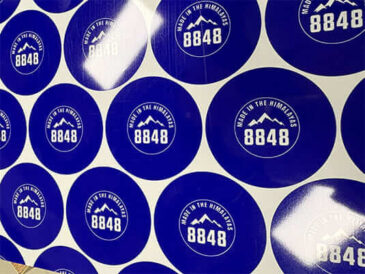
1100 Aluminum Circle Surface Display
Aluminum Alloys
To overcome the shortcomings of pure aluminum (low strength, poor corrosion resistance), alloying elements such as manganese (Mn), magnesium (Mg), and silicon (Si) are added to produce aluminum alloy circles.
| Alloy Grade | Key Alloy Elements (wt.%) | Thermal Conductivity (W/(m·K)) | Tensile Strength (MPa) | Corrosion Resistance (Salt Spray Test) | Applicable Cookware Types |
|---|---|---|---|---|---|
| 3003 | Mn: 1.0–1.5 | 190 | ≥ 110 (H14态) | 480 hours no red rust | Frying pans, sauce pots, commercial cookware |
| 5052 | Mg: 2.2–2.8 | 170 | ≥ 190 (H32态) | 720 hours no red rust | Pressure cookers, marine cookware, acidic food cookware |
| 6061 | Mg: 0.8–1.2, Si: 0.4–0.8 | 160 | ≥ 310 (T6态) | 360 hours no red rust | Heavy-duty commercial cookware |
Key advantages:
3003 alloy circles have 47% higher strength than pure aluminum, good formability, and are the most widely used aluminum alloy for cookware (accounting for 60% of alloy aluminum circle consumption).
5052 aluminum circles have excellent corrosion resistance (due to magnesium addition), which is 1.5 times that of 3003 alloy, suitable for cookware in harsh environments (e.g., coastal areas, acidic food cooking).
Clad Aluminum Circles
Clad aluminum circles (also known as composite aluminum circles) are multi-layer structures with aluminum as the core layer, combined with other materials (stainless steel, copper) through hot rolling or explosion cladding.
Their design goal is to integrate the high thermal conductivity of aluminum with the magnetic properties, corrosion resistance, or decorative properties of other materials.
Common structures and performance characteristics:
- Aluminum-stainless steel clad circles (most common): Core layer (3003/1060 aluminum, thickness 80–90% of total thickness) + outer layer (304/430 stainless steel, thickness 10–20%). Core advantage: Aluminum ensures heat conductivity, stainless steel provides magnetic properties (for induction cooktops) and corrosion resistance. Induction efficiency ≥ 90% (compliant with IEC 60355 standard), thermal conductivity ≥ 180 W/(m·K);
- Aluminum-copper clad circles: Core layer (1060 aluminum) + copper layer (thickness 5–10%). Thermal conductivity ≥ 280 W/(m·K), suitable for high-end cookware (e.g., professional chef pans), but cost is 2–3 times that of aluminum-stainless steel clad circles;
- Three-layer clad circles (stainless steel-aluminum-stainless steel): Double-sided stainless steel layer, ensuring food contact safety and durability, suitable for high-end household cookware (e.g., pressure cookers, stock pots).

Clad Aluminum Circles
3. Key Specifications of Aluminum Circle for Cookware Bottom
Thickness
Typical ranges depend on cookware class:
| Cookware class | Typical disc thickness (mm) |
|---|---|
| Light cookware (budget pans) | 0.8 – 1.8 |
| Mid-range frying pans / skillets | 1.8 – 3.0 |
| Heavy-duty “thick bottom” pans / cast-style | 3.0 – 6.0 |
| Sandwich core (internal) | 1.0 – 4.0 (as core layer) |
Thicker discs increase heat capacity and resistance to warping but add weight and cost. For induction, the magnetic layer thickness (stainless/steel) is commonly 0.4–1.2 mm on top of the aluminum disc.
Temper
- O (annealed): Maximum formability for stamping and deep drawing. Often used where heavy forming is required.
- H-tempers / strain-hardened: For discs that need springback control and dimensional stability after forming.
- T-tempers (e.g., 6061-T6): Provide higher strength but are less formable—typically used when the disc is machined rather than heavily formed.
Surface Finish
- As-rolled / matte: Good for adhesion of coatings and non-stick primers.
- Brushed / satin: Cosmetic finish for exposed bottoms.
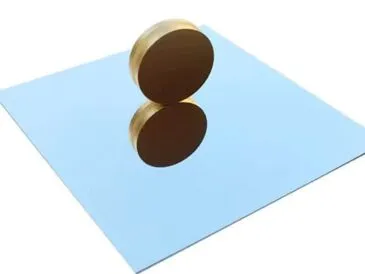
- Mirror polish: Decorative and sometimes used under translucent coatings.
- Roughness targets: typical Ra for cooking surfaces <0.8 µm after final machining; base underside roughness less critical but affects bonding adhesion—aim for Ra 0.4–1.6 µm depending on adhesive/clad method.
Dimensional Tolerance
- Diameter tolerance: typically ±0.1–0.5 mm depending on production grade.
- Thickness tolerance: ±0.05–0.3 mm depending on thickness and buyer spec.
- Flatness (runout): flatness ≤ 0.2 mm across base is a common target for premium cookware to ensure full contact with heat source.
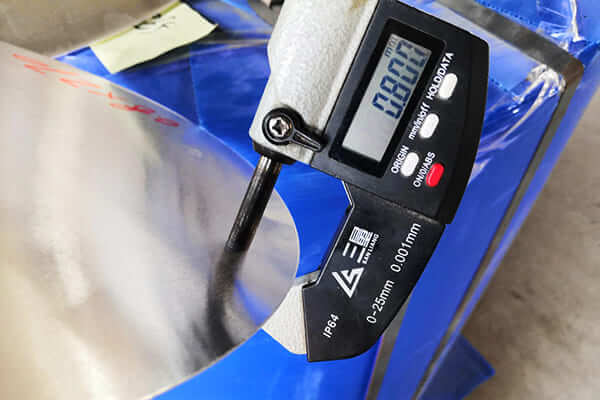
Aluminum Circle Thickness measurement
4. Properties of Aluminum Circle for Cookware Bottom
High Thermal Conductivity
- Why it matters: Rapid and even heat spread reduces hotspots, prevents local scorching and allows lower cooking power for the same results.
- Representative data: pure Al ~235 W·m⁻¹·K⁻¹; alloys commonly used (3003: ~160–185; 5052: ~130–150; 6061: ~140–160). Practical heat-transfer performance also depends on thickness and contact resistance.
Lightweight and Durable
- Density: ~2.70 g·cm⁻³. Compared with steel (~7.8 g·cm⁻³), aluminum offers substantial weight savings for equivalent area.
- Durability tradeoff: thicker aluminum discs or alloy selection (5052/6061) improve dent and warp resistance.
Corrosion Resistance
- Aluminum forms a stable oxide film (Al₂O₃) that passivates the surface. Alloys with Mg (5052) or Mn (3003) offer improved resistance to pitting and food acids. Coatings and anodizing further improve corrosion protection.
Malleability and Formability
- Many aluminum alloys are highly formable, enabling deep-drawn pans and contoured bottoms. Temper selection (O vs H) controls formability. Proper blank design, die radii and lubrication are critical to avoid wrinkling or cracking.
Non-Toxic and Food-Safe
- Aluminum itself is widely used in food contact applications. Regulatory compliance depends on country and coatings used—verify with migration and extractables testing when coatings or adhesives are involved.

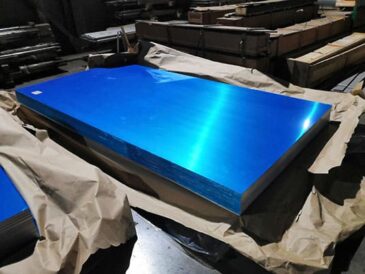
Huawei Aluminum Circles warehouse
5. Manufacturing Process of Aluminum Circle for Cookware Bottom
Production Steps
- Coil prep/leveling: remove coil stress and obtain flat stock.
- Blanking/shearing: high-speed blanking or laser/plasma cutting for low-volume prototypes. Burr minimization is essential.
- Forming: stamping / deep drawing / hydroforming to create any required contours. Use proper blankholder control and die radii.
- Planishing/flattening: to achieve final flatness and surface finish.
- Annealing/tempering: optional, to adjust ductility and dimensional stability.
- Bonding/cladding (if multi-layer): roll-bonding, diffusion bonding, laser welding or adhesive bonding to stainless or copper layers.
- Edge trimming & finishing: deburr, tumble or vibratory finishing.
- Surface treatment/coating: anodize, primer + non-stick coating, polishing or brushing.
- Final inspection & packaging.
Surface Treatments
- Anodizing: improves corrosion and wear resistance; thicknesses 5–25 µm common. Note: anodize is insulating—grounding points must be masked if electrical continuity is required for induction designs.
- Non-stick coating primer & PTFE or ceramic topcoats: require careful surface prep and curing schedules.
- Electroplating / local plating: at contact areas for improved conductivity or solderability.
6. Benefits of Using Aluminum Circles in Cookware
Efficient and Uniform Heat Distribution
One of the most significant advantages of aluminum circles is their high thermal conductivity, which typically ranges from 130 to 235 W·m⁻¹·K⁻¹, depending on alloy composition.
This enables rapid lateral heat transfer across the cookware base, minimizing hot spots and ensuring consistent cooking temperatures.
Improved Energy Efficiency
Because aluminum heats up quickly and distributes heat efficiently, less energy is required to achieve and maintain the desired cooking temperature.
Compared with thicker steel-only bases, aluminum-bottom cookware can reduce heat-up time by 20–40%, depending on thickness and heat source.
Lightweight Construction and Ease of Handling
Aluminum has a density of approximately 2.7 g/cm³, which is about one-third the weight of steel.
This allows cookware manufacturers to design pans that are easier to lift, tilt, and maneuver without compromising thermal performance.
Cost-Effectiveness and Manufacturing Efficiency
Aluminum circles offer an excellent cost-to-performance ratio. Compared to copper or multi-layer stainless steel bases, aluminum provides comparable thermal performance at a significantly lower material cost.
In addition, aluminum is well suited to high-volume manufacturing processes such as blanking, stamping, and deep drawing.
Compatibility with Non-Stick and Ceramic Coatings
Aluminum circles provide a smooth, uniform substrate that bonds well with common cookware coatings, including PTFE-based non-stick layers and ceramic coatings.
Their surface chemistry and formability enable reliable coating adhesion when properly pretreated.
Corrosion Resistance and Food Safety
Aluminum naturally forms a protective oxide layer that provides good resistance to corrosion in typical kitchen environments.
With appropriate surface treatments and coatings, aluminum circles meet stringent food-contact safety requirements.
Sustainability and Recyclability
Aluminum is 100% recyclable without loss of material properties, and recycled aluminum requires approximately 95% less energy than primary aluminum production.
This makes aluminum circles an environmentally responsible choice for cookware manufacturers.

Rice cooker inner pot used Aluminum Circles
7. Applications of Aluminum Circles in Cookware
Frying Pans and Skillets
Frying pans and skillets are among the most common applications of aluminum circles.
These cookware items demand rapid heat-up, uniform temperature distribution, and good responsiveness to heat adjustments.
Technical rationale:
- High thermal conductivity ensures even cooking and consistent browning.
- Typical bottom thickness ranges from 2.0 to 4.0 mm, balancing fast heating with thermal stability.
- Aluminum circles provide an ideal substrate for non-stick or ceramic coatings widely used in frying pans.
Sauce Pans and Stock Pots
Sauce pans and stock pots require steady, uniform heating over longer cooking times, especially for liquids and slow-simmer recipes.
Technical rationale:
- Aluminum circles improve heat distribution across the pot bottom, reducing localized boiling and scorching.
- Larger diameters and thicker bases (2.5–5.0 mm) increase thermal mass for stable temperature control.
- Lightweight aluminum reduces overall cookware weight, improving handling when filled with liquid.
Pressure Cookers
Pressure cookers operate at elevated temperatures and internal pressures, placing higher mechanical and thermal demands on cookware bottoms.
Technical rationale:
- Aluminum circles offer sufficient strength and stiffness when properly designed, often with reinforced or layered bases.
- Uniform heat distribution helps maintain consistent internal pressure and cooking performance.
- Compatibility with hard anodizing enhances surface durability and safety.
Multi-Layer and Induction-Compatible Cookware
Modern cookware increasingly incorporates multi-layer structures to accommodate induction cooktops while retaining excellent thermal performance.
Technical rationale:
- Aluminum circles act as the thermal core layer, bonded to an outer ferromagnetic stainless steel or carbon steel layer.
- Typical configurations include aluminum thicknesses of 2.0–3.5 mm combined with 0.4–1.2 mm magnetic layers.
- This structure delivers efficient induction heating while maintaining even heat distribution.
Woks and Stir-Fry Cookware
Woks and stir-fry pans require rapid heat response and strong temperature gradients to support high-heat cooking techniques.
Technical rationale:
- Aluminum circles provide fast thermal response and efficient heat transfer from the burner.
- Good formability allows deep, curved shapes without cracking or thinning.
- Lightweight construction supports quick pan movement during cooking.
Specialty Cookware
Specialty cookware often demands precise temperature uniformity across a large, flat surface area.
Technical rationale:
- Aluminum circles minimize temperature variation across wide diameters.
- Thickness is optimized to prevent center hot spots and edge cooling.
- Excellent flatness ensures consistent contact with flat cooktops.

Aluminum Circles for Specialty Cookware
8. Comparisons with Alternative Materials for Cookware Bottoms
| Material | Thermal Conductivity (W·m⁻¹·K⁻¹) | Density (g·cm⁻³) | Relative Material Cost | Formability / Manufacturability | Corrosion Resistance | Induction Compatibility | Typical Use Cases |
|---|---|---|---|---|---|---|---|
| Aluminum (3003 / 5052) <br>Typical cookware alloys | ~130–185 <br>(3003 ≈160–185; 5052 ≈130–150) | ~2.70 | Low–Medium | Excellent for blanking, stamping, and deep drawing; high production efficiency | Good; further enhanced by anodizing or coatings | No (non-magnetic); requires bonded ferromagnetic layer for induction | Frying pans, saucepans, aluminum cores in multi-ply cookware |
| Copper (C110) | ~385 | ~8.96 | High | Limited formability for large discs; usually used as insert or clad layer | Moderate; tarnishes and reacts with acidic foods unless lined | No | Premium cookware, heat-spreader inserts |
| 304 Stainless Steel | ~14–16 | ~7.90 | Medium–High | Good deep-draw and welding capability; widely used in cladding | Excellent (especially 304) | 304: No; 430: Yes (magnetic) | Cookware exteriors, induction faces, durable shells |
| Cast Iron | ~50–80 | ~7.0–7.8 | Medium | Casting only; no sheet forming | Moderate; requires seasoning to prevent rust | Yes | Traditional skillets, griddles |
| Carbon Steel (SPCC / AISI 1018) | ~45–60 | ~7.80 | Low–Medium | Good stampability and formability | Moderate; prone to rust without coatings | Yes | Woks, professional pans, cost-sensitive induction cookware |
| Composite Materials
(GFRP, ceramic-filled bases) |
~0.2–5 | ~1.8–2.5 | Variable | Moldable; high design freedom | Excellent chemical resistance | No | Specialty lightweight or insulated cookware |
| Clad Constructions
(Al core + stainless or copper layers) |
Al core: ~130–235 <br>(effective performance high) | Composite | Medium–High | Requires roll-bonding, diffusion bonding, or welding | Excellent (stainless exterior) | Yes (with magnetic outer layer) | Premium multi-ply and induction-ready cookware |
9. Conclusion
Aluminum circle for cookware bottom is a decisive design element for cookware. Thoughtful alloy selection, correct thickness and temper, precise forming and robust bonding/cladding produce bases that are flat, thermally even and durable.
For most consumer cookware segments, 3003 and 5052 alloys (or clad constructions with an aluminum core and stainless/copper exterior) provide the optimal balance of performance, manufacturability and cost.
Rigorous in-process controls—thickness mapping, flatness checks, bonding peel tests and thermal mapping—turn good designs into reliable production.
FAQs
Q1 — What alloy is best for a heavy, warp-resistant pan bottom?
A: For strength and warp resistance use thicker discs of 3003 or 5052, or consider a clad construction with an aluminum core and stainless or copper outer layer. 6061 can be used when machining/structural features are needed.
Q2 — How thick should the aluminum circle be for induction cookware?
A: The aluminum core typically ranges 1–4 mm, but induction requires a ferromagnetic layer (stainless or steel) bonded to the aluminum; that magnetic layer is typically 0.4–1.2 mm thick.
Q3 — Does anodizing affect heat transfer?
A: Anodizing adds a thin ceramic oxide layer (typically 5–25 µm) that slightly increases thermal contact resistance at microscopic contact points but is negligible in normal cooking. However, anodize is electrically insulating—mask grounding points for induction designs.
Q4 — What flatness tolerance should I require for premium cookware?
A: Aim for flatness/runout ≤ 0.15–0.25 mm across the cooking diameter for high-end pans to ensure full contact on flat cooktops.
Q5 — How do I verify the bond quality between an aluminum core and stainless exterior?
A: Perform peel/shear tests on sample coupons, cross-section metallography to confirm bond integrity, and thermal cycling with subsequent delamination inspections. Peel strength targets depend on bonding method but commonly exceed 10–20 N/mm for mechanically robust bonds.